Main menu:

Site search

Categories

February 2026
M T W T F S S
 1
2345678
9101112131415
16171819202122
232425262728  

Tags

Blogroll

Number crunching part 2.

This is a look at the second half of 2025, and a follow up to Number crunching part 1.

The summer saw us pretty much “off grid” apart from backup. Of course, we still have to pay the standing charge, currently a whopping £0.4595 a day, though I know that is better than many companies charge, and for us, during the summer, that suits us fine – a higher unit cost gives us a lower connectivity charge: yes please.

Our set up is this. We have an EPC rated B house, with good insulation, an air sourced heat pump supplying hot water and space heating, solar cells, 27 kWh of batteries, an electric oven, hob, microwave, washing machine, tumble dryer, electric car, etc. A pretty typical set up for the most part – central heating etc.

I am now going to fill in that table from Number crunching part 1, with the figures from July to December.

Month2023 electricity
usage (kWh)
2025 electricity
usage (kWh)
% difference
Jan697.101,327.00 190.4%
Feb537.601,044.60 194.3%
Mar615.65560.70 91.1%
Apr547.15205.80 37.6%
May492.45186.75 37.9%
Jun493.5168.00 13.2%
Jul787.5453.70 6.8%
Aug678.7573.30 10.8%
Sep609.60204.80 33.6%
Oct471.45585.150124.1%
Nov577.10895.90155.2%
Dec625.301,087.70173.9%
Total7,133.2006,293.4088.2%

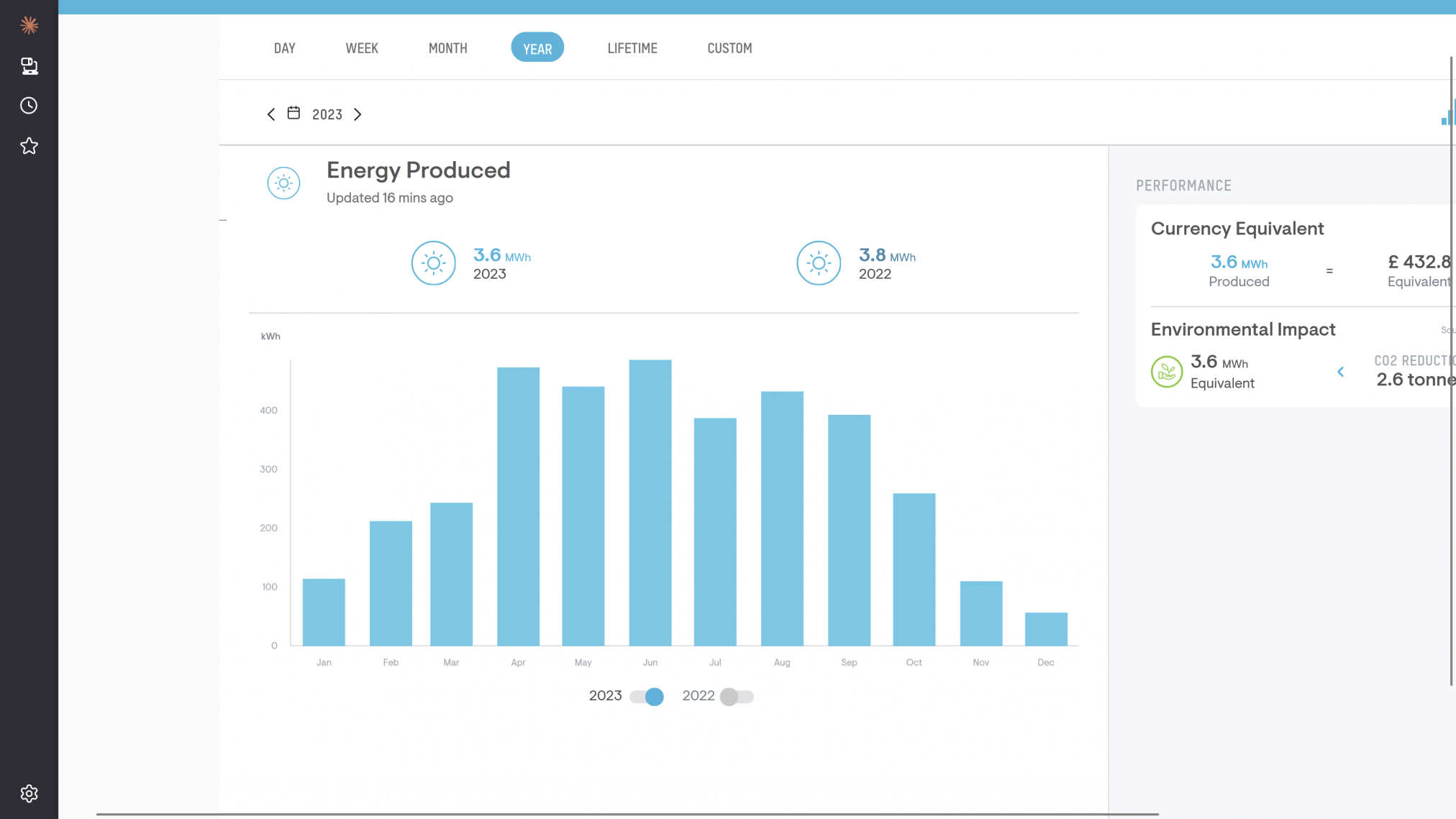
So, our billing usage has varied a great deal. During the summer, we were almost off-grid, though not quite. Next year, I may gear things like when we heat water and use the battery in a completely different way. I certainly started to do that in November and I am keen to see the numbers for January and February to see the difference that makes. Moving the hot water to be heated during the day means we use far less electricity from the grid – using the insulating properties of the house fabric and new windows meant that December’s usage was slightly better than November. (Partly expected as we had big holes in the lounge and master bedroom while building work was going on).

Making the most of the air sourced heat pump has a completely different mindset in play. Heat is more abundant during midday. So it makes sense to use the heat pump to heat hot water, a thermal store if you like.

Likewise, for heating the house. If you have good insulation and fewer loses through your windows, heat the house during the peak of day. Closing thermal bridges has become my favourite hobby over the past few weekends.

Yes, but what is your actual usage, not just what is coming off the grid?

Let’s fill in that table too.

MonthElectricity
usage (kWh)
Jan1,400
Feb1,200
Mar1,000
Apr670
May590
Jun447
Jul405
Aug432
Sep546
Oct749
Nov985
Dec1,170
Total9,594

OK, so basically that is a lot of electricity being used. But you’re generating about 35% of your needs over the year.

Pretty much. The batteries mean we’re actually using that – we have almost no earnings from exporting electricity. Interestingly, Tesla gave us a brake down of our power stowed over the year, and we’re in the top 7% of users who’ve gone off grid!

The huge difference is in the heat pump. It means, we have no other fuel expenditure in the house.

I can pull out our electricity usage for heating and hot water.

One of the important figures here is the SPF. This tells us about the efficiency of our heat pump or for how much power we put in, how much thermal energy (heat) do we get out? We calculate it from (thermal energy) / (heating usage). The estimate from the manufacturer was 3.51, so we’re doing a little better in our little bit of the world.

While ours is doing relatively well, it is worth considering that it is an average, based on the heat available from the air being used as a source. The air temperature gets hotter, the heat pump does better.

So, of our 9,594 kWh being used, 3,966.20 kWh was used to heat our hot water and house. Our car used another 2,000 kWh or so. Our cooking, cleaning (vacuum, washing machine, tumble dryer, hair dryer, steam cleaner, iron), and gardening (lawn mower, hedge trimmer, leaf blower/vacuum), computers, lighting, venting fans in bathrooms, mobile phones, refridgerator, freezer and insulin pump charging used 3,627.80 kWh.

Of course, we’re buying 6,293.40 kWh of that from the grid. Which makes us relatively heavy users.

Is the heat pump better than using gas?

Shall we look at the figures. As before, I am comparing to 2023 as it’s the last complete year’s figures I have.

The table below is a comparison of the gas we used to heat the house in 2023 and the electricity we’ve used to heat the house using the heat pump.

MonthGas Usage
(kWh) 2023
Electricity usage
(kWh) 2025
Percentage
difference
Jan2,021.181 925.0045.77%
Feb1,931.237 686.0035.52%
Mar1,408.429 486.0034.51%
Apr 735.847 187.0025.41%
May 353.446 113.0031.97%
Jun 17.835 38.10213.62%
Jul 0.000 43.00100.00%
Aug 62.561 41.4066.18%
Sep 569.986 90.7015.91%
Oct1,657.321 231.0013.94%
Nov2,134.510 510.0023.89%
Dec2,378.535615.0023.92%
Total13,270.8883,966.2029.89%

Basically, the answer to the question, is the heat pump better than using gas? is a no brainer: yes. The month by month comparison shows the ASHP outperforming the gas boiler every time. 13,270.888/3,966.20 = 29.89%. Basically we’ve used a third of the power. And that’s with big holes in our external walls during late November and early December! NB: I may do this again next year, just to show the difference it made in late November and early December.

Oh wait, what about the summer months?

Ah, what you can’t see in the “Gas Usage” figures is the solar diverter we were using from May to August. Rather than use CO2 generating gas to provide hot water back in 2023, we were using free electricity from our solar cells. It meant our gas totals were artificially lower, but they were still blown out of the water by the energy usage of the heat pump for heating the water.

The solar diverter has a coefficient of performance (COP) of 1, or 1 kWh of energy is converted into 1 kWh of heat. The gas boiler has a COP of 0.8, or 1 kWh of gas generates 0.8 kWh of heat. Our heat pump varies between 3.7 and 5.7, so for every 1 kWh of energy we put into the system, we get 3.7 to 5.7 kWh of thermal energy out – a yearly average of 4.1 or so.

Yes, the heat pump is not as good over the winter, but it is still miles better than a gas boiler, achieving 410% the heat output compared to a unit of electricity bought from the grid.

Basically, you are saying it has all been worthwhile then?

The aim has been to future proof our house and reduce our carbon footprint. By reducing our energy needs, we’ve minimised our running costs against changing fuel and energy prices, to protect against inflation, and give us a predictable base on which to live our lives and plan for our retirement.

I could have spent this money in the stock market. My father was a stock broker, in 2004 he sold stocks in Scottish Power and used the proceeds to buy solar cells. The solar cells gave him a return of 5.7%, way better than Scottish Power shares could have given him at the time. It protect my parents and us from the shocks in the energy supply market following the war in Ukraine.

Plus, like us, it allowed him to reduce his carbon footprint. When we moved in to our house in 2013, our energy use generated 2.4 tonnes CO2 per annum to give us heat and power. Now it generates 0.3 tonnes CO2 per annum. I call that a return on investment.

I was already committed to doing what was in my power to help reduce my carbon footprint. My parents showed me a way in which I could effectively do that, without giving up anything but a little thought and money.

I am hoping I have done the same for you. Shown you what is possible, within your budget. Even if it is only switching a light off when you leave a room, or not using a vehicle for a fare stage, or taking a stroll rather than park in the car park closest to the shops, everything helps. You make a difference.

What about the mullah?

As we’ve used 6,293.40 kWh from the grid, at £0.26, that equals £1633.14 in usage or £149.78 a month, including the standing charge of £0.4595 a day. Our house is 244m2, compared to an average house size of 85m2, so we’re doing OK: a house nearly three times as big as the average house is not paying any thing like three times the average direct debit for energy (which is between £143 and £154 per month including usage and standing charge). We’re not cold, we’re not sitting in the dark, we are running an electric car off that energy too and cooking with it.

Yes, electricity is more expensive than gas, but the efficiencies are costing in for us.

Last year, we managed approx. 35% off grid. By using power shifting with the heat pump settings, my hope is closer to 42%, though that depends on the solar generation figures: we might do better or worse.

Hope this has helped you form you plans for making the shift away from gas central and water heating, whether it’s to a heat pump or infrared panel heaters. Happy 2026.

Well done, you’re on your way…

The UK, that is. We have, as a nation, declared a set of tough targets:

  • Net Zero greenhouse gas emissions by 2050.
  • Key interim targets include cutting emissions by 81% by 2035 (vs. 1990 levels)
    and
  • achieving a net zero power system by 2030.

We’ve got some politically sticky situations about transportation of said power, especially sourced from off-shore wind farms or tidal power plants. It is far cheaper to install and maintain overhead power cables, but these have an impact on residents of the proposed paths. We should put a stake in the ground and see how the UK is fairing now there’s only 4 years left on those original targets for our power system – net zero power by 2030.

How is UK measuring its carbon intensity?

Most of my figures come from NESO – National Energy System Operator – as the UK privatised its energy sector, NESO was put in place to gather such statistics and ensure, along with OfGem, that industry regulations were being met, or better yet, exceeded.

The one we’re interested in today is NESO’s tracking of the UK’s commitment to Net Zero, explained by them if you follow the link above… One of the arguments I often hear against electric vehicles and heat pumps is that coal or gas is being burned to generate electricity – that really isn’t the case any more.

Indeed, it has not been the case for a while now. The last UK coal power plant shut in September 2024. But let’s look at where we are today, or rather November 2025.

Image taken from NESO site on the energy generated in UK from different sources.
Image taken from NESO site on Energy Generation in November 2025 from various sources.

We can see from November 2025’s figures that much of our electricity came from wind power. Gas was the 2nd biggest source still, but nuclear came next in the ranking. Hydro power generates 2.2% of the electricity generated in November 2025. The numbers vary month by month, as you’d expect, solar power comes much higher in the ranking in June, making up nearly 11.9% of the mix rather than 2.2% in November!

Importantly, the Zero Carbon figures demonstrate that the majority of the power in the UK is coming from zero carbon sources (wind, solar, nuclear, and hydro) during November 2025. When it is windy, 91% of the electricity generated comes from renewable sources (at 5am on the 30th November 2025)!

How much of November's energy was used.
How much of that generated power was used in the UK.

In November, our energy demand was 26TWh with peak demand being at 4:30pm on the 20th November of 43,666 MWh at 16:30, when people get home from school and turn on lights and the kettle.

NESO publish an instaneous carbon insensity map, that can help you work out the source of the generated energy and whether you want to move to using greener power. (NB – to see the map on the web page you need to scroll quite far down the page!)

Gas usage in UK from NESO.
Gas usage in UK.

The image above shows how much of the natural gas used in the UK generates electricity or goes into the “Distribution networks” – this is the gas burnt by boilers for hot water and heating purposes, and the sources of that gas. Russia was a major supplier of most of Europe before the Ukraine invasion, that has changed dramatically – those figures would appear under LNG or liquified natural gas imports, America is now the biggest importer of gas to the UK. Stored gas is where cannisters or tanks are used in individual homes.

But let’s get back to our look at where we are in the UK in terms of milestones and records…

Some records broken up to now.

2025 saw Max Solar generation being broken, with 14,023MWh (14GWh) on the 8th July 2025.

The Max Wind power record was broken on the 5th December 2025 and saw the power needs in the UK being met when 23,835 MWh (nearly 24GWh) were generated for a period of 30 minutes.

Carbon Intensity, or how much CO2 is produced for each single kilo-Watt-hour of energy generated, was approx. 177 gCO2/kWh in 2025 compared to approx. 207 gCO2/kWh in 2024. Indeed, on the 15th April 2025 the UK was running with a Carbon Intensity of 19 gCO2/kWh and on the 1st April 2025 we ran for 97.7% with Zero Carbon.

As we move to wind and solar power, we need some background generation to fill the gaps when it is not sunny or windy: cloudy days are often the ones where little wind is available to use to generate power.

Two such sources are nuclear and hydro-power. Nuclear makes up 10-20% of the UK generation mix at any point.

Hydro-power is even less. But water could be a great way to “store” excess solar or wind power. Systems which pump water up to a high reservoir when there is a glut of greener power sources and then release it when the sun has set or the wind has died down is a great way to do this – if you have the time check out this youTube entry talking about pumped storage hydropower (PSH).

Now, one thing you’ve seen me talk about is the efficiency of batteries in terms of round trip – pumped storage hydropower is about 70-80% efficient, so not quite as good as a lithium battery, but the real beauty of the system is in the net zero costs. Water is one thing we have in the UK, it doesn’t need to be mined, and more importantly, PSH can store power for hours of use – 10 hours is not a common duration for such a system. Which is difficult to do with a lithium battery.

Now, where I live in the UK is not ideal for a water dam generating hydro-electricity. But systems could and have been built e.g. Dinorwig Power Station in Snowdonia, Ffestiniog Power Station in Gwynedd, and Cruachan Dam in Scotland. Most of the other hydro-power plants in the UK are river and sea systems.

River sourced hydro-power is the most common type of plant in the UK, like Clachan, utilising a dam across a fast flowing systems of streams into a loch and reservoir in Argyll, Scotland.

Personally, it’s one reason I would love to live by a flowing river. An archimedes screw can be installed providing efficient generation of electricity with little harm to wildlife, like the one on the River Stour, Suffolk rated at 11kWh, it provides a third of the energy used by the National Trust’s Field Studies Centre located at Flatford Mill.

Tidal power is of course open to a little island country like the UK. We have a couple of tidal stream systems (one in Orkney and one in Anglesea) and a dam on the Severn Estuary harnessing tidal range power. Less suspectable to draught than river systems, tidal power gives a predictable fall back position but is much more invasive to the environment than archimedes screws. And expensive – expensive and invasive, not ideal. But the UK is breaking ground in this area, leading the technology across the globe.

Of course, even if we do harness that power, we need to transport it back to homes where people can use it, that hold second paragraph in this article. On Farming Today, 14th December 2025, a home in Northumbria using a diesel generator for its electrical generation was discussing the issues of achieving Net Zero.

Several listeners wrote in asking why not move to using solar power with batteries or at least wind power. The owner of the farm walked jerry cans to the generator because a lorry could not park close enough to the abode to make a delivery! Installing solar cells was not going to be trivial for this family. Also, the chances of supplying enough solar power during the winter to power the house were small, given the get 7 hours 45 minutes of daylight at a hmax of 90°-55°-23.44° ≈ 11.56°. And that’s not mentioning the difficulties of installing said batteries…

Remote locations in England, Northern Ireland, Wales, and Scotland mean that many people do not have access to mains electricity even in the 21st Century. Please consider that is the case for some in your country when you are sitting in your home in a town or city.

Back to the chase, please? How is the UK doing, please?

OK, but I think I’ve demonstrated the UK has some way to go and needs to ensure no-one is left behind. But we’re making in-roads and every step on that journey will help the UK reach its goal in 2030.

An interesting idea from Australia.

As you know, I’ve been passionate about making the most of the excess power generated in the UK during our peak solar periods.

I am sure I haven’t influenced Australia, but I love this idea and wish it were copied across the world: free-energy-while-the-sun-shines.

Power shifting is something I have spoken about and makes so much sense. Batteries can be up to 93% efficient, but making use of the electricity fresh off the grid makes a great deal of sense. Giving free electricity to all users is a no brainer, as per the example Australia is setting the world. Even if people use it to charge their own batteries.

Dishwashers, water heaters (something we do), washing machines, and tumble dryers are all prime candidates for doing the chores while we work. Slow cookers and timed cooking can do the same for food – making bread while the sun shines, so to speak. We set our heating timers to heat our water during peak solar time to use our water heater as a solar battery, we do a few of the rooms round the house too, dramatically reducing our costs on sunny days.

Rather than running these remotely, a simple timer delaying when the machine starts is a boon for achieving this while you are in the office. It was common in such machines between 2003 and 2015. Slowly the industry moved to wifi control, which is not as good because you are meant to start this at the right time! I don’t know about you, but I am a little busy while I’m working during the day…

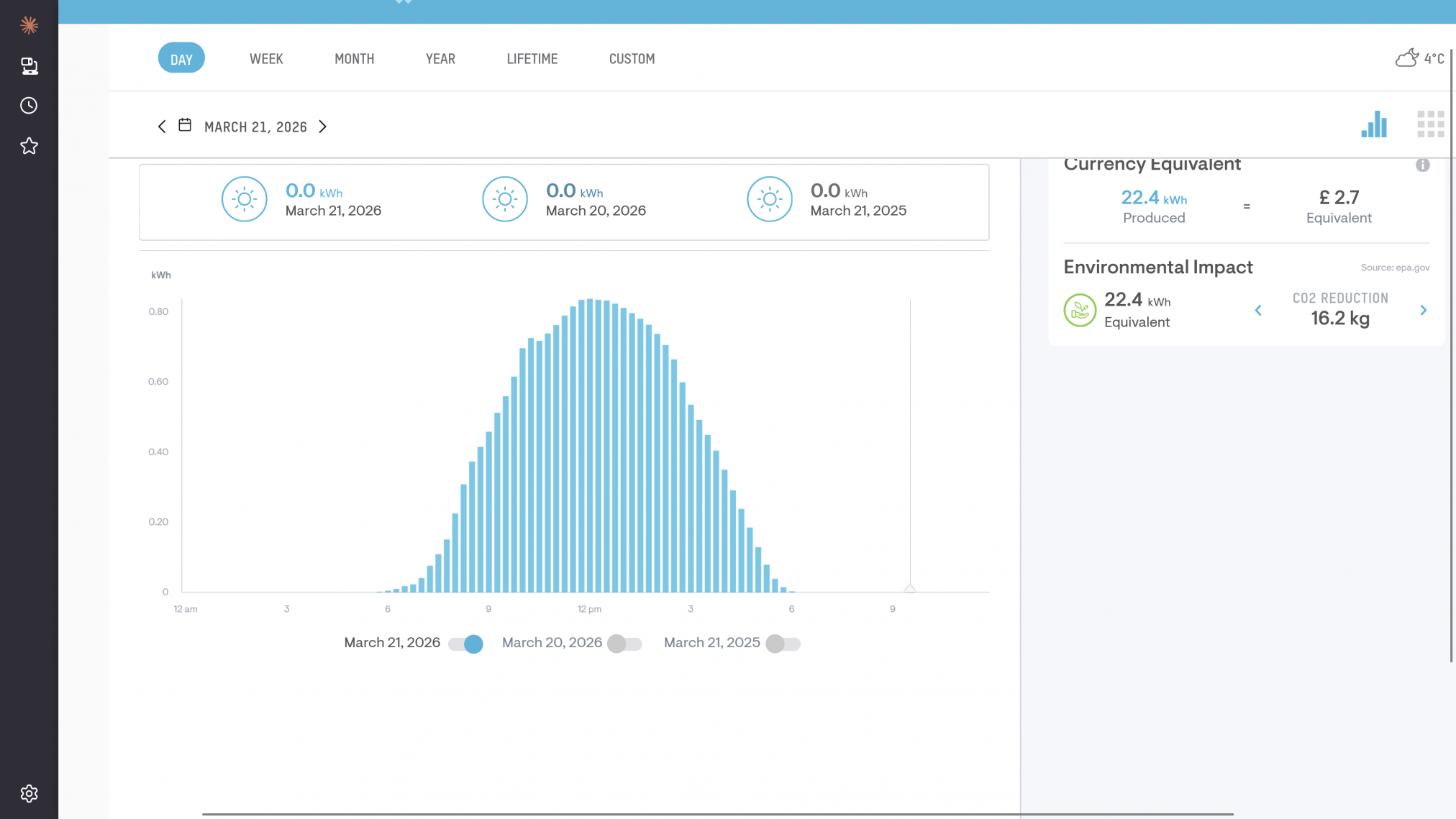
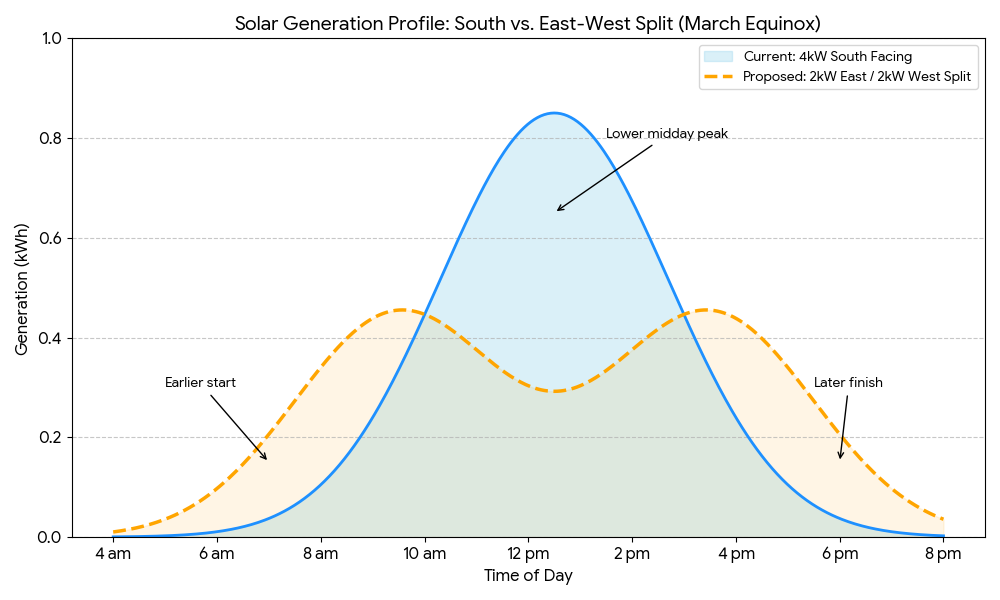
What we have been doing that made a bit of a difference is ensure we’re not using power between 15:30 and 19:30 where at all possible – when the UK experiences its peak draw. Heating happens during the day, car charging, etc. Our hot water disinfectant cycle is done between 12:00 and 14:30 every Friday during the winter, and 13:00 to 15:30 during the summer – using Gemini, I work out the next week’s max solar generation times.

Of course, it’s not fool proof. Storm Claudia has been raging today, though the East of England. So I moved our disinfectant cycle to yesterday. Hence, our usage has been lower on the darkest day we’ve had in 2025.

We could hook up our solar diverter to our car – with the heat pump, even on a cold day it makes no sense to use an immersion heater. Why? Well, the immersion heater is 100% efficient (every 1kWh we put in we get 1kWh of heat) but the heat pump is at least 350% efficient, for every 1kWh we put in we get 3.5kWh of heat out. We do not use the solar diverter to heat water, as a result.

We’re at the point where it makes sense to do the right things for the right reasons otherwise you are not helping anything, or indeed making things worse! We’re getting close that being the case.

Optimising from here on in is not going to be trivial. We are going to have to make conscious decisions for each and every step.

Surely, you are doing enough?

Can anyone ever do enough? I ask as it always seems there is some area in which we personally can give a bit more. If enough people do that, we can achieve net zero as a nation, and wider, as a planet.

Call it our little gift over Christmas, and beyond. Merry Christmas, or hope you had a happy Hanukkah.

Please note: I wrote this before the massacre in Australia. I do not agree with what is happening in Gaza or what is happening in retaliation, like these events. I hope we can all find better ways to settle our differences in 2026.

A fully dressed window.

This is a bit of a departure from my normal sort of post, but with the changes going on in our place, I wanted to cover making a house a home.

Over the years, there have been many articles written in many types of publications (like this one) and TV shows talking about style, sometimes about insulation, sometimes about other considerations.

But can I be brutally honest, please?

In a bedroom, you may want some blinds for extra light control or privacy, but nothing is as cozy or insulating as a pair of curtains.

My beloved and I had to swap some light busting venetian blinds in our gable end window in our bedroom to fit a French door in a few weeks. What a difference it has made. My beloved is a wiz at putting up shelves and curtains, so having bought the pole and ready made curtains, he did the honours and he hung them yesterday (about a half hour planning task and about an hour to do).

Swapping dark blinds for “soft-white” curtains means we have a “reflective” surface when the curtains are closed. Using eyelet curtains means it’s a full and luxurious look without costing a fortune for a pair of ready made curtains. Having had them installed last night, our room felt so much warmer and the insulating properties spoke for themselves with much less power being used to retain the heat in the room.

While they are a little long currently, it is so much easier to shorten a pair of ready made curtains than start from scratch.

Curtains are one of those really time consuming things to do yourself, and really needs a dedicated workspace, if you are living with a family larger than one. To look right, they need to be perfectly made, lined for cutting out light and heat loss, and all that is very tricky to get right. The bigger the window, the harder it is. For any window with two curtains, it is at least a day of effort because you do it once in a blue moon unless that is your day job.

Newly hung curtains
Newly hung curtains

Eyelet curtains were our choice because we didn’t want a traditional look in our bedroom, but somehow, they look a bit more polished than tab tops. It is also significantly cheaper than traditional curtains with the heading tape. As we’re happy with the results, if I get a spare couple of weeks off next year, I will buy some fabric and make my own pair. As a quick, cheap, and easy solution pre-made, I’m a big fan.

One thing I didn’t know until this round of decorating, was that you can iron your newly bought and packaged curtains. In fact, where we bought these featured that on the youTube video forming the instructions.

I have always just let them drop. You learn something new every day.

Of course, this is a litle prep before the main work is done, so we have moved some furniture ready for the window to be turned into a French door. It will take a couple of days to do the work and another couple or so for the plaster to go off so we can rehang the curtains for the last time. Let me put it this way, we’ll sleep somewhere else in our home until the room is ready. Then I will share the final, completed look – hopefully having taken a few inches off the bottom of the curtains by then!

OK, I’ll bite, how do you shorten pre-made curtains?

This is the downside to buying pre-made if your window does not fit the “standard” sizes made. Ours didn’t, being a wide but short (comparatively, apparently) French door.

The downside to buying the eyelet curtains is that you have to shorten from the bottom, which I think is much more fiddly to get right.

If you know the curtain will need shortening, before hanging the curtains, take one down to your local haberdashery and find a suitable thread – match a shade darker than the curtain, especially if it is a plain fabric as thread always sews up lighter when the job is completed. Hold the thread against the fabric and check disappears when it is a single strand.

Hang the curtains and see how they drop (so to speak). If not ironing them, leave them to drop the creases, which takes three weeks or so for our set.

With a friendly partner, fold up the bottom of the curtains so you have 5mm or so off the ground. Pin at one end of the fold and repeat the other end of the curtain. Remove the curtain and pull the bottom of the fold tight and pin the curtain in the middle.

Press the fold into the curtain using a damp tea-towel, and pin all the way along. This gives you the line along which you will sew, I don’t tend to cut the curtains down as this makes two jobs and when someone is finished with the curtains, they make great dust sheets for decorating.

Do the sewing. If you have folded the curtains up, the original hem line will give you a straight line along which you can sew. With thicker fabric, I do this by hand, a simple running stitch, ensuring I take out the pins as I go along the line.

Rehang the curtain and do the second one. Here is the results (bear in mind, the creases need to drop out fully).

Shortened, close, curtains.
Shortened curtains, open to show view.
Shortened curtains, open.

Bear in mind, anything being done by hand is going to take a while. If the window is wide, you are looking at around ninety minutes a metre, probably longer if you don’t sow regularly. Machine sowing is quicker, between fifteen and forty-five minutes a metre, mostly for the preparation, but if your curtain is thick with a lining, that is not going to be possible on a standard machine.

Hope you have a very cozy and Merry Christmas.

Preparing for Christmas guests

I’ve taken a day off, what with all the work to get the house ready for the photos we promised the window company, to get the house clean for guests over Christmas.

The house is deserted as Jon is working in the office today, so I also need to look after myself. Not a problem with the trusty microwave.

My unit has a “programmable” feature – I can combine 3 steps to a function. As I am reheating a meal later, I can plan a stop at noon. Set the first stage of the cooking for a couple of hour’s time, then the time to reheat the meal (about 4 minutes) then a minute to stand the food. Now I can clean, knowing there is a tasty and nutrious lunch waiting for me at noon on a warm plate, all economically cooked in the microwave…

It’s cheaper to buy it done for you.

I love when people say this, because the thing I’m interested in is the total cost of ownership.

Since lockdown, we’ve kept up many of the dishes and techniques we learnt when we had more time. And when you are doing the cost, you really should take your time into consideration. When you are money rich but time poor, that sum may come in favour of buying pre-made food (aka ready-meals).

Some things we do, we do regardless of what we’re earning. I have never bought a batter mix, or premade yorkshire pudding. Or a white or bread sauce mix. Because they do not cost in if you own a pair of scales – when you set up home you need a means of weighing out ingredients! That one investment will pay itself back in no time.

Really?

Yes. You need a pair of scales and a 500ml jug as a minimum. Some just use volumes to combine ingredients in the right proportions (many American recipes give everything in cups and spoons. I don’t, I often use metric units, and kilograms and grams are the scientific units for mass.

Let’s have a look at the total cost of ownership for a cheese soufflé. I’ve chosen this recipe because it is often a choice in the ready meal section and it is deemed an tricky meal to get right, using techniques many believe are difficult to master. It is easy to see why you would choose this ready meal over making it yourself.

Ingredients.

IngredientsQuantity in recipeUnit sizeCost per unitCost of item in recipe
Cheese 40g150g£2.00£0.53
Cornflour14g250g£1.30 £0.07
Butter14g200g£2.95£0.21
Eggs26£3.40£1.13
Milk75ml1136ml£1.25 £0.08

This makes the ingredients worth £2.03.

The cooking takes me 30 minutes. I use my hand blender, and either a manual cheese grater or a food processor attachment for my hand blender. Every utensil cooking this item goes in the dishwasher – I have included packing the dishwasher in this calculation.

The microwave is used to make the roux for the soufflé. It is used for 90seconds at 1000W => 0.025kWh at £0.25 per kWh, that’s £0.01.

We’ve also got 18 minutes in the oven function for the microwave. My combination oven uses 1.38 kW when it is used as an oven. I’m going to add the 7 minutes to warm the oven up – essential for a soufflé. So our power cost is (25/60)*1.38 kWh => £0.14.

So our total is the cost of the power and the cost of the ingredients. That’s £0.15 + £2.03 = £2.18. Excluding our time.

A cheese soufflé from Waitrose is £4.50 for the same quantity. It takes 18 minutes in the oven – we tend to use the microwave for the job. So the power is (18/60)*1.38 kWh = £0.10. Giving a total of £4.60, excluding our time (about 5 minutes).

Basically the question is, is my time worth £2.42?

Yes, that really is the question. The washing up or running the dishwasher happens what-ever meal you have. I would also put to you that the ingredients used here can be used for many different meals, where as the cheese soufflé from Waitrose can only really be a cheese soufflé.

Sometimes, it is really good to have some nutrition that isn’t made from involved recipes like a cheese soufflé. Beans on toast, a sandwich or piece of toast that is so simple you can do it with both hands tied behind your back.

Some say that you can have such emergency food through batch cooking. This needs planning – I am not sure I have ever been that into planning my meals in advance! Some food works well being reheated: some does not.

It takes more than planning. Containers for storing the food well, and somewhere to put the containers. Washing up and storage when there is no food in the container.

Then you have to eat the food before it goes past its best. We try not to cook more than we need for the vast majority of our meals.

Roast dinner and Christmas dinner are the exceptions. Mostly because we cook meat. An animal died to feed us – not eating all of it is wasteful.

How do you run things?

A day being one of those stay at home types.

Today is Saturday 20th December, and I have plans.

My beloved is doing his turn stewarding a game at our local football club, and I am aiming to achieve the following:

  1. Get some food in, to finish off Christmas dinner but also something tasty for me to have for lunch.
  2. Shorten the premade curtains in our bedroom.
  3. Bake some tea cakes for my beloved’s return from stewarding – in December it can be a little chilly out there.

Ideally, the aim was to do a little more, but those were the big three. So, how did I do?

Well, I woke up at 5:30 am and couldn’t get back to sleep, so I had breakfast, grabbed the bottles and glassware to recycle and headed for the supermarket by 07:22. What a game changer – the shelves were stocked (ours is not a 24 hour store), and few customers were about. So much room in the carpark! Even being as inefficient as I was, I was out and home by 08:25. By 08:45, everything was stowed away and I was enjoying a cup of tea.

While in the supermarket, I realised I didn’t have any thread to shorten the curtains – so my beloved drove me to the haberdashery’s as soon as it opened with the un-pinned curtain and I got some colour matched thread.

We got home, and Jon finished off shortening the pole enough to put the end caps on and I started sewing. Not trivial, not least because it had to be done by hand, so I had to relearn how to do a back-stitch and thread a needle, and cast on… In the end the 2m28 curtain took nearly four hours to finish and get back on the pole. These were not fun filled times and I have to say, I should have set timers for breaks rather than distance marks – when I got tired, I made far more mistakes being a beginner.

Jon went off to the football and I stopped for lunch at 12:30. I took an hour’s break, not least because the low sun was causing visibility issues and until the curtains are hung, I have no means of blocking the light!

While doing this, I laid out the ingredients for the tea cakes and generally prepped by setting an alarm – Jon was due back around 18:00, and it would be good to have them ready for him to have when he had changed out of his uniform.

Started the third round of sewing – by which time muscle memory is kicking in, and finally I am making some progress. The alarm goes off to make the dough for the tea cakes.

Fourth stint of sewing and I am done – it is now 16:45 and I have 27 minutes before the dough needs to be put in the oven for the first raising.

I have a cup of tea and watch some TV. Which inspires me to make use of some ingredients that are in the fridge into a tasty cheese soufllé. Which is not the best bit of planning.

For a start, I rarely make either the tea cakes or the soufflé. It is not an elegant display of culinary skill those both dishes rise well and taste delicious.

I am also, by this point, seriously knackered. Thank goodness for the dishwasher to lift the load off our shoulders by sorting out the mess.

Tomorrow is Christmas Ham day. But this is a well practiced affair. Today was one of those days when I remember why I am a professional worker and not a full time home maker.

Is there such a thing as breaking even?

For many, the costs of producing energy efficient good, thermal insulation, or green power consumption, far outweighs the benefits. In the past, Number crunching part 1 has examined how much carbon was used in producing our batteries and solar cells, and whether that effort made a return – is the juice worth the squeeze? – so to speak.

We should look at the same numbers for the replacement windows. Although, can I put a caveat here that the windows were failing, whatever we did to preserve our thermal envelop was necessary. We just took the opportunity to go the full way with triple glazing.

We replaced twelve windows with triple glazing at 110-140 kg CO2, let’s call that 125 kg CO2 a pop => 1,500 kg CO2. And one double glazed window, coming in at 110kg CO2, so our total is 1,610 kg CO2 for the windows.

We then have 3 UPVC French doors, two triple glazed and one double glazed. The triple glazed ones are 140 kg CO2/m2, so that’s 5.4 m2 * 140 kg CO2/m2 = 768.18 kg CO2. The double glazed unit is 110 kg CO2/m2, so 301.785 kg CO2. French doors in total is 1,069.965 kg of CO2.

The aluminum patio door is harder to judge, because it depends on how the aluminum was sourced, but 140 kg CO2/m2 is probably fair. So, that one cost is 743.4 kg in terms of CO2. So all the doors contributed 1,813.365 kg of CO2.

The total for the windows and doors was 1,610+1,813.365 kg CO2 or 3,423.37 kg CO2. Or 3.423 Mg CO2.

In the UK, 124g CO2 (or 0.124 kg CO2) is generated per 1 kWh of electricity produced. That means to break even, our windows need to save 27.6 MWh of electricity.

Given our pre-window expenditure of 3.9 MWh on heating, we can expect it to be 3.25 MWh, (an estimated save of 650 kWh over the year), they should break even in their life-time, hopefully within 10½ years.

This is a reasonable estimate, we may do better, it’s hard to tell until we start to see it in action. It also takes into account we had to replace our existing windows either this year or next and took the opportunity to upgrade the performance. If we’d gone for double glazing everywhere and retained our layout, the cost would have been less both in terms of money and CO2 produced, but the efficiency gains would have been much less too, so the returns would have possibly come in during the life-time of the product.

There’s so much to take into account here, not least because of when we’re doing the replacement. It meant we got a great price on the windows, but losing our thermal envelop in each and every room of the house meant we had to use electricity to restore the thermal levels – the temperature in each and every room.

This means I may have to play about with November’s numbers to get a blended estimate, if I want to do an annual comparision pre- and post- replacement windows. Or I may just exclude November. Both would be reasonable approaches, the later probably being much more meaningful and understandable. In the rooms where the windows had already failed, it is already much easier to get the rooms up to temperature and to maintain them there.

Hopefully, this article gives you the means to work out if it is worth the replacement for you and your carbon footprint!

NB: Stephen Hawking’s editor said Prof Hawking lost sales for every mathematical formula published in his book. Please be forgiving, as this is the easiest way to explain what is happening regarding payback.

Also, Number crunching part two is coming in the first week of January, when the numbers are all in for the year.

It went from mild to ‘Baltic’ in five minutes.

We take how warm our houses are for granted, but as someone who took advantage of a cheap deal if we got our windows replaced during the “autumn” (autumn my #@!£$), it is interesting to see why we keep windows and doors closed while it is 5°C outside!

Our Tado radiator valves and thermostats all tell you the temperature in your individual rooms…

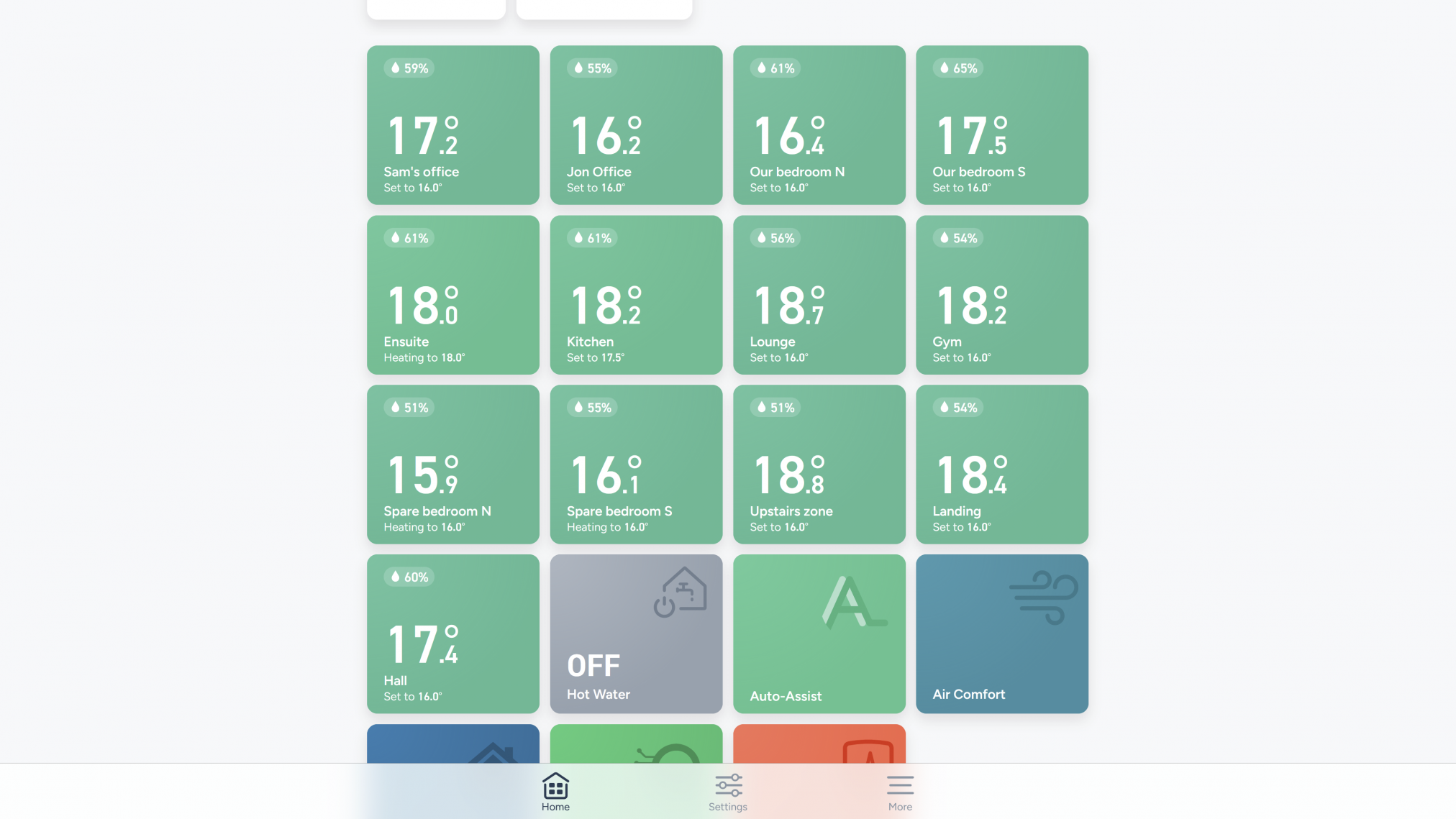
Temperatures in the house
This picture shows a list of thermostats in a grid with the temperature in degrees Celsius alongide its room’s name.

Our super-controllable house is in “frost protection” mode during the fitting times, because the heat is just leaching out of holes in the walls where the old windows used to be. Our bedroom was 19°C this morning but with the front door open and a window missing in the spare room, the temperatures soon start to drop. The internal doors are thankfully insulating, but there is no point heating a couple of rooms when the corridors are dropping in temperature this quickly every time you open the room’s door.

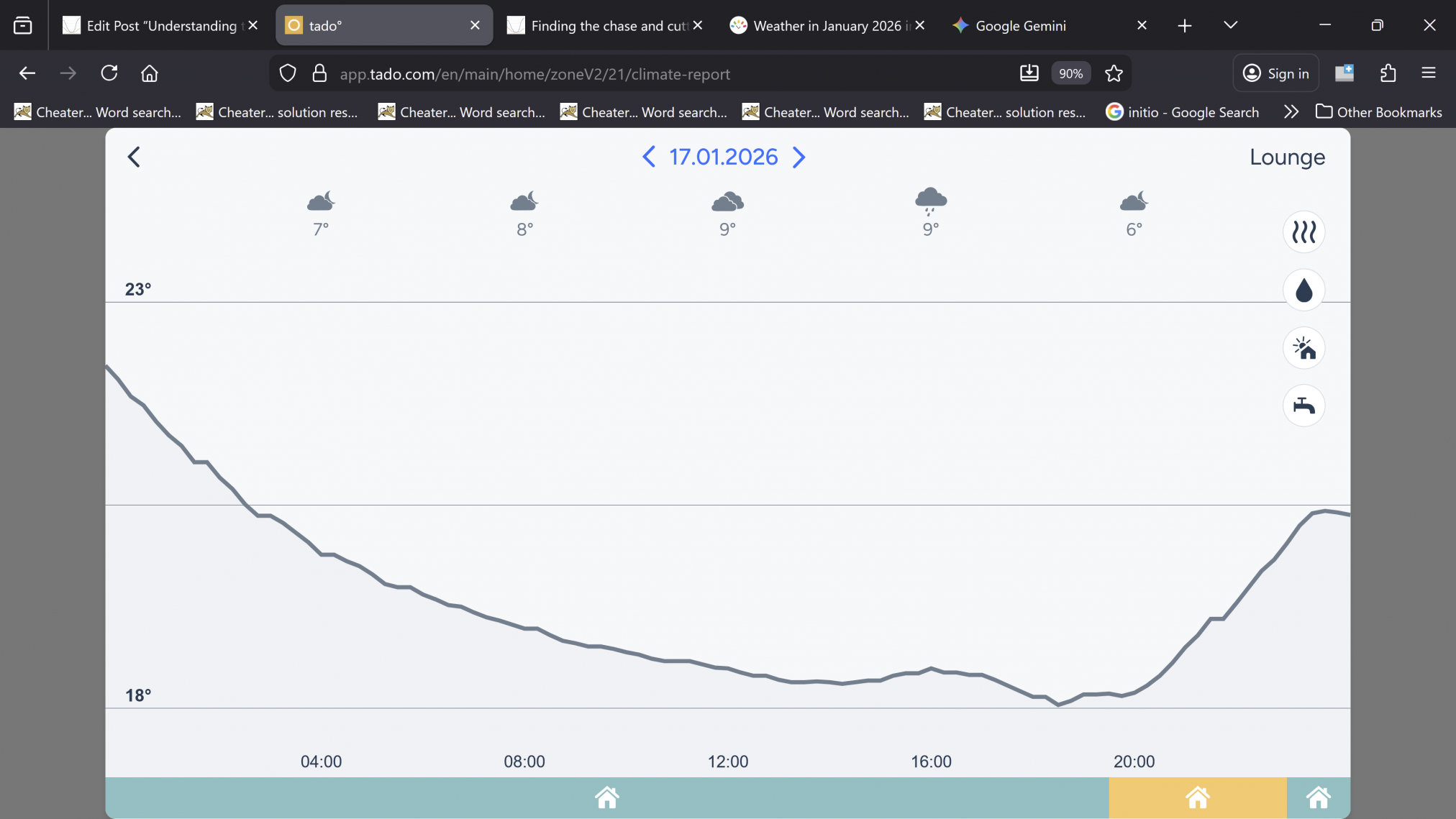
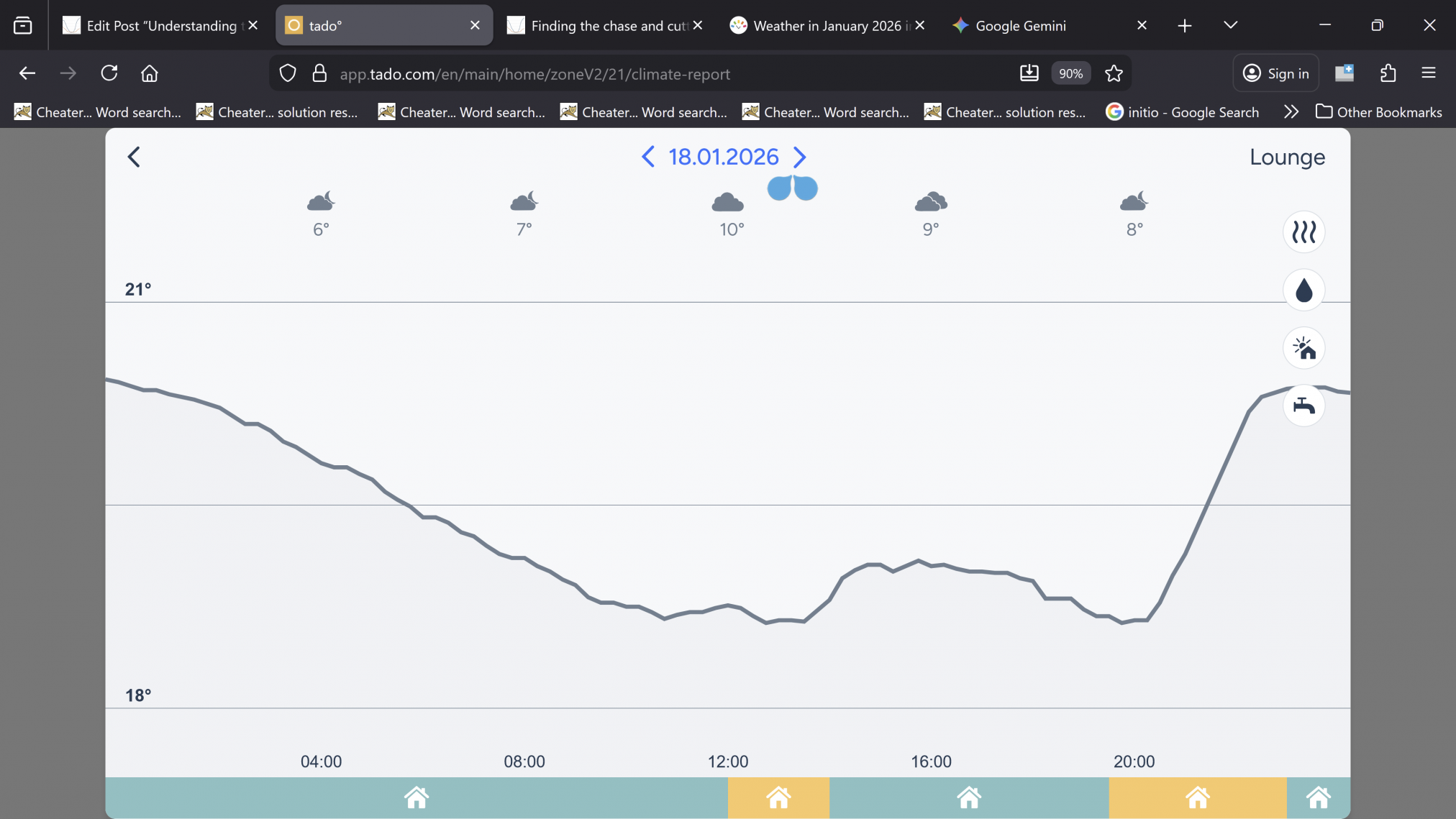
We can see the drop in one of the last to still be heated, my beloved’s office:

Temperature drop in a particular room, gong from 19.3°C to 18°C in 30 minutes or so.

We can see from the readings from the smart radiator valve thermostat that the heating came on this morning for his office about 06:30. Even with the heat pump, the temperature rose to its setting of 19°C. All the cold air rushing past his office door then brought that temperature down to 18°C.

In a room with the actual window out, that is exacerbated. I switched off that room’s thermostat before the work started, naïvely thinking that would be enough. Obviously, it wasn’t, and the impact has been huge.

Why go to all this bother, then? You had double glazing!

Our double glazing was failing after 16 years. This first window to go was the one I had repaired (remember the extra caulking), because it had a 3mm gap between the window pane and the frame!

This one is having a tilt and turn window, which is more popular in Europe according to our window fitter and our son, respectively, for pretty much the reasons the Europeans have them installed. Our south face of the house bakes in the summer sun. Having a window upstairs we can open inwards means we can fit external shutters, allowing us to shield during the summer heat and recover during the night. Instead of opening the window to vent, we can tilt it at night with the shutter shielding us from moths and other insects.

We don’t need this downstairs, because we can walk to the outside of the window and pull a shutter closed, but upstairs, we need to do something different.

The triple glazing is to reduce our u-value further – vital for the north face of the property during the winter. U-values are the rate at which heat is lost from a surface and is dependent on a few things such as materials, air gaps, and is measured in Watts per square meter a degree Kelvin or W/m2K. (Kelvin’s are used here as they are the scientific unit (also known as the SI unit) for temperature, unlike the Celsius unit and you then don’t need a pesky ° symbol when typing this out). The lower the u-value, the better. It’s one of the things measured on an EPC (Energy Performance Certificate) report.

Our old units, were starting to fail (apparently they were made in 2009 and installed later that year, looking at Google Map’s “see other dates”). No-one lived in the house until late 2011, early 2012. By the time we had moved in May 2013, some of the fixings and hinges had begun to rust. The vaccum units started to fail last year – but with the boiler failing, we had other priorities!

Windows are never as good as brick at keeping a house warm. But on top of good units, having them fitted by someone who knows what they are doing is essential. Any gaps round the windows will let any heat poured into the room find an escape route. I know people who moved into a house that had had the windows (not UPC ones, just wooden frames) installed upside down. When a window is installed upside down, rain pours into closed windows from the top. A good fitter is vital otherwise it can all go horribly wrong.

One of my pet peeves is trickle vents. Required by building regulations, they poke a hole through your sealed units. Doh! The idea of them is to “let hot damp air vent when you can’t open a window” but all they do is chill the windows allowing said damp air to condense on your glass panes. Eight months of the year, in the UK, they are just causing more issues than they solve, and the other four months of the year, we can just open the window!

That aside, it’s really exciting to be fixing our window problems for the next 25-30 years.

By the time you read this, all the work will be complete and you’ll only have to wait a week to see the finished result. We’re at the point now with 80% of the upstairs windows fitted though not completely fixed and finished.

What about the temperature inside your house at this point?

Good question. Let’s have a look at that.

Temperature at 13:00.

The kitchen and Jon’s office have kept their temperatures up – the benefits of a closed door, good insulation, and windows not being messed around with. The spare room is, frankly, a bit parky. As is the landing – having dual aspects and open doors here. My office has lost a few degrees too, but is looking great with its new window. Our main bathroom has also been done but it’s thermostat isn’t a smart one, so isn’t showing the 12°C on the room’s thermometer.

Most of the removal and refitting has been done today, so I am gently starting up the heating. Upstairs that means the ensuite and bathroom in our spare room – our home from tomorrow night for a few days – will start to get warm again.

Sounds like hell.

But it should be worth it. I will do a deep dive analysis on the figures at a later date.

Though, as hinted, this is about more than just improving the u-values. Our house was completed in 2012. Yet, “cottage-style” windows were installed. By choosing modern style windows, we should be improving the aesthetic too and allowing light to fill the rooms.

Converting our bedroom’s window to a French door (with balustrade initially) will let in more light and allow the courtyard to be see from anywhere in the room.

The same goes for the large patio door in the lounge. It shares the same view, albeit from the ground floor. Only, the small French door and window the other corner of the room meant the courtyard could only be enjoyed from a few points in the room. The window area is increased but so too is the wall area – and corners, we will gain two big corners in the room.

It’s hard to describe the benefits of walled corners in a room. A place to put a cabinet or a chair, a set of shelves, or just a piece of wall. The 1960s architecture in the UK often featured wall to wall windows. Why, oh why?

There are some wonderful rooms that have round the corner windows, with a great view, this can be stunning. But it needs really careful thought about how you enjoy those views.

We’re lucky in that our lounge is really open, a basic rectangle that can be divided into zones. A reading zone, TV zone, small table for a snack in the evening and a music listening zone. With the new patio door, the courtyard is now a feature against all these activities.

One of my favourite things about the courtyard is the fact there is a flower in bloom at every stage of the year. Whether chrysanthemums and a clemetis in October, November, December, a Christmas rose or snow drops in January and February, bluebells in March and April, Wisteria in June and July, honeysuckle and weigela in July and August, clemetis in July, August, and September. Something is happening somewhere for you to look at. Whether in the garden or in the lounge.

Why do what you do?

Motives are what define us. They allow us to get up in the morning and get a boogie on rather than languish in bed – and believe me, we have all had those mornings where staying in bed and pulling the covers over our heads makes the most sense!

For many, their jobs allow them to live. They do not enjoy what they do, it is simply a means to an end. When I was growing up, my parents allowed me to see that if I wanted them, I had options.

It doesn’t mean there haven’t been impossible days at work (or in real life), but even then, I have had choices about what I do with those days, how I act and carry myself. Hopefully, I have always done that to the best of my ability.

Is this going anywhere? Or is it just a 50+ person being a boomer?

Firstly, I’m a Gen-X person, not a boomer, but whatever my age, our motives are what drives us. Secondly, I got to go to a Christmas fair yesterday and met some amazing people living their dreams. That is always inspiring: indeed, the experience inspired me to write this piece, as we have spent the past couple of weeks achieving a bit of a dream of ours. Albeit, nearly at the end of what seemed a long journey while we where travelling!

We’re coming to the end of our window installation, well, it was a replacement window exercise for all but three of our windows, which were radically transformed.

We got a bit of a bargin because of the time of year we did it, but it was still a big job and once the building work is done, our bit of the story will begin.

Building work is not typical in having your windows replaced. We have a bit of experience of doing this, having turned an existing window into French doors, which can be transformational. Letting more light and much more of a view into any room. It also created some corners in a room… For a modern house, it can make a feature for surprisingly little effort if you have a lintel that’s at the right height.

This time, we turned a window in our bedroom into a pair of French doors, and took a window and a pair of French doors near two corners of a wall in our lounge and turned them into a patio door in the centre of that wall opening into a courtyard garden. We thought it was an obvious thing for the architect to have done but it was never in the previous owners drawings for the house, so we had to do a bit of a rennovation and found a company willing to do it. The work went smoothly but took some planning, which always takes time.

Can I confess to something? I love painting walls. I do the prep I need to, including masking tape (a terribly stressful part of the operation), but the rhythmic dipping of a paint-pad in a tray of emulsion, smoothing the paint onto the wall, and the end result when it is finally dry. I do this without music: just me and the wall to be done. Of course, I am going to be doing two walls with two doors on them – masking tape is going to take a good hour of the prep work. There’s a ceiling to do too. It’s a big job – a good weekend’s worth. Bliss!

The balustrade for the upstairs French door is being constructed and fitted as I type this. The render will need refreshing (and some patching). But unlike previous years, we should be able to do that leaning out from our safe doorway.

Just this moment, the world feels safe and hopeful. I can see the thaw of last night’s frost steaming off the fence in the courtyard as the noon day sun hits its peak in teh sky on this crisp December day. Hope you’re having a great day where-ever you are.