
Here comes the sun!
It’s February, so how can this be the topic of a post today?
Or Solar elevation and what it means for me…
Human beings have been interested in how high the sun gets in the sky since ancient Greece was a dominant power. In fact, the Greek astronomers founded an equation anyone can use to work out the elevation of the sun at any point in the earth – this was the foundation of sailors being able to navigate the world long before GPS was a twinkle in anyone’s eye.
To our modern, land-locked people, it helps us work out when sunrise and sunset occur and, in terms of generating solar power, when the peak can be expected.
The equation is hmax=90°-L+δ, where hmax is the height the sun reaches, L is the latitude of your position on the earth, δ is the declination from the sun to the earth which varies from +23.44° during summer solstice to -23.44° during the winter solstice (in the UK). Declination is the angle between the sun and the equator at the point of time being discussed. In this case, we’re looking at the maximum angle in a day.
My latitude is about +52°, so during the summer, our hmax is 90°-52°+23.44° ≈ 61.44° (read this as approximately equal to). During the winter, 90-52-23.44 ≈ 14.56°. We can see how this changes in the table and graph below.
| Month | δ average | Peak |
|---|---|---|
| January | -21.2° | |
| February | -13.0° | |
| March | -2.4° | |
| April | +9.4° | |
| May | +18.8° | |
| June | +23.3° | +23.44° |
| July | +21.2° | |
| August | +13.5° | |
| September | +2.2° | |
| October | -9.6° | |
| November | -18.9° | |
| December | -23.1° | -23.44° |
This results in a solar elevation in Ipswich of….
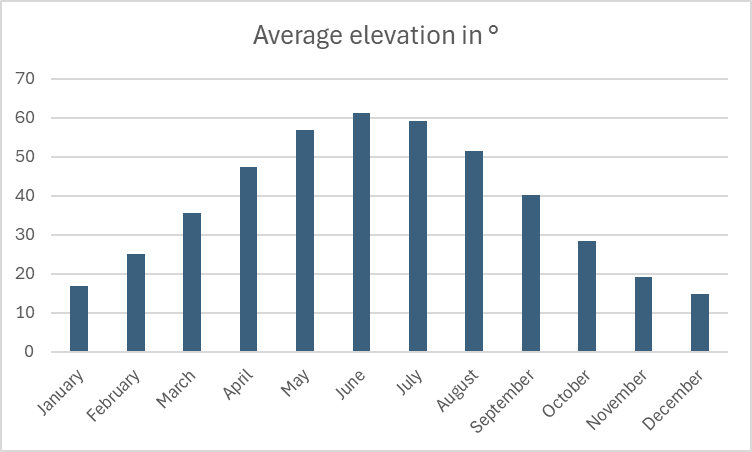
So, for our little corner of the world, we can see that indeed the sun’s height wobbles between 61.44° to 14.56°. Which is fine and dandy.
A valentine’s gift…
As seen in the graph, during the year, it varies between that maximum and minimum of 61.44° and 14.56°. Today is the 14th February, so it’s about 25.1°. Compared to any day in December, when the elevation was ~16°, it makes a big difference to solar generation potential, and why January and February are so much better for our generation than November and December.
The next consideration is your roof’s pitch (if siting the solar cells on your roof). Given our northern latitude, a pitch of around 53°, as we have, maximises the solar harvesting during the winter, but it is not ideal for during the summer, when a pitch of 35° would be more effective. With a heat pump supplying our heat and hot water, this is ideal for us.
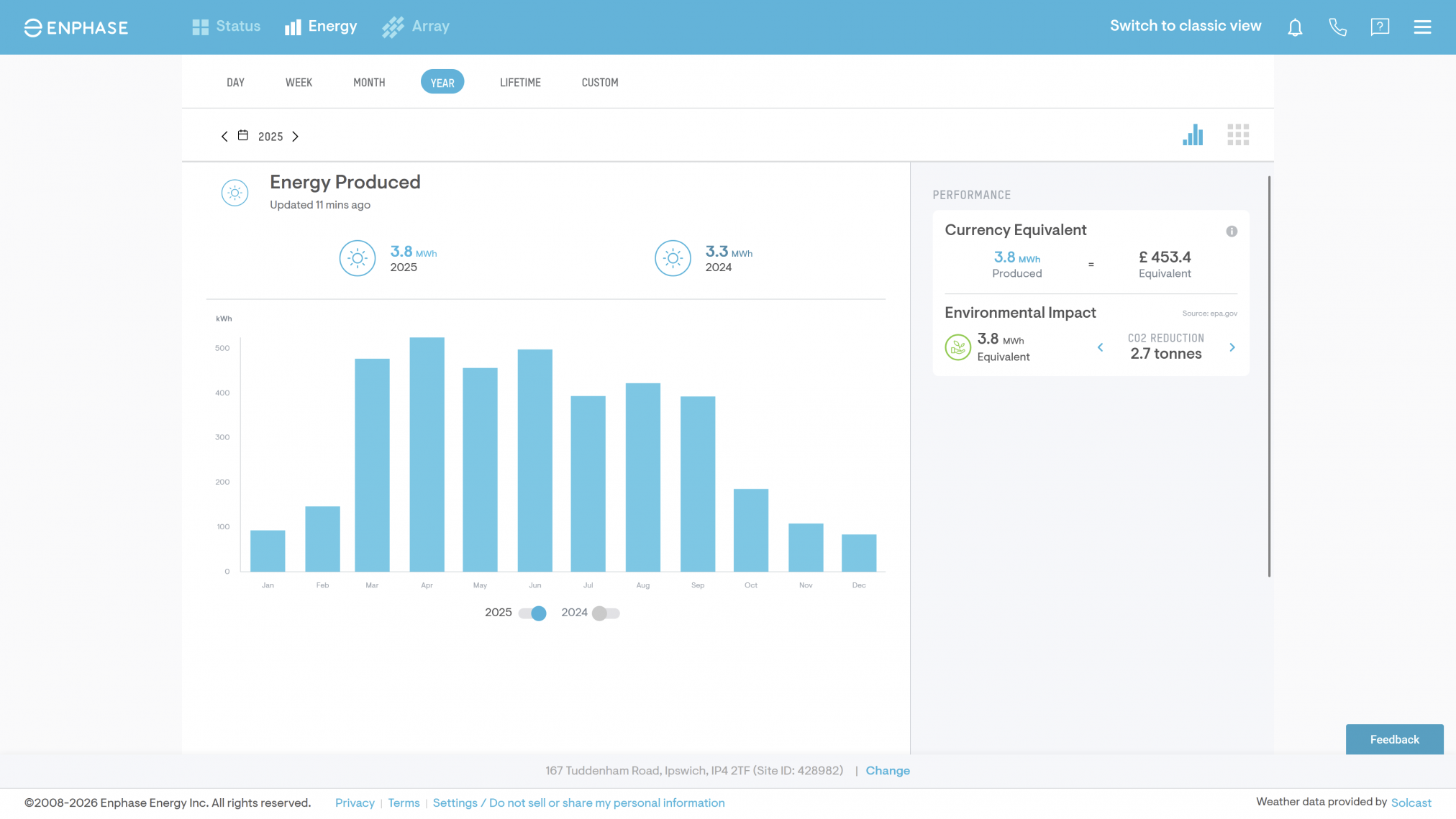
The proof of this is seen in our solar generation figures; we typically generate more in March and April than we do in July. But we don’t need as much energy then, so it suits us.
This matters in terms of solar generation, as solar cells work best when the sun hits them as close to perpendicular as possible. Basically, if the angle is shallower than 60° or steeper than 90°, there is some reflection happening. Indeed, so much is reflected that the generation suffers. During the winter, our roof is ideal, as the angle is well above that 60° floor, but during the summer, the angle is well above 90°. The angle between the sun and your roof matters. If you want to be solar powered over the winter, your cells need to be at a steep angle. That doesn’t mean it’s ever going to be great, short days and all that, but it maximises what you have to play with.
For some, this is an argument they use to say that solar power is not worthwhile somewhere like the UK. I have never found that a convincing reason to not harness an abundant source of power used by plants in the UK for millenia. Of course, plants are a bit cannier than the average human in making the most of what is available…
For me, these changes mean a fixed installation is fine but it would be relatively simple to engineer a system that could maximise the gathering of photons pretty easily – only that is not encouraged in the UK. We go for fixed systems, often targetted at the winter gathering options. Indeed, if you are mirroring the pitch of the cells to the sun’s zenith, why not have simple systems to track the sun across the sky during the solar day? After all, this is what the common or garden plant does to ensure it thrives.
Again, not encouraged in the UK, at all. Our house was built with a due south (180°) azimuth view roof, which is a good compromise. I do not see houses being rejected in planning where that is not the case.
Our roof is limited because we are a “chalet style bungalow” – dormer windows mean we have shadows cast on our solar panels by our need for natural light as humans. Again, why not let the architects build a flat roof in 2012, maximising the potential to generate power?
Our solar generation has varied over the past 11 years between 3.3MWh a year and 3.8MWh with 3.6MWh being the modal generation (most frequently occurring). We don’t really have an easy option to put in more cells because of the roof architecture. We do have an east face we could exploit, and a west roof, but the generation potential of these surfaces is reduced.
Please planners, look at the limitations you are putting on people when plans are submitted, in these terms. What would our potential be if we’d had a standard roof?
Posted: February 14th, 2026 under Driving off the grid.