
Number crunching part 1
Can I be honest here? Although I had “done the numbers” and figured out that we would indeed be:
- Reducing our annual carbon footprint. From 1.2 tonnes per annum to 0.3 tonnes.
- Making the most of the energy we were generating.
- Paying off a big up-front payment for the batteries and heat pump.
I didn’t expect to feel as happy about all that as we do. I think I expected to feel anxious and nervous about the dramatically higher electricity bills.
I feel like I am waiting for the other shoe to drop, but our Tesla battery set-up is working really well for us. We have hot water on tap, and during the summer, that costs us nothing to achieve.
From the grid’s point of view, we are low energy users between March and October. We haven’t reduced our usage dramatically, we are just sourcing it from our roof.
Last night, because a thunderstorm was predicted, we used a whole 8.0kWh from the grid, to absolutely guarantee we were not impacted by a power cut. Because we live in the UK, there are few power cuts in these circumstances, but we were ready just in case!
As today is fairly sunny, the battery is currently charging while 92% full. Since getting to 100% on Friday, it has kept between 70 and 100% all day. We got the panels cleaned a fortnight ago, which has dramatically improved the output from each pannel. Despite some cloud, most days we’ve harvested 19kWh a day.
The only days we take any more than 2kWh from the grid is when we’re cooking, washing clothes, and charging the car. And making many cups of tea. I have proposed cutting tea consumption, but my beloved husband just gave me a look to say, no honey, no way!
During the summer, the heat pump is typically returning a seasonal performance factor (SPF) of over 5 (so for 1kWh power we put into the system, we get an equivalent 5kWh in terms of heat). Indeed, during June that went up to 6 – although you do need to compare that to January when the SPF was 3.7.
At this half-way through the year point, is our electricity use dramatically higher for going all electric?
The short answer is no, when you ask the grid. Because of the batteries, everything we generate (bar some losses) is used by us.
Last year, we got the first battery in October, the second one in March 2025, and you need to remember we were using plugged in heaters from end of March (the coldest March in living memory!), so I am going to go back to 2023 for my comparison.
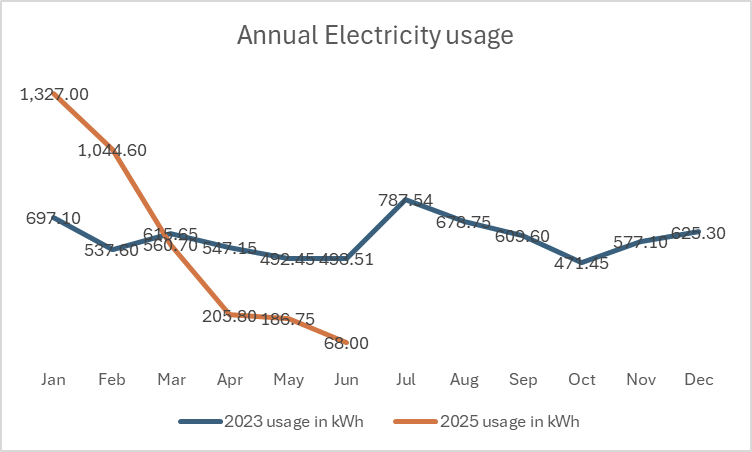
| Month | 2023 usage (kWh) | 2025 usage (kWh) | % difference |
| Jan | 697.10 | 1,327.00 | 190.4% |
| Feb | 537.60 | 1,044.60 | 194.3% |
| Mar | 615.65 | 560.70 | 91.1% |
| Apr | 547.15 | 205.80 | 37.6% |
| May | 492.45 | 186.75 | 37.9% |
| Jun | 493.51 | 68.0 | 13.2% |
| Jul | 787.54 | No figures yet | |
| Aug | 678.75 | No figures yet | |
| Sep | 609.60 | No figures yet | |
| Oct | 471.45 | No figures yet | |
| Nov | 577.10 | No figures yet | |
| Dec | 625.30 | No figures yet | |
| Total | 7,133.200 | 3,392.85 | 47.6% |
Woah, January and February look terrible!
Yes, but remember, we are not spending anything on gas and that is alll our:

Bearing that in mind, everything since March has used a lower amount of electricity from the grid, on average 0.2kWh a day at £0.2602 per kWh. About £0.05 at day.
If we take out the heating power, we are dramatically “using less” from the grid.
Our solar power had always worked well for us: what we couldn’t use we sold back to the grid. Which meant what looked like high bills were dramatically off-set by the SEG payments. If we use the energy ourselves, we do lose the SEG payments…
Though when the battery is 100%, everything we don’t use is exported.
We’re a long way off being self-sufficient, but we’ve used half the amount of power from the grid this half-year (and that includes our heating and hot water!), and are paying relatively little in our direct debit and are warm, clean, fed, for relatively little.
And protected from power cuts.
Out of interest, what were the values for the “excluded year”, please, 2024?
Last year, we used 8,414.56kWh. It wasn’t dramatically higher than 2023, but the figures for March and April were extraordinarily high, so would stand out like a sore thumb.
Of course, by mid-July, we had our heat pump, so the numbers would look comparable, which wouldn’t do for the comparison. By November, we had the batteries…
Happy that I did the right thing for the comparison, please?
And your actual usage, not just what’s coming off the grid?
According to the Tesla app, our figures are shown in the table to the right.
| Month | Electricity usage (kWh) |
| Jan | 1,400 |
| Feb | 1,200 |
| Mar | 1,000 |
| Apr | 670 |
| May | 590 |
| Jun | 290 |
| Jul | |
| Aug | |
| Sep | |
| Oct | |
| Nov | |
| Dec | |
| Total | 5,150 |
That is high usage. Really, high usage. Bearing in mind 2023, our whole usage was 7,133.2 kWh…
Without that up front investment in the solar panels and the batteries, that electricity would have cost around £1,854.36. Instead we’ve paid £834.78.
That’s driving to and from the local office, heating the house, etc.
Maybe that’s why I am fairly relaxed about it. Our investment in solar panels and batteries is making a difference to our standard of living, without costing the earth.
Actually, that’s a good question, what has the CO2 cost been?
For the solar panels, about 100kg per panel, making about 1,600kg, and about 2,700kg for our two batteries.
So the up front cost were dramatically higher than one year’s reduction. But our solar cells are now 12 years old, so that footprint was recouped in the first two years. The Tesla batteries were recouped in the 3rd, 4th, 5th, and 6th years, we had our solar cells.
The past 5 years, we’re easily carbon netural in terms of the costs of making our equipment. They should all last at least 15 more years and that’s 15 years of saving 1,300kg CO2 per annum.
Posted: July 5th, 2025 under Heat Pump, Sustainable Living.