
Number crunching part 2.
This is a look at the second half of 2025, and a follow up to Number crunching part 1.
The summer saw us pretty much “off grid” apart from backup. Of course, we still have to pay the standing charge, currently a whopping £0.4595 a day, though I know that is better than many companies charge, and for us, during the summer, that suits us fine – a higher unit cost gives us a lower connectivity charge: yes please.
Our set up is this. We have an EPC rated B house, with good insulation, an air sourced heat pump supplying hot water and space heating, solar cells, 27 kWh of batteries, an electric oven, hob, microwave, washing machine, tumble dryer, electric car, etc. A pretty typical set up for the most part – central heating etc.
I am now going to fill in that table from Number crunching part 1, with the figures from July to December.
| Month | 2023 electricity usage (kWh) | 2025 electricity usage (kWh) | % difference |
| Jan | 697.10 | 1,327.00 | 190.4% |
| Feb | 537.60 | 1,044.60 | 194.3% |
| Mar | 615.65 | 560.70 | 91.1% |
| Apr | 547.15 | 205.80 | 37.6% |
| May | 492.45 | 186.75 | 37.9% |
| Jun | 493.51 | 68.00 | 13.2% |
| Jul | 787.54 | 53.70 | 6.8% |
| Aug | 678.75 | 73.30 | 10.8% |
| Sep | 609.60 | 204.80 | 33.6% |
| Oct | 471.45 | 585.150 | 124.1% |
| Nov | 577.10 | 895.90 | 155.2% |
| Dec | 625.30 | 1,087.70 | 173.9% |
| Total | 7,133.200 | 6,293.40 | 88.2% |
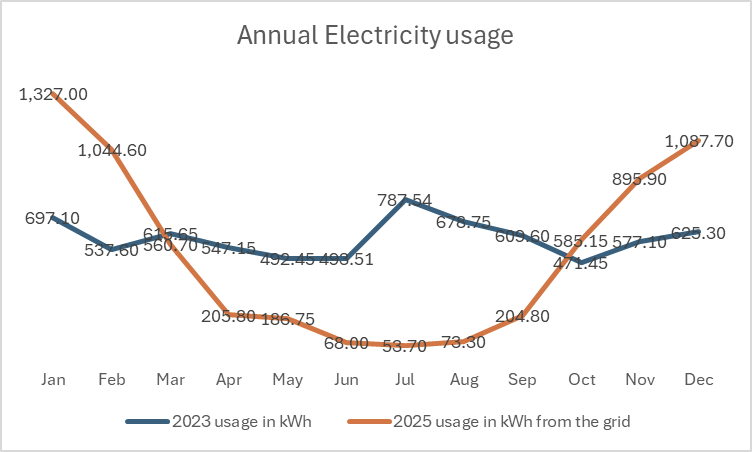
So, our billing usage has varied a great deal. During the summer, we were almost off-grid, though not quite. Next year, I may gear things like when we heat water and use the battery in a completely different way. I certainly started to do that in November and I am keen to see the numbers for January and February to see the difference that makes. Moving the hot water to be heated during the day means we use far less electricity from the grid – using the insulating properties of the house fabric and new windows meant that December’s usage was slightly better than November. (Partly expected as we had big holes in the lounge and master bedroom while building work was going on).
Making the most of the air sourced heat pump has a completely different mindset in play. Heat is more abundant during midday. So it makes sense to use the heat pump to heat hot water, a thermal store if you like.
Likewise, for heating the house. If you have good insulation and fewer loses through your windows, heat the house during the peak of day. Closing thermal bridges has become my favourite hobby over the past few weekends.
Yes, but what is your actual usage, not just what is coming off the grid?
Let’s fill in that table too.
| Month | Electricity usage (kWh) |
| Jan | 1,400 |
| Feb | 1,200 |
| Mar | 1,000 |
| Apr | 670 |
| May | 590 |
| Jun | 447 |
| Jul | 405 |
| Aug | 432 |
| Sep | 546 |
| Oct | 749 |
| Nov | 985 |
| Dec | 1,170 |
| Total | 9,594 |
OK, so basically that is a lot of electricity being used. But you’re generating about 35% of your needs over the year.
Pretty much. The batteries mean we’re actually using that – we have almost no earnings from exporting electricity. Interestingly, Tesla gave us a brake down of our power stowed over the year, and we’re in the top 7% of users who’ve gone off grid!
The huge difference is in the heat pump. It means, we have no other fuel expenditure in the house.
I can pull out our electricity usage for heating and hot water.
One of the important figures here is the SPF. This tells us about the efficiency of our heat pump or for how much power we put in, how much thermal energy (heat) do we get out? We calculate it from (thermal energy) / (heating usage). The estimate from the manufacturer was 3.51, so we’re doing a little better in our little bit of the world.
While ours is doing relatively well, it is worth considering that it is an average, based on the heat available from the air being used as a source. The air temperature gets hotter, the heat pump does better.
So, of our 9,594 kWh being used, 3,966.20 kWh was used to heat our hot water and house. Our car used another 2,000 kWh or so. Our cooking, cleaning (vacuum, washing machine, tumble dryer, hair dryer, steam cleaner, iron), and gardening (lawn mower, hedge trimmer, leaf blower/vacuum), computers, lighting, venting fans in bathrooms, mobile phones, refridgerator, freezer and insulin pump charging used 3,627.80 kWh.
Of course, we’re buying 6,293.40 kWh of that from the grid. Which makes us relatively heavy users.
Is the heat pump better than using gas?
Shall we look at the figures. As before, I am comparing to 2023 as it’s the last complete year’s figures I have.
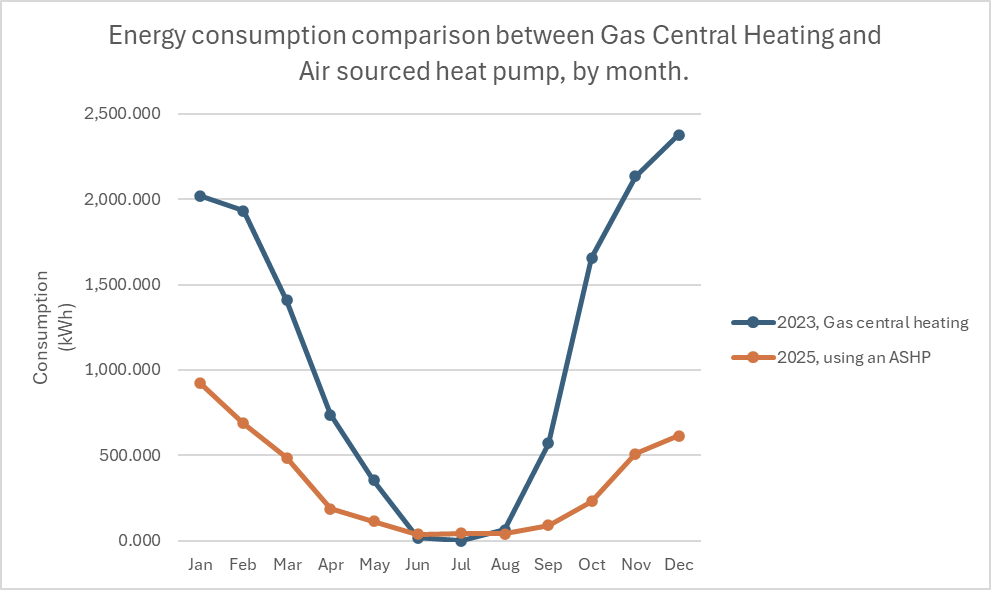
The table below is a comparison of the gas we used to heat the house in 2023 and the electricity we’ve used to heat the house using the heat pump.
| Month | Gas Usage (kWh) 2023 | Electricity usage (kWh) 2025 | Percentage difference |
| Jan | 2,021.181 | 925.00 | 45.77% |
| Feb | 1,931.237 | 686.00 | 35.52% |
| Mar | 1,408.429 | 486.00 | 34.51% |
| Apr | 735.847 | 187.00 | 25.41% |
| May | 353.446 | 113.00 | 31.97% |
| Jun | 17.835 | 38.10 | 213.62% |
| Jul | 0.000 | 43.00 | 100.00% |
| Aug | 62.561 | 41.40 | 66.18% |
| Sep | 569.986 | 90.70 | 15.91% |
| Oct | 1,657.321 | 231.00 | 13.94% |
| Nov | 2,134.510 | 510.00 | 23.89% |
| Dec | 2,378.535 | 615.00 | 23.92% |
| Total | 13,270.888 | 3,966.20 | 29.89% |
Basically, the answer to the question, is the heat pump better than using gas? is a no brainer: yes. The month by month comparison shows the ASHP outperforming the gas boiler every time. 13,270.888/3,966.20 = 29.89%. Basically we’ve used a third of the power. And that’s with big holes in our external walls during late November and early December! NB: I may do this again next year, just to show the difference it made in late November and early December.
Oh wait, what about the summer months?
Ah, what you can’t see in the “Gas Usage” figures is the solar diverter we were using from May to August. Rather than use CO2 generating gas to provide hot water back in 2023, we were using free electricity from our solar cells. It meant our gas totals were artificially lower, but they were still blown out of the water by the energy usage of the heat pump for heating the water.
The solar diverter has a coefficient of performance (COP) of 1, or 1 kWh of energy is converted into 1 kWh of heat. The gas boiler has a COP of 0.8, or 1 kWh of gas generates 0.8 kWh of heat. Our heat pump varies between 3.7 and 5.7, so for every 1 kWh of energy we put into the system, we get 3.7 to 5.7 kWh of thermal energy out – a yearly average of 4.1 or so.
Yes, the heat pump is not as good over the winter, but it is still miles better than a gas boiler, achieving 410% the heat output compared to a unit of electricity bought from the grid.
Basically, you are saying it has all been worthwhile then?
The aim has been to future proof our house and reduce our carbon footprint. By reducing our energy needs, we’ve minimised our running costs against changing fuel and energy prices, to protect against inflation, and give us a predictable base on which to live our lives and plan for our retirement.
I could have spent this money in the stock market. My father was a stock broker, in 2004 he sold stocks in Scottish Power and used the proceeds to buy solar cells. The solar cells gave him a return of 5.7%, way better than Scottish Power shares could have given him at the time. The move to solar protected my parents and us from the shocks in the energy supply market following the war in Ukraine.
Plus, like us, it allowed him to reduce his carbon footprint. When we moved in to our house in 2013, our energy use generated 2.4 tonnes CO2 per annum to give us heat and power. Now it generates 0.3 tonnes CO2 per annum. I call that a return on investment.
I was already committed to doing what was in my power to help reduce my carbon footprint. My parents showed me a way in which I could effectively do that, without giving up anything but a little thought and money.
I am hoping I have done the same for you. Shown you what is possible, within your budget. Even if it is only switching a light off when you leave a room, or not using a vehicle for a fare stage, or taking a stroll rather than park in the car park closest to the shops, everything helps. You make a difference.
What about the mullah?
As we’ve used 6,293.40 kWh from the grid, at £0.26, that equals £1,633.14 in usage or £149.78 a month, including the standing charge of £0.4595 a day. Our house is 244m2, compared to an average house size of 85m2, so we’re doing OK: a house nearly three times as big as the average house is not paying any thing like three times the average direct debit for energy (which is between £143 and £154 per month including usage and standing charge). We’re not cold, we’re not sitting in the dark, we are running an electric car off that energy too and cooking with it.
Yes, electricity is more expensive than gas, but the efficiencies are costing in for us.
Last year, we managed approx. 35% off grid. By using power shifting with the heat pump settings, my hope is closer to 42%, though that depends on the solar generation figures: we might do better or worse.
Hope this has helped you form you plans for making the shift away from gas central and water heating, whether it’s to a heat pump or infrared panel heaters. Happy 2026.
Posted: January 1st, 2026 under Driving off the grid.