
Well done, you’re on your way…
The UK, that is. We have, as a nation, declared a set of tough targets:
- Net Zero greenhouse gas emissions by 2050.
- Key interim targets include cutting emissions by 81% by 2035 (vs. 1990 levels)
and - achieving a net zero power system by 2030.
We’ve got some politically sticky situations about transportation of said power, especially sourced from off-shore wind farms or tidal power plants. It is far cheaper to install and maintain overhead power cables, but these have an impact on residents of the proposed paths. We should put a stake in the ground and see how the UK is fairing now there’s only 4 years left on those original targets for our power system – net zero power by 2030.
How is UK measuring its carbon intensity?
Most of my figures come from NESO – National Energy System Operator – as the UK privatised its energy sector, NESO was put in place to gather such statistics and ensure, along with OfGem, that industry regulations were being met, or better yet, exceeded.
The one we’re interested in today is NESO’s tracking of the UK’s commitment to Net Zero, explained by them if you follow the link above… One of the arguments I often hear against electric vehicles and heat pumps is that coal or gas is being burned to generate electricity – that really isn’t the case any more.
Indeed, it has not been the case for a while now. The last UK coal power plant shut in September 2024. But let’s look at where we are today, or rather November 2025.
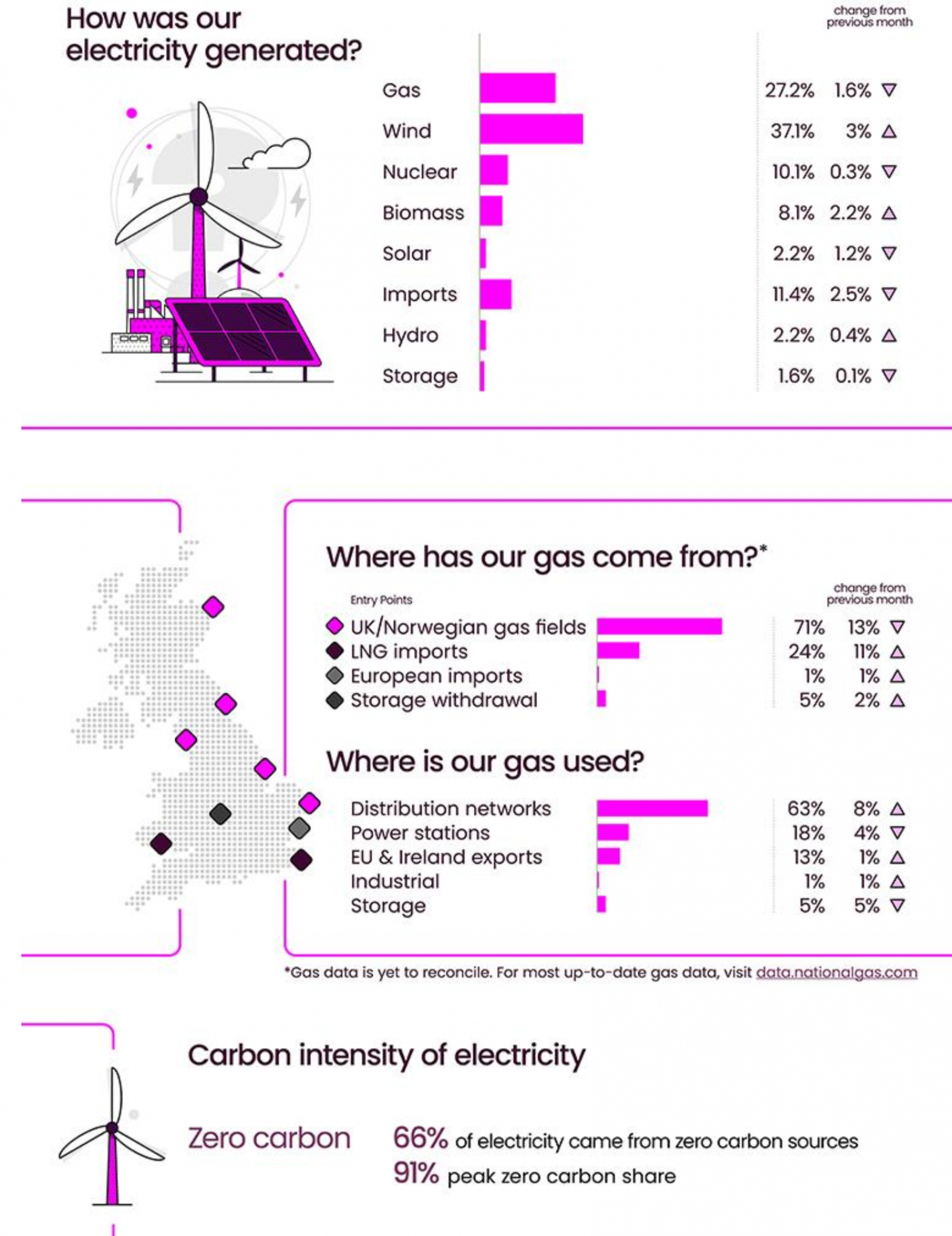
We can see from November 2025’s figures that much of our electricity came from wind power. Gas was the 2nd biggest source still, but nuclear came next in the ranking. Hydro power generates 2.2% of the electricity generated in November 2025. The numbers vary month by month, as you’d expect, solar power comes much higher in the ranking in June, making up nearly 11.9% of the mix rather than 2.2% in November!
Importantly, the Zero Carbon figures demonstrate that the majority of the power in the UK is coming from zero carbon sources (wind, solar, nuclear, and hydro) during November 2025. When it is windy, 91% of the electricity generated comes from renewable sources (at 5am on the 30th November 2025)!
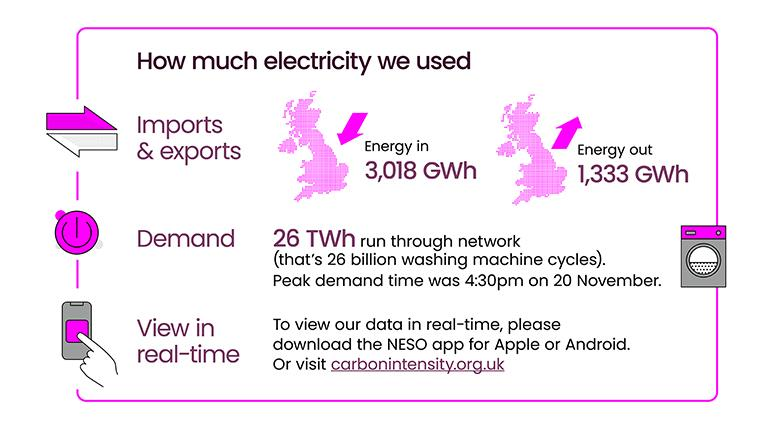
In November, our energy demand was 26TWh with peak demand being at 4:30pm on the 20th November of 43,666 MWh at 16:30, when people get home from school and turn on lights and the kettle.
NESO publish an instaneous carbon insensity map, that can help you work out the source of the generated energy and whether you want to move to using greener power. (NB – to see the map on the web page you need to scroll quite far down the page!)
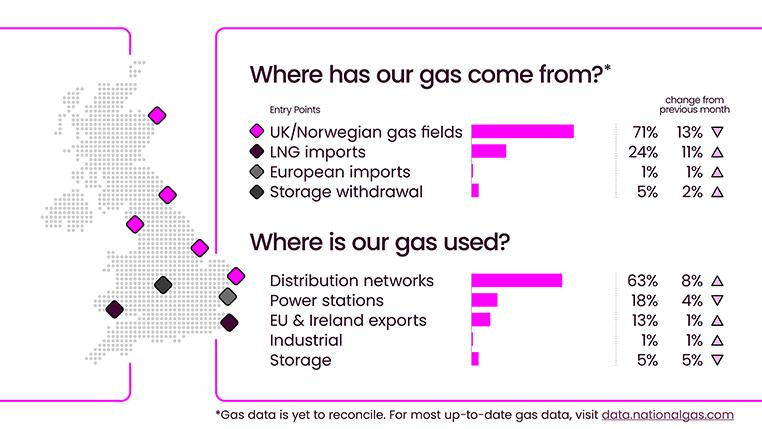
The image above shows how much of the natural gas used in the UK generates electricity or goes into the “Distribution networks” – this is the gas burnt by boilers for hot water and heating purposes, and the sources of that gas. Russia was a major supplier of most of Europe before the Ukraine invasion, that has changed dramatically – those figures would appear under LNG or liquified natural gas imports, America is now the biggest importer of gas to the UK. Stored gas is where cannisters or tanks are used in individual homes.
But let’s get back to our look at where we are in the UK in terms of milestones and records…
Some records broken up to now.
2025 saw Max Solar generation being broken, with 14,023MWh (14GWh) on the 8th July 2025.
The Max Wind power record was broken on the 5th December 2025 and saw the power needs in the UK being met when 23,835 MWh (nearly 24GWh) were generated for a period of 30 minutes.
Carbon Intensity, or how much CO2 is produced for each single kilo-Watt-hour of energy generated, was approx. 177 gCO2/kWh in 2025 compared to approx. 207 gCO2/kWh in 2024. Indeed, on the 15th April 2025 the UK was running with a Carbon Intensity of 19 gCO2/kWh and on the 1st April 2025 we ran for 97.7% with Zero Carbon.
As we move to wind and solar power, we need some background generation to fill the gaps when it is not sunny or windy: cloudy days are often the ones where little wind is available to use to generate power.
Two such sources are nuclear and hydro-power. Nuclear makes up 10-20% of the UK generation mix at any point.
Hydro-power is even less. But water could be a great way to “store” excess solar or wind power. Systems which pump water up to a high reservoir when there is a glut of greener power sources and then release it when the sun has set or the wind has died down is a great way to do this – if you have the time check out this youTube entry talking about pumped storage hydropower (PSH).
Now, one thing you’ve seen me talk about is the efficiency of batteries in terms of round trip – pumped storage hydropower is about 70-80% efficient, so not quite as good as a lithium battery, but the real beauty of the system is in the net zero costs. Water is one thing we have in the UK, it doesn’t need to be mined, and more importantly, PSH can store power for hours of use – 10 hours is not a common duration for such a system. Which is difficult to do with a lithium battery.
Now, where I live in the UK is not ideal for a water dam generating hydro-electricity. But systems could and have been built e.g. Dinorwig Power Station in Snowdonia, Ffestiniog Power Station in Gwynedd, and Cruachan Dam in Scotland. Most of the other hydro-power plants in the UK are river and sea systems.
River sourced hydro-power is the most common type of plant in the UK, like Clachan, utilising a dam across a fast flowing systems of streams into a loch and reservoir in Argyll, Scotland.
Personally, it’s one reason I would love to live by a flowing river. An archimedes screw can be installed providing efficient generation of electricity with little harm to wildlife, like the one on the River Stour, Suffolk rated at 11kWh, it provides a third of the energy used by the National Trust’s Field Studies Centre located at Flatford Mill.
Tidal power is of course open to a little island country like the UK. We have a couple of tidal stream systems (one in Orkney and one in Anglesea) and a dam on the Severn Estuary harnessing tidal range power. Less suspectable to draught than river systems, tidal power gives a predictable fall back position but is much more invasive to the environment than archimedes screws. And expensive – expensive and invasive, not ideal. But the UK is breaking ground in this area, leading the technology across the globe.
Of course, even if we do harness that power, we need to transport it back to homes where people can use it, that hold second paragraph in this article. On Farming Today, 14th December 2025, a home in Northumbria using a diesel generator for its electrical generation was discussing the issues of achieving Net Zero.
Several listeners wrote in asking why not move to using solar power with batteries or at least wind power. The owner of the farm walked jerry cans to the generator because a lorry could not park close enough to the abode to make a delivery! Installing solar cells was not going to be trivial for this family. Also, the chances of supplying enough solar power during the winter to power the house were small, given the get 7 hours 45 minutes of daylight at a hmax of 90°-55°-23.44° ≈ 11.56°. And that’s not mentioning the difficulties of installing said batteries…
Remote locations in England, Northern Ireland, Wales, and Scotland mean that many people do not have access to mains electricity even in the 21st Century. Please consider that is the case for some in your country when you are sitting in your home in a town or city.
Back to the chase, please? How is the UK doing, please?
OK, but I think I’ve demonstrated the UK has some way to go and needs to ensure no-one is left behind. But we’re making in-roads and every step on that journey will help the UK reach its goal in 2030.
Posted: December 31st, 2025 under Driving off the grid.