Main menu:

Site search

Categories

February 2026
M T W T F S S
 1
2345678
9101112131415
16171819202122
232425262728  

Tags

Blogroll

Driving off the grid

The new filling station

Charging our Leaf


To be absolutely honest, we were not seriously looking to buy a car in Nov 2013.  We’d moved into the largest town in our area and found that the journeys I was doing every day were not great for the cars.  I have a 5.4 mile journey to work now and 97% is in a 30mph limit.

In our cars that meant we had a 1.5mile section to get the engine warm before turning it off.  This type of driving is not great for petrol or diesel cars: even with modern cars, this is the hardest driving for the engine that’s possible to do for the average driver.

Logically, then, we were looking at a different vehicle for me.  I’ve never been a fan of hybrids, for me it always seemed a shame that the weight of carrying round an engine, with all that complexity which you are not really able to get the most from: the hybrids are automatic, the electric motor could be used to help acceleration but none of the current vehicles are set-up that way that I’m willing to buy (let’s face it the McLaren P1 and Porche’s 918 Spyder are not within budget).  That’s fine for the average commute, but what about the other types of driving you do?

Electric cars didn’t look any more practical.  The possibilities of the technology were promising but the cars were expensive, range degraded over time and they were odd (at least the ones we were willing to take the risk on…)

So we looked at a Fiat Panda 4×4 from Glyn Hopkin in Ipswich.  Which is also a Nissan garage.  We drove up in a BMW 650i, which is a 361bhp V8 5 litre engine.  We were realistic, we’ve both driven small engined, low powered cars.  But the experience was not great.  Good car, 4×4 drive, etc, but a bit of a culture shock.  Terrific fuel economy but no, what do Renault say, “Vavavoom”.

So, was a Leaf available for a test?  We were expecting no, but there was one and we filled in the test drive forms and took it out.  The Leaf was strange: high torque throughout the driving range, quiet, controllable, reasonable suspension, traditional controls, all round cameras for parking and slow manoeuvring, great satnav, heated seats all round (even the back) and a heated steering wheel.  It had the toys the Panda lacked and the controls were much easier to use than our quirky beamer. Interesting.

We went home and did some homework and thought about it.  Mid-January, I borrowed one for the commute to work.  We have charging points at work, so I had some tests figured out.  What would the commute be like, could I charge it while I worked, would I like it in January?

The first shock after getting back to my house was hitting the first 30mph zone.  I am passionate about 30’s – you have no excuse to break them and you should do everything you can to keep it slow around non-powered road users.  So I am heading up the road, pressing the accelerator as normal and thinking, what am I doing?  It wasn’t 30!  Quick release of the accelerator and I am back to where I should be (thankfully no-one was behind me).  Reasonable engine breaking but then I was in high powered mode.

OK, let’s just get to work. I had borrowed a charging card to allow me to plug it in to charge during the day. Not trivial and being January, it was cold and wet out but I got the plug connected at both the car and the charging end and headed off to do a day’s work. Because I was borrowing the car, I couldn’t make use of the communications technology and check on the progress of the charging, but when I got back at the end of the day, it was fully charged.

I took it home and Jon, my husband, tried it and it looked like a reasonable solution.  So we bought one: actually a Leaf Techna with a 3KW charging harness and a boot liner (seriously, most of the toys where completely standard).  We were exceptionally lucky we my husband’s trade in – if it had been registered 23 days later, it’s VED per annum would have been £480 instead of £220 which meant it was worth more in trade-in.

Our leaf on the day we bought it.

Our Leaf on the day we bought it.

Seven weeks on…

Writing a review after a few miles didn’t seem to offer much benefit, so this is our review having achieved 660 miles between us, charging it in town, charging it round relatives and general use.  My husband also used it to get me to my sinusitis operation mid-February, so it has been used as a family car.

Driving

Mostly we drive in the regenerative braking mode (B-eco) which allows the engine to charge while the driver is not pressing the accelerator pedal.  The weirdest thing when driving is not necessarily the fact you take your foot off the accelerator it stops, but that it doesn’t change gear.  At all.  Which means while the 0-60mph is not impressive, you catch ICE (internal combustion engine) cars off junctions and round-abouts really quickly: they all have a pause while either the driver or the automated gear-box changes gear (obviously there are drivers out there who can do this quicker than the electric car can accelerate, but they are few and far between).

The second thing is how quickly the car is able to go: there is no turning over the engine.  You press “On”, you put the driving mode selector in the direction and mode you want to use and go.  Actually, it has a number of “bongs” it will happily chime if the parking brake is still engined or the driver and/or passengers are not wearing their seatbelts but these are the only noises apart from the radio.  The first few journeys were a bit stilted for that as both of us waited for the car to say it was ready.  You get over that pretty quickly.

The direction mode (for want of a better word as the car has no gears) switch is laid out like a slightly unusual gear automatic stick: you press the centre button to put it in park and move it to the right to choose reverse (right and up) or forward is down, in either drive (mode D) or regenerative drive (mode B).  I get why, this is the convention used for automatics, but it seems very strange that forward isn’t forward and backward isn’t reverse.  My instinct here is that the Leaf doesn’t really feel like a normal car, the dash is more like a computer simulation and few programmer’s would make a joy stick pull backwards to move forward.  Thankfully, you get the hang of it in the first five seconds of driving.

It then has accelerator pedal for the right foot and brake pedals both operated by the left foot.  The brakes can feel very sharp and need only gentle pressure although it does an emergency stop amazingly well.

The parking brake follows American convention and is operated by the left foot.  Again, something we are now completely used to though I wish it had an electronic parking brake – it’s obvious that having a purely mechanical device to holding the car in position is necessary, but it seems a missed opportunity.

The steering is really light (after all there no ICE sitting above the front wheels) and for a car which sits four comfortably the steering feels pretty sharp.  At low speeds it has a camera which builds an image of all around the car as well as either the front or back depending on which direction you are heading.  This is great for parking up next to a charger as the connector is sited at the front of the car.

The past 6 months, I have had chronic sinusitis or been recovering from an operation to alleviate or fix the issue and the Leaf is beautifully quiet.  Getting it when we did meant that when Jon drove me home from the hospital, I didn’t get my usual “journey home after general anaesthetic nausea” – the car doesn’t shake while moving (understandable in an ICE powered car as it generates forward motion by exploding an oil based liquid).  Many new cars cut the engine when stationary, but the shudder when the ICE is running is completely absent and that is such a boon.  Since the operation I haven’t done anything more than a 10 minute drive, but it’s been lovely either as passenger or driver.

Comfort

Some weird things are done to save power.  All the passenger seats are electrically heated as this is more effective than warming the cabin air, but this is a great extra for the back seat.  Climate control is standard.  There’s a power efficient in car entertainment system and LED lights both externally and internally.  The steering wheel is heated.  All to save power.  There are front and back fog lamps, and the setting one down from the automatic headlamps setting is off (which is annoying when it is foggy).

The front seats are manually adjusted, but the mirrors do fold, although only when the car is “switched on”.  There’s no sun roof and the parking brake is very manual.  There are cameras instead of parking sensors (again more energy efficient).  The cameras actually give a top down view too which takes a lot getting used to

The seating position is very high but it is comfortable.

Charging it up and range anxiety

I don’t miss getting petrol.  For most of our use, we get to charge it up most journeys: Waitrose has installed many charging points and there’s one at work (just as I have been either away or working from home).

There was a deal for us to get a charging point fitted for free at home (one of the reasons we didn’t upgrade to the higher power public charger) which gives a full charge from zero in less than five hours.  The thing is, it is not like a petrol station, it doesn’t have to be open and I don’t need a reserve to get to it, so for everyday driving, I typically have more than 50miles charge available to me, including 20 minutes at 70mph.

The first weekend we had the car, we took it 46 miles to see my parents.  Getting there only used 55% of the battery, but being winter, we wanted to make sure we could get home so we charged it at my parents using the AC charger.  In two hours (and two short journeys) the car hadn’t got beyond 55% (it takes longer to charge when cold).  It was going to be touch and go, but a frost was likely, so we didn’t want to wait around too long.  We also reasoned that if we could get within 5 miles of home, we could always pick up the diesel and tow the Leaf home.

We were careful heading home.  It was dark, so dipped and main beam headlamps had to be used, but there are 20 miles of 70mph dual carriage on the route and that meant we had to go at least 50mph on these sections.  The radio was off, but hot air was required to keep the windscreen clear (though the back stayed demisted right from the off).  Everyone was over taking us on the A47, but we held our nerve and reached the A140 with 46% of the battery charge remaining.

Within 15miles from home we hit the 50mph limited dual carriage-way linking the A14 and A140.  It’s a bit of a upward slope (more than I’d appreciated) and we hit the 8% and a range of less than it was going to take to get home.  We took the back route, hitting the A14 at Claydon (most of this road was 40 or 30 mph respectively and I was 10% under the limit in each case).  Thankfully, there were no other cars around so nobody was made to over take us, though it did mean on the 4 miles of 60mph we had to use main beam headlamps.

We reached Norwich Road in Ipswich with only 2% of charge left.  At this point, our route home took us past three petrol stations and none with a charging point.  It was also up hill most of the way home.  We all held our breath (which was good for keeping the windscreen clear without the heater going).  Few cars were about and we didn’t have to wait at any of the junctions (green lights all the way down Norwich Road :)).  We got the big 0% as we were 1.5 miles from home.

We made it, with enough residual charge to get the Leaf in the garage.  But it felt pretty fraught.  We think in practice we could have travelled for another 5 miles as the Leaf is very conservative in its estimation of range, but I’m glad we didn’t need to do that.

Ironically, if we had done the journey on any day but a Sunday, there is a fast charging DC point (0-80% full in 30 minutes) in Norwich at the Nissan garage.  Being a Sunday though, everything was shut.

Of course, with the operation and everything, we haven’t done any thing like this and Nissan do actually include 2 weeks free hire of a petrol/diesel to all Leaf owners.  But I’d have no qualms about doing the Home to Norwich journey on a week day, but unfortunately I have gainful employment.  Heading south to London, there are a stunning number of quick charging points, but in East Anglia there are far fewer.  Waitrose is amazing (every Waitrose seems to have a charge point offering  3KW or 7KW points), but there are not Waitrose’s everywhere.  Nissan have promised to offer free charging at all their dealerships: there are three Nissan dealerships in Suffolk, 1 in Norfolk and 1 in Essex and one in Romford/London.

The DC charges are amazing, the nearest one to us is at a Nissan garage in Colchester (the picture at the top shows the car plugged in), as per zap-map, although not all points are created equal.  It hums while charging, 50KW providing approximately 3% a minute charge.  These points provide their own cable which fits in to a different charging point on the front of the car.  Before you attach the cable to the car, you need to specify either the length of time you wish to perform the charge or a limit on the battery.  As a standard charge, the charging point is set to 80% and if the car has 20% left on the battery that happens in 18 minutes.  Looks wise, the fast chargers look much more like traditional petrol pumps.  The first time I used it, I did need to be walked through the connection procedure, but it is pretty straight forward.

In Suffolk, many charging points are attached to offices.  A great example of this is the Suffolk County Council car park.  This is not used by office staff at the weekend yet there is no access to members of the public (is there a business opportunity here?).

We do a lot of our shopping in Waitrose now.  An hour’s shopping time (and coffee) gives us 20% charge.  Cards are needed, the same Source East ones which are the ones I use at work.

Work has a pod-point too, using the Source East card.  Now I am using the charge point often, it normally works though I do find people use the charge points as normal parking.  If I’m at 15% when I turn up to work at 9am, I am back to 80% by midday.  I do this a couple of times a week.

Home charging point

Home charging point

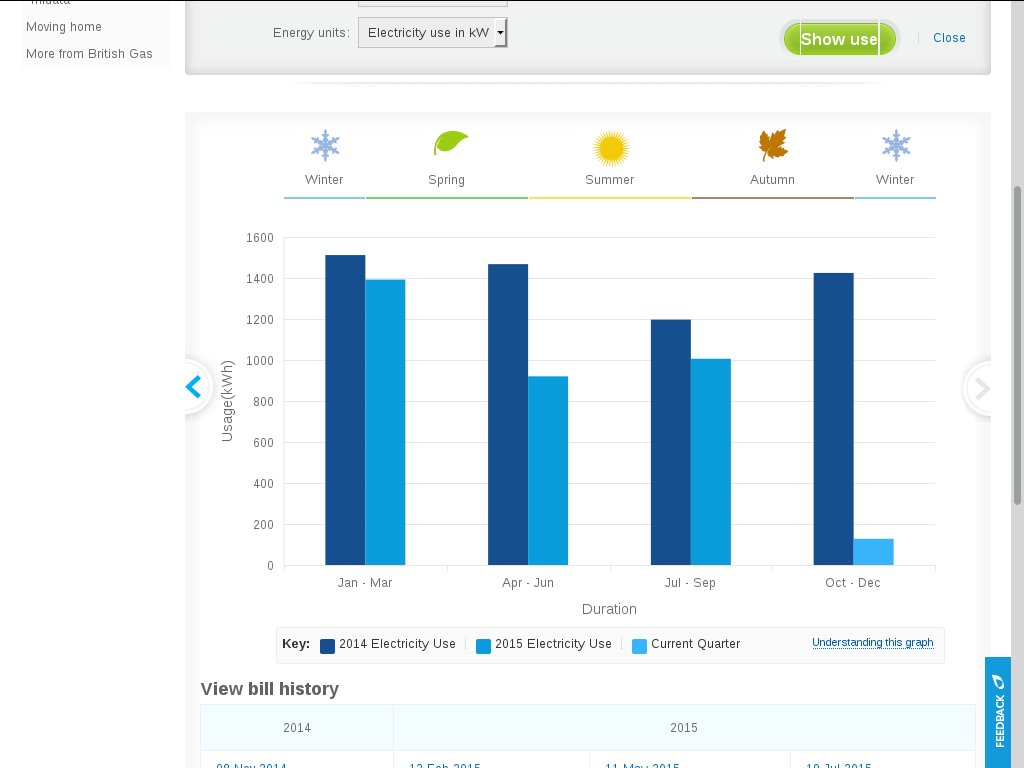
We also charge the car at home with our charging pod installed by British Gas, shown to the left, which has a permanent cable and charges at 16A unlike the normal AC charging cable which charges at 10A.  Either way, a charge from 0%-80% is circa 16 units of electricity, so costs around £2 and takes around 3 hours.

So?

Yes, we like it and we’re happy we have one.  In fact given the power delivery and the economy, I love it.  I don’t know of any diesel or petrol focus sized cars that can give a weeks worth of commuting for less than £2 today.

It’s just different.  I actually find the diesel we also have a bit annoying, having to go somewhere periodically to fill it up.  In the Leaf, the petrol stations on my way home are always busy and I just don’t need to do that with the Leaf.

Shell power

Reused from…

I first learnt to programme on a Commodore C64, and the way I used that computer was through what I now know is a command line interface or CLI.  This interface is a shell between me and the fundamental operating system which allows me, the user, to read data off the storage and put them into the computer’s memory or RAM: when this data forms instructions, this shell allows me to run a programme.

I was taking my first steps in the 1980’s at home.  In the commercial world, Mike Cowlishaw of IBM was producing a language which could be used in a command shell to run other programmes as if a human were using them through the command interface.  This language was called REXX, if you’ve used macros in Excel or Word, REXX was the granddaddy of macro languages because you could run a REXX script outside of the programme and indeed link the output and functions of many programmes together to achieve your goal.  I encountered REXX in 1995, in a port on the Amiga 1200.  That was when I finally moved away from using the mouse as my main interface with computers by preference.

In Windows 7, 2008, 2012 and finally 8, everyone gets use of PowerShell (in various guises) which has this REXX capability.  You have the ability to manipulate programmes in Windows to perform repetitive tasks quickly, easily and safely.  The normal DOS shell lacked this, so it was with interest that I first looked at using Powershell at the recommendation of a friend.

I have successfully used Powershell to get Excel reports out of hundreds of Word documents, convert 100’s of Word, Powerpoint, Visio and Excel documents to other formats (typically png and pdf), complete templates from data held in Excel documents and run testing schedules for web programmes.

It’s very good: multi-threading is built in to get through tasks quickly and I’m not even using it to it’s fill extent.  If you are learning to programme, this may be a useful first step 🙂

:(

The outlook is not good.

In 1993, on the back of a piece of paper I drew what I thought a pump should look like: a motor, a casing and a pen cartridge, some tubing and the cannula.  In 2002, I got my first pump and it looked like that, albeit with a 3ml cartridge instead of a 1.5ml one (which is much, much, much better).  The beauty of using a pen cartridge is that if the pump breaks, I whip the cartridge out and put it into a pen.  I have one set of orders out for spares and day to day living.  Simples!

But the company I bought the pump from sold to Roche and after 12 years, they are dropping the product.  I have tried different pumps but nothing is as nice as the Dtron or as convenient. Especially when it comes to travel and ordering supplies from the GP.

There is a new pump manufacturer out there, the http://www.snappump.com which is built round the pen cartridge.  Not nearly as pretty as mine, but I can put up with ugly for the sake of not having to draw up a cartridge once a week.  I wish they would talk about how the basals are delivered – that is the other nice thing about the Dtron – every 20 minutes I get a tiny amount of insulin…

The king is dead, long live the king

XP dies on the 8th April 2014.  Actually it doesn’t, it’s just that Microsoft is no longer going to support it.

While some made the move back in 2006 to Windows 7, many held back and are now looking going straight from Windows XP to Windows 8.

If you followed the expected path, Windows 7 included a virtual machine enabling old XP programmes to run despite a change of operating system.

Windows 8 does not include this as standard, but you can achieve the same result!

Step 1: download the tool allowing Windows 8 to pretend to be XP.

On the expensive version of Windows 8, this is available as part of the package and can just be installed, otherwise you need to get it from the Microsoft Download Centre at Client hyper-V .  Client hyper-v will allow you to run XP and its programmes while still running Windows 8.

Download then install Client hyper-V.

The rest…

is covered in How to build a new XP VM.

Expectations

We have a family motto: my word is my bond. Mostly ,I think because none of us disrespects anyone enough to lie: treat others as you would have them treat you.
But maybe it gives you unrealistic expectations. Maybe others do not appreciate when they lie.
I recently had a case where I took someone who was in need at their word and gave them a big helping hand. They made three promises when they accepted that help and kept not a single one of them.
When it came to withdraw the favour because they were hurting my property, and ultimately my family, they made a last promise. As of mid-night, they have reneged on that too.
I feel completely let down.
Did I expect too much from someone who claimed to be my friend?

I live in Suffolk, why am I not a member of parliament and unlikely to ever be

I was born in Ipswich, Suffolk in 1973. The year Margaret Thatcher became prime minister, I watched the news with my parents not really understanding why it was such a big deal. Mrs Thatcher was not only a grammar school kid, she was a woman.
If we look at the prime ministers of the past 15 years (Mr Blair came in while I was in my final year of university), the majority have attended independent schools (Eton educated Mr Cameron, Fettes College was Mr Blair alma mater and Mr Brown was a student at the Kirkcaldy High School comprehensive although at the time it had a fast track scheme for the exceptional students like Gordon Brown).
So, I have the comprehensive curse. Suffolk small town comprehensive curse, where having a passion for history and maths did not suggest anything more than accountancy or tax inspector.
I also live in a community where few school girls grow up wanting a serious career and few educated women succeed in the locally run businesses.
I tried to buck that trend by joining a large multi-national but where London, Cardiff, Edinburgh and Glasgow have women in the top teams, that does not happen in Ipswich for my company. Recently I mentioned the fact that only 8% of women earn £40K or more per annum and a couple of my local male work colleagues suggested that women did not want to earn that much.
This is not true.
Neither is the fact that women returning from maternity leave do not wish to have a meaningful career. These two men felt that the majority of women were not interested and in fact many preferred to stay at home.
When I talk to women who did get as far as A levels, this is also not the case but the low wages they are often taking home and on-going commitments mean that many do not see the point. Women earning a lot in Ipswich tend to be GPs or in education which have understood how to retain and progress female career women. It’s beginning to change in my company but it’s taken a long time and having got past child producing age, it does seem to be changing faster.
On my return to work having had my son, my male manager was stunned that I had actually done some meaningful work on my first day back from maternity leave!
In many ways I have been lucky, when I was given an opportunity to run a team that had been run by a man earning £20K more than I was salaried, I did get a solicitor to help me fight to close that pay gap – all the men, many of whom joined the company after me and were operating at the same grade as I was were on a minimum of £7k per annum more than I was getting. Money allows many opportunities, including more time. Out-sourcing means I have more time.
And time is the valuable piece. I travelled 30K miles last year not just for work but for all the commitments including getting my insulin to keep me alive. On average I spend 1 hour a day in the car – I live only 18 miles from work.
So why am I not running for parliament this time round? Well, to be honest, I would love to. I am an engineer with a passion for politics but I have very little support from friends to do this and a woman is a hell of a risk. Possibly a software engineer more than that.
Unlike the men of my age, education and intelligence levels, I have not been encouraged to fast track for my career allowing me the financial cushion to take the risk personally. If I take a year or more off to develop a career in politics, who is to say I would ever get to the same level in industry again?

A flash in the pan?

Facebook - social networking site Google - search engine and services shape YouTube - Web 2 content provider Yahoo - search engine Baidu - search engine Wikipedia - online collaborative encyclopedia Windows Live - search engine Amazon - online merchant qq - chinese search engine twitter - micro blogging site

It happened this Wednesday: Facebook finally took the top spot globally according to alexa.com.

Of course, by the time I write this blog, Google is back up there but what helped Facebook outpace a search engine?  How long before youTube overtakes Google?

Over course, it helps to understand what the top ten sites are: we have 4 web search engines up there, but if you want to find something out quickly that wasn’t necessarily fixed published information, would you use a straight web search engine?

A great example is the use of the global village.  Say I am heading out to Birmingham tomorrow, would I read a weather report or look at the tweets or Facebook reports from friends talking about the commute or school run?  If they haven’t done that, a quick FB message is much more likely to get a response than a txt or email.

Of course the beauty of Twitter is the tweets can be fully public where-as Facebook is still working on that one (if I publish something, who is consuming it today?)

For me, that’s the reason Facebook and Twitter sit in the same company as Google, Yahoo, Windows Live and of course, Baidu.  QQ is a similarly marketed “life portal” as Facebook within China (numbers count).  Google is making headway with Google+ though it is much easier to get a decent smart phone/tablet app for Facebook than Google+ today.  Maybe, today that’s the point – anywhere, anyhow, any time access.

But, what of youTube?

Smart phones, tablets, computers and newer TVs can all consume youTube.  How long before the battle stops being between search engine and social networks but between web and TV?


Which is better, Front Page or Dreamweaver?

I was asked this on Christmas day, much to my amusement. Since 1996 I haven’t used any kind of editor outside of a classroom (you know, where the tutors are insisting you don’t use notepad (actually I prefer Vi as the text editor of my choice and have ported this to most of my computers)).
Back in 1996, I took a course in Virtual Environments and Multimedia at the University of Hull as part of my degree course and at the time Netscape came with a WYSIWYG editor and I did use it, I carried my website around on a floppy so at any computer connected to the internet, I had my links.
But learning about the World Wide Web Consortium (W3C to you and me) and the standardisation of HTML made me look at how Netscape was rendering my HTML.
It was a mess, not as bad as some but I stripped out all the Netscape’isms. It was all done in notepad on a PC and Final Writer on an Amiga: Final Writer had an AREXX port that would verify my links and also render the pages to test.
I had a style I was using but these were defined in the forerunner of cascading style sheets and were easy to find and replace when I wanted to change the look and feel. By the end of 1996, my website fitted on a single floppy including 30 images.
All well and good, but the grounding in HTML meant that when new things came along, I could easily incorporate them. I took CSS (cascading style sheets) under my wing in 1999 and was writing code that could dynamically create webpages back in 1998. (CSS meant this was really easily achieved, a single style sheet for an subsite) and by 1998 my pages did not sit on a single floppy. I even did a javadoc style interface for Oracle Web Server interfaces – 80 functions presented in HTML and used by around 500 people within the company paying for my time.
I had also started to do this at work: data driven quotation tools using Oracle web server, even a data driven style sheet meant that a website generating 1300 page combinations could be restyled in less than five minutes.
innerTube when it came along in 2008 had a similar basis. A library of code driven from a data base. More importantly, moving that to HTML 5 took 30 minutes while testing on the top five browsers to do all 7 sub-sections of my home web site and less than that for the ones I run at work.
There are still differences between them, and there are many more out there than Firefox, IE, Chrome and Safari as tracked by the W3C. I usually like to get users to test pages rather than checking it myself (user acceptance testing at the same time) but if I am seriously trying something new, I use http://browsershots.org/.
Very occasionally I do forget the pain and try to use Front Page or Dreamweaver and they do what they set out to do, create very standard pages quickly and easily – but the post processing necessary to get them to do anything like managing anything about 5 pages is always the let down – who has time for that?
Have you considered using WordPress?

Seasons greetings making a difference to what’s being surfed?

Google - search engine and services shape Facebook - social networking site YouTube - Web 2 content provider Yahoo - search engine Baidu - search engine Wikipedia - online collaborative encyclopedia Windows Live - search engine Amazon - online merchant qq - chinese search engine twitter - micro blogging site

Merry Christmas and Happy New Year.  Surfing habits are not significantly different since April this year, apart from the obvious swap between the positions of Twitter and Amazon. Good news for the on-line trader but is this a seasonal blip?  Would you expect surfing habits to move from the twits to the shops?

Amazon is interesting at the moment for a verity of reasons not least its changes to its virtual desktop offerings.  Amazon, like Google, allows registered users in the USA to get a desktop, storage and services at a moments notice by a pay as you go model.  In late November it upgraded this offering in terms of bangs per buck, with a desktop with much more punch (ready to run a Windows 8 desktop?).

So is it just shopping increasing Amazon’s surfing draw or will this trend continue into the new year?

When I grow up…

From quite early, you are asked what you want to be when you grow up.  I knew I’d go to university from when I was very small but as I grew up that changed from being a medical doctor to a masters in business administration to something with maths and computers.

I basically didn’t know and there wasn’t an obvious thing I could see: I always enjoyed maths but didn’t want to do that for a living and computers were things seriously clever people did otherwise it wasn’t interesting.  I found languages interesting, I did French and German at GCSE, and loved history and geography especially the practical.  I did physics and chemistry because they were interesting at GCSE but again couldn’t see a future for me doing those (though my Chemistry teacher did cry when I didn’t do Chemistry A level, I think my physics teacher cheered!).

So for A levels I choose double Maths and German at school and promptly left to do Economics, Pure Maths and German at college (long story), with still no clue.  I wanted to do computer science but there didn’t seem to be a quick way in – all my programmes had been done at home (let’s face it, the home computer was way better than the green terminals at college and school).

At 18 I left home, travelled 256 miles to do an interview for an apprenticeship with the MOD.  This was no easy option: we had 9 week blocks alternating between placements (in the first year these were highly practical engineering techniques) and academic.  If you failed one of the modules (and there were typically 4-6 subjects from GCSE in the first year to A level standard in the 2 and 3 years) you had one chance to resit otherwise you were asked to leave the job.  I didn’t resit any subject.

It was hard and interesting, on top of our wages we were given money to rent accommodation but we were completely responsible for everything.  I was 18 when I start but some of my colleagues were only just 16.  By the end of the first year, 3 people had dropped out.

I didn’t complete the four years: I sat an extra A level at the end of my third year so I could leave for university.  By comparison, university was a breeze 🙂  I did joint honours computer science and mathematics.  I did OK, although a friend at university complained that it didn’t look like I was working hard because everything was in on time and I didn’t revise like a loon during exam week.

But my apprenticeship was fun, really interesting and I would encourage any one who does not know exactly what they want to be at 16 to consider one.  It’s not a soft option, but a real opportunity.