Main menu:

Site search

Categories

February 2026
M T W T F S S
 1
2345678
9101112131415
16171819202122
232425262728  

Tags

Blogroll

Lighting the way, or why solar just works for us.

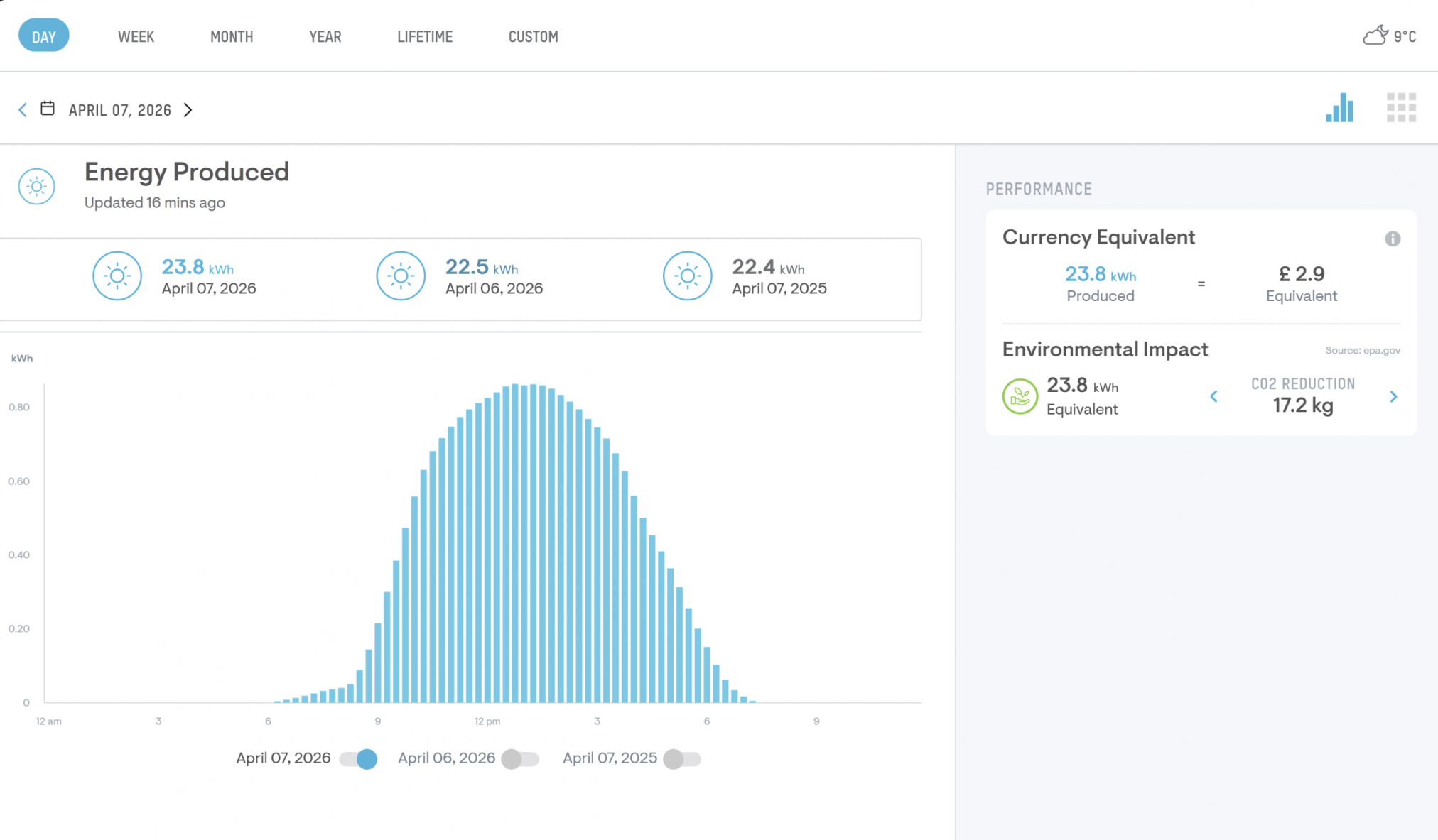
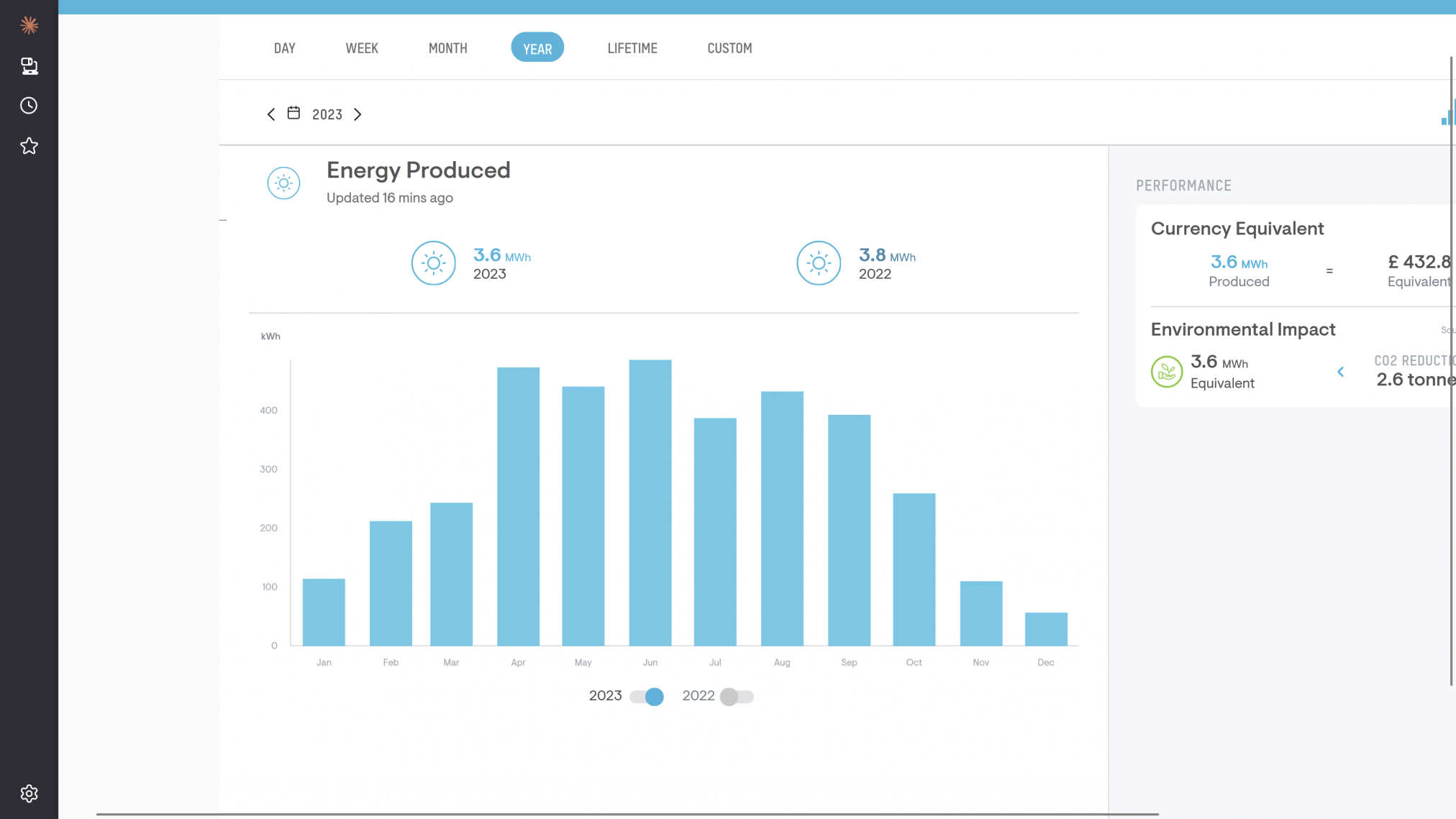
It’s the 2nd weekend of October, and, technically, we did past the milestone earlier in the year of having generated more than the whole of 2024, but we are currently sitting at having generated 3.5MWh off our roof mounted solar panels since 1st January 2025.

It’s the first year we have had batteries in play, so since March 2025, we have had use of 90% of that energy. It doesn’t mean we are off grid, but it should mean we do pay less for what we use as less is coming from the grid. So, is that actually the case?

Up to yesterday (as that how our smart meter reports), we have used 3.85505 MWh from the grid. Plus the 3.5 MWh we generated, that makes our total usage circa (3.9 + .9*3.5) = 7.05 MWh. And that’s before we hit the cold parts of this year.

Now, we’re doing a great deal with our electricity: heating the house, all the hot water we use, and of course, powering the electric vehicle (why this part of the blog is called “Driving off the grid”). 6.9 MWh isn’t too bad and 3.9 MWh off the grid, is pretty remarkable.

The current estimates for people running an EV and a heat pump is between 7 and 12 MWh. We might get to use 10 MWh for the calendar year, if use 2.4 MWh for November and December, as we did last year. The majority of that came from the grid last year, because we only had the one battery, just 100 kWh were provided by our solar cells and our single battery.

I always like to compare this to our gas usage, and for that I need to go back to 2023.

MonthGas usage (MWh)
October 20230.569986
November 20231.657321
December 20232.134510
Total4.361817

So, actually, while the energy use this year seem high for October, for December and November, they seem very reasonable. Of course, we are doing much more with that power. The gas was only keeping us warm and heating our water, not powering our transportation and providing hot meals and lighting and entertainment and clean clothing.

But you would say that, you are generating much of that power yourself!

Up to a point. Going by our general stats from the solar cells over the eleven years we have had them installed, we have had the best of the year. From here on in, the days are getting shorter and the sun is no longer as high in the sky.

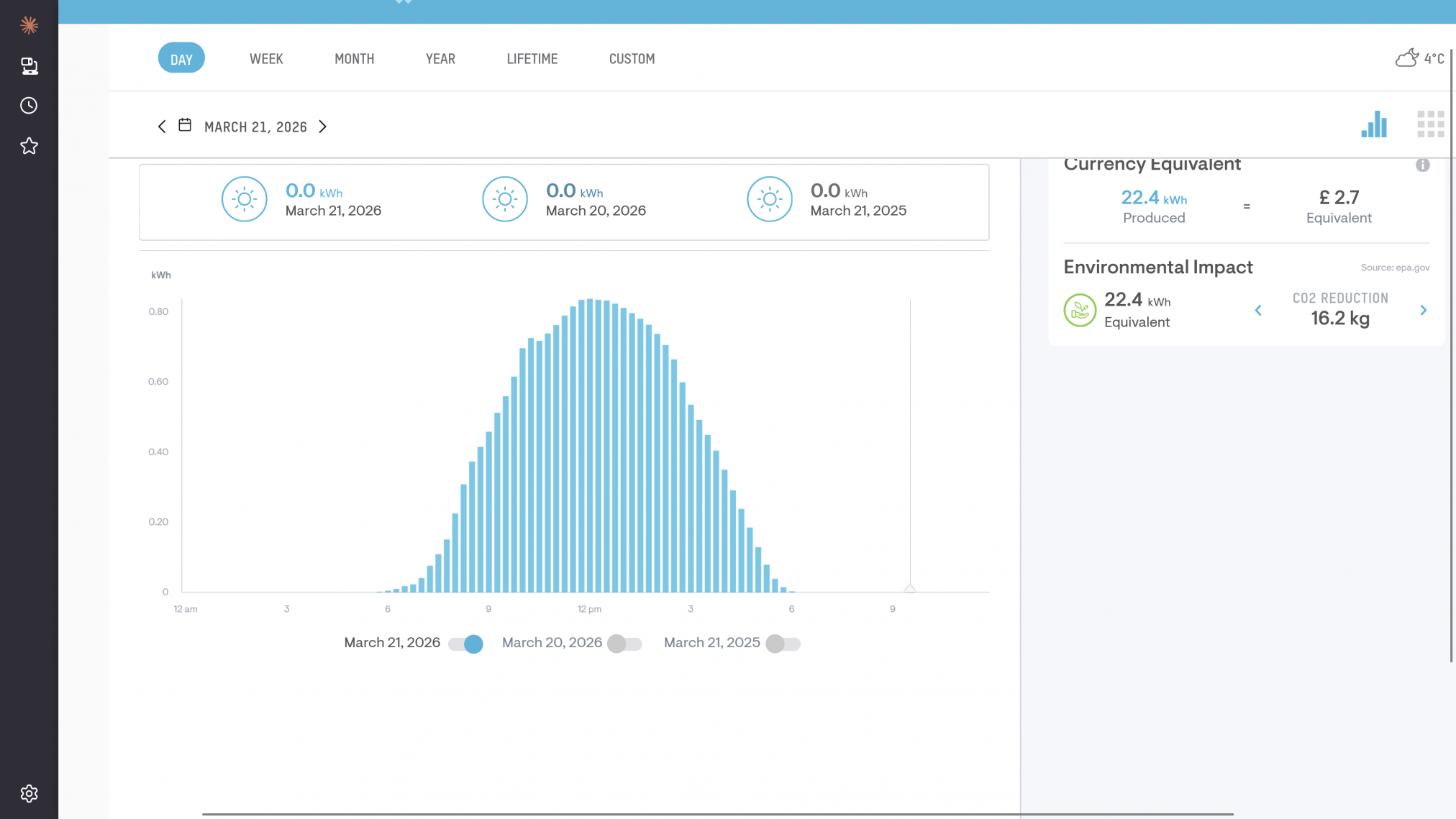
In April, our generation is typically around 350 kWh (0.35 MWh), in October, more like 240 kWh (a good year), November is in the low 100s kWh and December, that figure drops to 50 kWh. (Edit from 14th November – this year came in as 185 kWh! November looks much better so far, and we’ve reached 3.6 MWh for the year.)

With the shortest day of the year, December is definitely the darkest month and the one where we are not getting as much off the roof. January looks more like November and February and October are comparable.

Hence the new triple glazing upstairs to stop our loses through the windows. It should mean we make the most of our heating.

Due to the nature of where we live, April and May are often our best generating months thanks to there being fewer leaves on the trees. We’re not in favour of pruning trees to give us better solar generation, but do enjoy those couple of months when a higher sun, sparser foliage, and cooler temperatures suit us to a tee!

Thank you for the…

insulin, for giving it to me…?

Yesterday was World Diabetes Day (14th November), held during Diabetes Awareness month (November). The reason for the 14th November is because (Dr Fred) Banting was born on the 14th November. (For all those who write raw HTML, be in awe of my dedication to not para-phrase that to save on the HTML mark-up). This year’s theme is “Diabetes and the workplace” because many of us face stigma in the work place, from being in school (honestly, I had some great and shockingly bad experiences at school) and university through to being in work (again both the good and the shockingly bad experiences).

World Diabetes Day is a relatively new thing, established by the World Health Organisation in 1991 to “address the growing threat of diabetes”.

Which is odd because by 1991, the Diabetes Control and Complications Trial was underway which proved that diabetes impacted people did better if their glucose control was closer in range to those who didn’t have type 1 or type 2. Which meant that if your treatment allowed you to optimise control, you could live as long as someone without diabetes.

I term it that way, because it isn’t that simple – I have been given insulin dosages twice in my life – once when I was diagnosed and once when I got my pump – and both times, the expectation was that those starting points would be tuned to suit me.

Some thoughts on that:

  • That english looks strained, because at 4 years old, I was not capable of doing that. My parents had to do that for me. “Never work with children or animals” is twice as impactful when you’re dealing with a child on insulin!
  • Many people have been shocked by that – they felt that I should be tied to a doctor to help me live. They cannot understand that it is down to me.

(And that all ignores the fact my body produces antibodies to the insulin I inject – so after a while, I need a different sort of insulin to keep healthy and that insulin may not be as good as the last one I had, initially, as they all work differently.)

The UK is a bit strange in that respect, thanks to R D Lawrence, a surgeon who was one of the first in the UK to get insulin in 1922. He later went on to found the British Diabetic Association (aka Diabetes UK), but started a diabetes clinic to help people thrive on insulin. He recognised that doctors couldn’t be there 24/7 and help people work out what they needed, so his approach was to teach people how to tune doses themselves. That approach survives to this day. He also helped to get insulin funded for all in the UK, and went on to found the International Diabetes Federation (IDF) to help diabetics across the world.

Lawrence realised really early on that the burden needed to be eased. In 2014, Stanford University published a paper saying that on average a type 1 diabetic makes more than 180 decisions regarding their insulin regime – to me that sounds like an easier day.

And there are days when you cannot get it right because despite continuous (blood) glucose monitoring systems (CGMS), we don’t have all the information on what is going on.

Our bodies are different to each others (no type 1 is the same as any other type 1) but also, physiologically, a type 2 has different levers at play to a type 1 diabetic, even if they are both on insulin. And don’t get me started on type 3cs, who don’t have the safety net of producing their own glucagon.

Yet, we are told we can be seen as lazy if we do not get it perfectly right.

Think about that for a second. Think about the complicated job a diabetic (type 1, 2, or 3c) is doing and then be amazed we ever get it perfectly right, and many of us do. If the insulin and its delivery system (or other medication) is doing what it should do, it is still not a trivial task.

The first insulin pumps were developed in 1960s compared to the 1950s for the heart pacemaker and the 1940s for the kidney dialysis machines. While dialysis machines were widely available in the 1970s, it took another 25 years for insulin pumps to start hitting 2% of those with diabetes. Another twenty years for CGMS to be reliably right often enough to be considered to tweak the insulin basal and bolus, for corrections, as needed. My family does not like me using it and if I do use it, I need to check it doesn’t do something stupid.

While people many thought these early pumps were “automatic”, they needed complex programming to be useful to the users, and that is still the case today. Insulin pumps are not the same as a pacemaker in setting a guiding beat for a heart, or cleaning the blood in the case of a dialysis machine.

Responding to just blood glucose readings (and in our case, these are interpreted results from interstitial fluid) is not enough – in a non-type 1 pancreas, insulin release also impacts how much glucagon is released into the blood stream and the insulin a non-type 1 has only has a half-life of 10 minutes. My subcutaneously absorbed insulin hangs around for 5 hours!

It may not look it, but the average type 1 is doing a lot to keep safe and healthy. Occassionally, those two things may be contradictory. But just because you can’t understand what they are doing and why, please don’t think we’re not doing our best at this moment in time!

Born in the UK

Doesn’t quite have the same ring to it as born in the USA.  But right this moment, I am pretty proud of my little corner of planet Earth.

Go on, I’ll bite, why?

Why, as you can see, right this moment, the electricity hitting my bit of the UK grid is being produced with 0g of CO2!

I am not sure about your feelings on nuclear power, but it is a carbon neutral source, I’m pretty keen.

Our local reactor is a pressurised water fission reactor, Sizewell B. Up to February 2025, it had generated 250 TWh of electricity. But it is still going strong. In the East of England, just at this moment, it makes up 28% of the power on the local grid.

Our bit of the UK has invested heavily in both on and off-shore wind power – that’s causing a little controversy at the moment, because we’re generating more than we can use in our relatively sparsely populated part of England. There’s an idea to put up a cable running over ground to power parts of London and South Essex.

The other generation source on the grid is solar.

As we can see from https://energyguide.org.uk/solar-farms-uk-map/, this part of the UK is not the only one investing in renewable sources of many different kinds, including battery sources. It’s an interesting scene. And an important one, giving the UK independence from gas and oil.

France has been ahead of this game in a number of ways, not least their use of nuclear and wind power. France has a relatively scarce population compared to the UK, and that has allowed wind turbines to be placed on agricultural land, but this is not the only opportunity the UK is wasting.

We have a number of round-abouts in our city. If each one had a wind turbine on it, how many local houses could they supply? Often the round-abouts already have power going to them, so cabling into the grid would be easy. The installations could be done at night, causing little disruption to the traffic flow.

Hey, aren’t wind turbines noisy? Who’d want that on their road?

Can I answer that question in a bit, please? The reason I want to do that is to talk about wind power in general.

Wind turbines are not new, and are a secondary solar source as our wind patterns are governed by the solar radiation hitting our skies.

Unlike solar, though, wind is, potentially, 24 hour in the UK. In Europe, we’ve harnessed wind power for milling and pumping for hundreds of years. It’s more efficient than a internal or external combustion engines, and ideally could achieve 59.3% efficiency (please see Wikipedia’s page on this: wikipedia Wind_turbine ).

Since the 1940s, there have been several common types of turbine used to generate power: VAWT (often Savonius, Giromill, or Darrieus) and HAWT towered.

VAWT stands for vertical-axis wind turbine, which means the sails or blades of the turbine rotate round the axis (think pole) of the tower. These can work at low wind speeds and can be engineered to be relatively quiet in operation. For micro-generation, i.e. where they are mounted on individual roof-tops, these can be reliable, quiet, and self-managing. They are perfect for small installations up to 20kW but do not scale well – there are few that manage more than 20kW.

HAWT means horizontal-axis wind turbine, these are like a child’s toy windmill, there is a body on which the rotors are fixed and that body does the conversion to electricity. The majority of high tension (lots of power) and off-shore wind turbines are of this sort. They can be massive and it is difficult to make these quiet. They can achieve great reliability scores but often need high wind speeds that their VAWT counterparts.

Looking at this intro and the wiki page, this seems much more complicated than just having solar cells and batteries!

Yes, it is much more involved. In urban areas, it’s advisable to check if you need planning permission if looking to put one on your roof, for example.

The returns are much harder to guage too. Wind speed can be disrupted by a variety of sources, whether the trees have leaves on them can dramatically cut the wind power received compared to the values seen during the winter.

Solar is much easier by comparison and really well studied.

“You have been awarded the badge of master bread maker”

I start, along with the confusion of achieving something new, my husband’s tone was “game show announcer” – not something I hear from him very often!

The prompt for this announcement was my own surprise at having finished a packet of yeast before it had gone past it’s best before date – again, my beloved’s observation.

An empty packet of dried yeast
Empty packet of dried yeast

When you work full time, life is pretty hectic. During lockdown, and the great bread and packet mix shortage, it was much more understandable to be in that position, but I never really managed it.

“Of course, life isn’t like a computer game, is it. You don’t get awards for the everyday things.”

Which is so true. But, so far, everyday I wake up warm and safe. I do make decisions about how the day will work for me. I quite like that autonomy.

Being made redundant, I now have a bewildering number of options. A pay out for the incovience (believe me, I’d much rather have the role. I was doing some interesting work on managing risk), means I don’t have to leap blind – a position I have been in a few times in my career, although I have made it work for both parties.

I have a few things to do in the house, and some skills I’d like to brush up on.

Or I could pull my finger out, and write my book and my apps. I’d like to form a not for profit to provide augmented tooling for people with conditions that can be chaotically modelled.

We’re moving to a smart meter, we’re not scared…

Like many, we got the email saying we were getting a smart meter to replace our old meter.

As you know, I’m a big fan of smart meters, giving people the ability to see their usage as they are actually using it. But, I do think it was badly done when it came to energy meters (gas and electricity).

Critical, you, surely not!

Hey, I just have a point of view. I also think the energy companies focused on their needs and not their customer’s. Take our case, if I wanted to see the current, in the moment energy use, I had to go to the meter and have a look.

Which meant no-one else in the house could read that in-home display (IHD).

Now, for many, that is really useful, and I’m not saying they should not have offered IHDs to every household, but it’s worse than that. If I want to compare today’s usage with yesterday’s, I have to use our power provider’s app, and they only publish that about 13 hours after they get the data (on average).

This doesn’t change behaviours and for families, it is a disaster. The IHD can only be read in the house, so if you’ve left for work that day, you can’t see that you’ve left an appliance on until you get home and see how much energy you’ve burnt.

What should have been done, is you should have got the read only login details for your meter so you could access it with your computer or phone or tablet. By all means, do the IHD, but that should have been the basic.

Apps could have appeared for tellys, imagine seeing the amount of energy being consummed on the telly while you’re watching it.

Unfortunately, it doesn’t look like the water meter is going to be any different, it’s much more focused on showing you what you’ve done, not what you’re doing. Which is not how people work.

Ironically, getting live data from the Tesla Powerwall app is making a big difference to the decisions we make about what we run, when and how. That has impacted our behaviour and made a difference.

Well you talk about metering being a good thing anyway: where is your evidence?

Well, I am going to share our usage data. This time much more accurately than I did in my article earlier in the year. (Sorry about that, not sure how I managed to manually transpose the figures from the paper bills so badly).

Again, this has been an irritating process, not least because billing data is not “how water is being used when”, but just pure numbers.

YearUsage per person per day
(litres to 2dp)
2019200.15
2020208.03
2021166.29
2022121.41
2023150.61
2024174.27
2025131.16 (so far)
Our water per person per day against the year.

That’s quite dramatic. What’s happening and why?

Well, 2019 and 2020 were lockdown and we were doing much more cooking, bathing, washing, all at home. Every visit to the toilet was at home.

2022 our son came home, which meant the totals were between three, and actually, things like washing machines and cooking are then divided by three. Washing bodies is higher usage, but if you’re all showering…

Our son left again late 2023, moving into his own place. 2024, we saved money by not doing any holidays. Still a dramatically lower amount than 2020, but not trying hard to save water.

Which we have this year, not least because we were asked to, due to concerns about the weather causing droughts.

We’re not doing badly but the United Nations say that a sustainable level of water usage is 100 litres a day (as a maximum). So we have some way to go.

Much of what we’re doing is in terms of machine usage, harvesting grey water and using it where we can, and just being careful.

Fighting the damp British weather.

It’s a sunny Sunday afternoon in September, which is an great time to air the house!

In historic times, houses breathed – they were cool in the summer, and potentially, freezing in the winter without heating. But, even in the wettest of seasons, the houses were not damp, if the roofs, walls, and windows were sound.

Of course, modern technology has improved our lives in many ways, but houses with great insulating properties can be, well, a bit damp.

So, the question becomes how can we keep the heat in and allow the air to get out?

Duh, buy a dehumidifyer!

This is not a terrible idea, they do work on similar technology to our heat pump – they chill the air passing through the intake and condense the water out of the air, thereby drying it.

I always think this is my preferred way on a day when there is plenty of electricity floating round the grid on a winter’s day. Why? Well, the dehumidifyers create waste heat. On a summer’s day, that can be a little annoying!

Or, if you have an autumn or low humidity winter’s day, open windows. Remember to turn off the heating in the room being dried out, and watch the humidity readings – you are aiming for between 40% and 60%.

Typically, that takes 10 minutes or so. Close the windows when done, and turn the heating back on.

Isn’t prevention better than cure?

Yes, the difficulty in the UK is that we are a damp little island in the north Atlantic ocean that has significant rain fall.

We also have very short periods of daylight during the winter.

Now, I appreciate many will be frustrated as they read this that I haven’t spoken about the vents in modern double glazing units that are designed to keep air moving.

These are not good during our winters, springs, and autumns: they cool your window down allowing condensation to happen, and let damp air in too! Many houses have their radiators under windows, so even worse, you can be venting your hot air straight out of your vents…

The window vents are brilliant during our summers and I have spent this time closing them all down when I finish the airing process. The 1st May is the day I will open them all up.

During the summer, when humidity levels are high, I do not open windows up during day light hours. If you are actively or passively cooling your rooms, this will only let hot air back in! As soon as the sun sets, open up the windows to let hot air escape from the house, taking the moisture with it.

During the summer, while there is plenty of solar power to run a dehumidifyer, the heat generated can aggrevate stuffy and hot rooms.

Again, ideally, you are aiming for that 40% – 60% humidity reading.

Whether winter, spring, summer or autumn, ventillating fans in bathrooms and kitchens are your friends. Outdoor venting ones are the best for keeping things dry: modern versions have dual shutters, allowing some insulation keeping rooms cool or warm as required.

During the winter, such fans can be much more effective that opening windows which can chill a room quickly. Making use of shower squeegees can minimise the use of the fans to being required only while the shower or bath is running water. A rubber blade much like a window squeegee allows you to push water straight down the drain – 5 minutes after every shower or bath can save having to run an extractor fan for 30 minutes or more.

Keeping rooms warm helps prevent condensation on walls and well insulated windows. Roller blinds in bathrooms and kitchens can provide an extra layer to stop water hitting a cold window pane, so drawing the blind not only provides privacy but relief from condenscing water. Try to remember to open the blinds once you’ve finished in the room to give the windows a chance to breathe again.

Isn’t it best to go with a window vac or dehumidifyer during the winter months?

By all means, if humidity is above 55%, consider running a dehumidifyer once a month to bring levels down. But do remember to empty it regularly and make use of the automatic function so that you do not over dry a room, either.

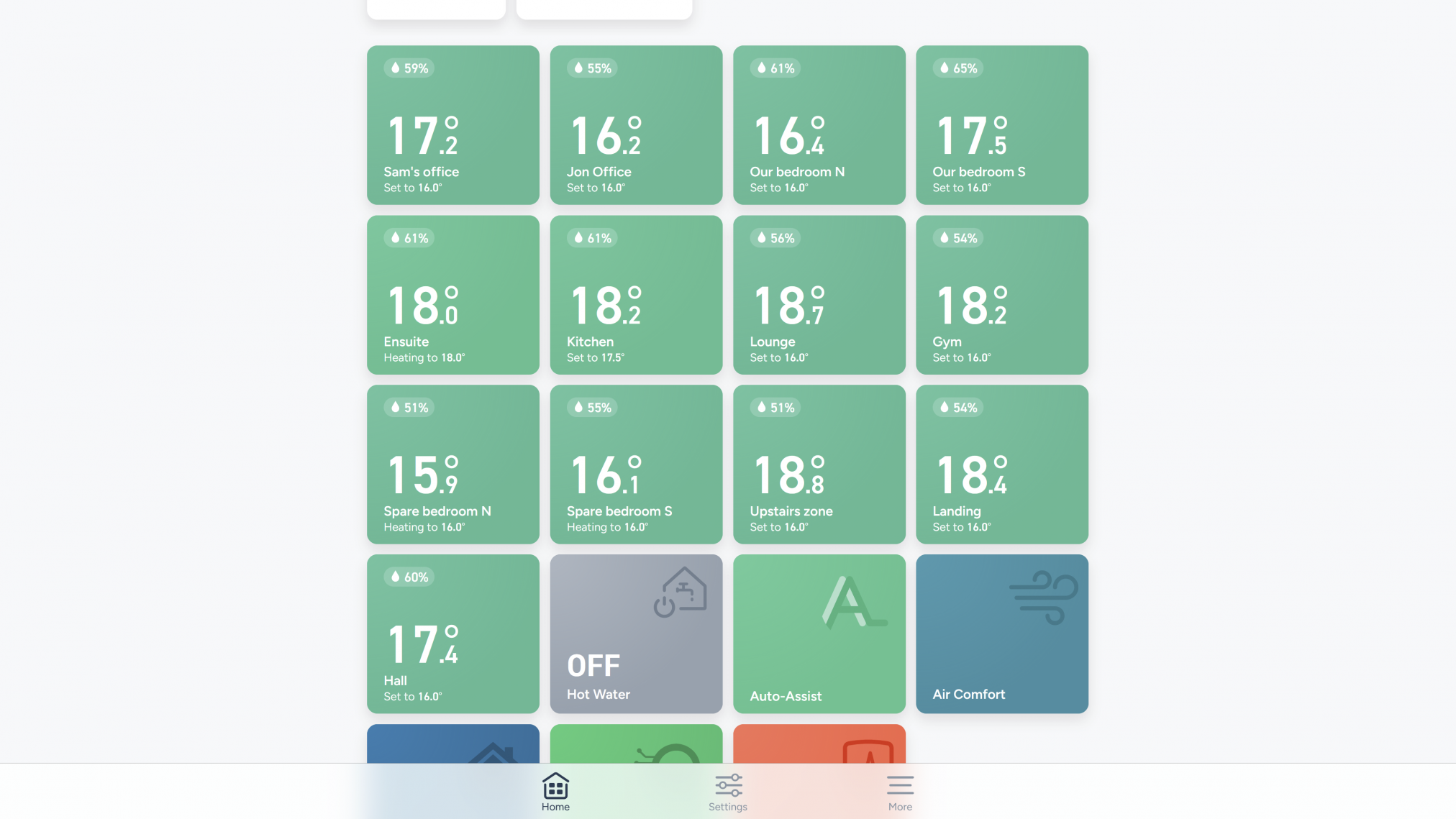
I honestly think prevention is better than cure. So try to find out why rooms are damp to start with – with our house, it was because nothing had been properly allowed to dry after building and some of the windows needed to be recaulked due to warping. Keep rooms warm to ensure air keeps moving also helps. The WHO recommends above 18°C as a minimum during the winter.

When it comes to drying clothes, a tip we took from the back of a daily calendar was to double spin your clothes – most washing machines let you “drain and spin” clothes as a separate function, so everything we plan to dry is double spun.

Low cost pump

This has been inspired by https://www.sciencedirect.com/science/article/pii/S2468067222001201 .

Having funded a pump myself, I appreciate that the pump itself is an expensive piece of kit, but that isn’t where the costs lie. Let me take you through this.

Examination of cost of buying and running a pump.

ItemFrequency of paymentCost over life time.
Pump1xfour years£3,350
Cartridges2 boxes a month, so 10 a year @ £32.25 a go for the four years.£1,290
Infusion sets2 boxes a month, so 11 a year @ 89.90 a go for the four years£3,955.60
Grand totalPrices during 2020. This is almost certainly out of date.£8,595.60

What if we do something different? Take the open source design and gear it towards something that costs less to get going and less to keep running. The trick is the cartridge cost, I feel. If we reuse a mechanism that already existing, preloaded insulin pen cartridges, all we need to do is provide an adapter, which should be a much lower cost.

Item Frequency of payment Cost over life time.
Pump 1xfour years £100
Adapter 2 boxes a month, so 10 a year @ £10 a go for the four years. £100
Infusion sets 2 boxes a month, so 11 a year @ 89.90 a go for the four years £3,955.60
Grand total   £4,155.60

Which is a big difference! The clever thing here is the removal of the cartridge in the design of the open pump source pump. By reusing insulin pen cartridges, we just need an adapter, literally a needle piercing the cartridge and providing an anchor point for the tubing and cannula.

Pen cartridges are available for Lispro (300iu for Admelog, Humalog and Lyumjev), Fiasp (300iu) (a modified aspart), Novorapid (300iu) (aspart), Apidra (300iu) (glulisine).

I’m also keen to swap the mini-USB for a USB C connector. I’m looking to build an app that allows today’s basal to be preloaded through that interface. I think we could use that port to recharge the battery too, which would strengthen the case construction.

Why not use bluetooth for the communication?

Good question, for two reasons: bluetooth is hard to secure, it can be done but it is a broadcast protocol; secondly, I want something that isn’t going to date too quickly. USB C looks good from both points of view. Cables are cheap and it is a common protocol.

Are you allowed to do this?

It’s a good question. I don’t know. Even if I did, it would need testing and refining. One of the big issues with pump therapy is that you can do more damage than good.

So it needs careful examination.

A private person

This may seem like an odd thing to say, given my posts are all about what I/we have done as a family to lower our carbon footprint, but I am a very private person.

Being type 1 diabetic, I don’t feel that that is something I can do easily. It’s a relatively obscure condition for most people. Yes, they know we need insulin (often), but our day to day lives and how we do things are not well known and that leads to some weird conversations.

Here are some myth busting things you might want in your back pocket.

Yes, I wear my insulin pump 24/7. All day, every day. Even my hybrid pump needs me to do things, like give extra insulin when I eat. Or programme in a starting “basal rate” or background insulin programme. It does not run itself, it is not a cure or artifical pancreas.

The rest of my pancreas works just fine, thank you. My beta cells are one of 8 endocrine cells in the pancreas and the rest are working just fine – that’s not the case if I were type 3c.

My pump needs filling with insulin and its insulin cartridges, tubing and cannulas (tubes that go into the skin) all need changing regularly. Yes, it is more suitable for me than injections, no, I am not a bad diabetic and that’s why I have the pump. For me to do what I do with the pump using injections is extremely difficult.

Yes, my pump does get my sensor readings, but only if I allow it do can it do anything based on the readings. No, it does not outperform me in terms of blood glucose control – because it is only reacting to my blood glucose, it can make mind-blowingly bad decisions.

No, I am not ignoring you, I’m just checking stupid, I mean my insulin pump, isn’t making such a decision.

Yes, I do use the automation sometimes, because I do need a break sometimes. No, I do not do that and not check on what it is doing.

Often, when exercising I need more insulin, not less. No, it is not a good idea to do vigorus exercise when my blood sugar is high without having some insulin available – that can lead to diabetic keto-acidosis.

Even if I don’t eat, I still need insulin. There is no food that can as insulin.

Theoretically, I can die from a hypo, but I am much more scared of complications from high blood sugars (hypers). I have been type 1 diabetic for 48 years this year and don’t have any (yet).

No, giving up meat will not “reverse” my diabetes – my autoimmune system destroyed my beta cells. There’s a chance they grow back every so often, but my immune system goes and kills them again, so until anyone can stop that mechanism. I need insulin.

No, going for a keto diet will not remove my need for insulin.

No, doing hours of exercise a week will not remove my need of insulin.

No, I am not “used to it” yet. Despite being four, I remember what it was like to not be diabetic.

Insulin is way better than the alternative.

No, the insulin pump does not give me a treatment that is as good as not being diabetic. But it is better than injections. It is hard work, even a hybrid loop is hard work, much harder than injections – but the results can be better.

No, I can’t take “human” or “animal” insulin any more: the immune system that destroyed my beta cell functionality learnt to attack them too. I’m on my second analogue insulin. I am not sure what happens in 15 years or so if that stops being effective. I guess there’s glulisine…

Yes, I should get more than my insulin for free on prescription. I am really glad that was decided, because while I didn’t understand it when I was younger, I get why that decision was made.

If there was a cure available tomorrow, I would be in the queue to get it.

Yes, I would still test for a while to guarantee that cure was effective.

No, the injections/pump is not the bad thing about being diabetic. The testing, decision making, and being out of ideal range are the things that take their toll.

My glucose sensor is not as accurate as taking capillary blood samples. It can be affected by many different things which can stop it working completely or skew the results. It is a great deal more convienent.

Trying not to teach grandma to suck eggs

I have spent 30 years of my life paying rent: 6 years to landlords and 24 to a bank for a mortgage.

Thankfully, those days are over – we decided to overpay our mortgage once we were off a fixed rate deal because our interest rate had gone from 1.34% to 8.2% – as that was partially what we wanted to do anyway, but partially because we didn’t want to be accuring a large debt just from not paying attention.

Which might sound great, we suddenly had quite a bit of money left in our bank accounts each month but not actually working for us and helping us to retire early. Yes, I know I complained a few blogs ago about my beloved getting old before his time, but I do not want to be going out to work everyday while my beloved is at home on his own.

But what does a budget look like post-mortgage?

Most people use the 50:30:20 rule

  • 50% towards needs: rent/mortgage and living expenses, including property taxes.
  • 30% towards wants: leisure activities, entertainment, etc.
  • 20% towards savings: funding future plans and investments.

Which is what we used to pay off our mortgage early but we were lucky to be earning relatively more than our other outgoings.

Post-mortgage, we can do something more interesting.

  • 38% towards needs: rent/mortgage, working and living expenses, running vehicles for commuting and fun, including property taxes and energy payments.
  • 30% towards wants: leisure activities, entertainment, etc.
  • 32% towards savings: funding future plans and investments.

After-all, we’re not paying rent and can comfortably afford the essentials.

Same for the wants, largely we’re easily self-funding and don’t need anything more. We pay for holidays out of this money too.

Which is all well and good until your world gets turned upside down and you are made redundant. If you are lucky, you will get a pay out, the basic case is statutory or a maximum of 1.5 weeks’ pay for each year of service for each year you worked over the age of 41 years of age capped at 20 years: 30 weeks pay or just over six months pay.

Many firms do voluntary leaver terms (which you must physically accept), which can be up to a year’s pay.

You get £30,000 of that tax free, the rest may take you over your normal tax threshold though, so watch what you do with it.

If you are lucky, the notice period can mean you walk into another role. Or take a break with a comfortable month’s cushion.

But none of these are the same as having a job. For some, it can be the chance for rebirth, a chance to do something different. Some ease back and take on lesser roles, others spring board in to promotions that were hard to realise in their old firms.

Others go and found their own businesses. Sole traders do not need to make nearly as much money for tasks as bigger firms. Famously, a well known musician and programmer in our part of the world, paid for their home using the earnings from a game no-one would buy from them. What bought them a house was considered too small for the gaming firms to buy!

Life is rarely plain sailing, even a small wave can capsize your plans. It’s what you do afterwards that matters.

Our air sourced heat pump’s first service…

Our heat pump is a year old (ASHP, air sourced heat pump).  Its present was a service.

Now, at this point, I remember every annual boiler service being a good £170 plus what-ever parts were needed and the cost of fitting them – largely opaque on the invoice. Last year, when the boiler died, it was barely 13 years, and our plumber thought that was beyond its expected life-span!

The ASHP should last 15-20 years. Transparency is the word here with the invoice we got. From pressure rebalancing to filter replacements, everything was listed and priced. A bit more, £218 including VAT, which is a bit more than a gas boiler service, but it should be something we can budget around.

You mug!

To be honest, we did shop around. Olive Air had a cancellation, so the fact our previous appointment had been cancelled by the other firm meant we got our servicing completed only three days later than planned.

There is far less competition out there for the hearty band of sourced pump service engineers than there is for gas boiler engineers – hopefully that will change over time.

Whatever, I guess it’s your life…

I am really happy with the decision we made to change. Ideally, the house would have been built with it and an air to air system but this is not a bad half-way house.

We also see it as our bit to help reduce the costs of such systems in the long term. 76,000 homes had made use of the Boiler Upgrade Scheme (BUS) by May 2025 and we were one of those homes.

More people in rural areas have made use of the scheme than people in towns – the suspicion is that they have more land and home space to make the move – I have friends in London and Cambridge who don’t have room for a small hot water tank let alone one the size of ours which nestles in our garage.

Rural areas are also much less likely to have mains gas: an air sourced heat pump removes the need for a LPG or oil tank for the boiler. Ironically, the big air pump takes much less space than a big liquid petroleum gas (LPG) or oil tank!

Of course, it is not the only way to move from gas or oil central heating to an electrically powered system. Let’s do a quick summary of what is out there. I am going to talk about efficiencies in terms of x00% – which means for every unit of electricity (1kWh) you put into the systems, how much “heat power” do you get out – 300% efficiency means you get out 3kWh of heat for every 1kWh you “buy”.

Bear in mind, a very efficient gas boiler gives 80% efficiency, or for 1kWh you buy you get 0.8kWh of heat.

Electric storage heaters:

Convert 100% of the electricity into heat. Teamed with an electric immersion heater, this is a very simple way to get heat into your home.

They work by getting warm for a short period then dissipate the heat until the next heating period.

The immersion heater can be powered from solar diverters: when you are generating more solar power than you are using, the solar diverter sends the electrons to the immersion heater rather than a grid – think of it as a water heating battery! We are on our second one.

Traditionally, you would power your heaters from the grid over night and enjoy the heat over the day. If your house is well insulated, or you work from home, this is a great solution, more efficient than a boiler any day of the week.

With home solar power, this is not how to work the system. Get the storage to heat during the day off your solar heat and give off heat once the sun goes down. Free electricity to heat when the sun is shining.

(Ironically, most solar cells work best when it is cold).

Air sourced heat pumps:

With efficiencies of between 300% 400% over the winter, and 600% to 700% over the summer, this is a good option if you have radiators in situ.

They work by using a heat exchanger to take any “heat” out of the input air, and using that to heat either water or air, depending on your heating system type.

If you don’t have radiators in your house already, an air to air system allows you to have hot air pumped through your house during the winter and cold air during the summer. Used a great deal in America, houses are built with vents which allow the air to be pumped through. In the USA and Canada, these systems are called “Heat and air”. It is really unusual in the UK.

Teamed with a well insulated house, an air to water system sends cooler water than a boiler does round the house. Weirdly, you heat for longer in the day but it costs you fair less.

The air pump can also heat stored hot water. During the summer, we have spent very little to have hot showers and lovely baths during the summer where we haven’t used our solar.

People occassionally ask about noise, but even in the rooms near the pump or standing outside by the pump when it is going, it is very quiet.

Water or Ground sourced heat pump:

These work on a similar principle to the air sourced heat pump but use coils of water or another fluid sunk in a body of water or buried in your property’s garden.

Very expensive to put in after the building has been constructed, and may need planning permission.

The efficiencies used to be much higher than any air sourced heat pump, but I think these still out perform an air sourced system in the winter, delivering between 300% and 500% efficiencies. Expensive to buy, cheaper to run.

When the coils need replacing, a ground system can be expensive to do too.

Infrared panel heaters:

Like storage heaters, the efficiencies are not as high as heat pumps but out perform boilers dramatically, at nearly 100%.

Unlike storage heaters and radiators or air vents, infrared panels heat objects, like your walls and you! So long as your home is shielding from wind, that means the produced heat is enjoyed by you and insulation performing a subtly different function.

The panels can be ceiling mounted too, freeing up wall space.

I have friends who did this recently and can confirm, as a guest, I couldn’t tell the difference on a cold December day.

If I was moving into a house which hadn’t had radiators or under floor heating, I would definitely consider this as an option. It could be done as a DIY tasks, too. Here is a quick walk through by a supplier: infrared heaters complete guide top recommendations for 2025.

An immersion heater is then used for hot water.

That’s all well and good, what if I don’t have a water tank for an immersion heater!?

Condensing boiler system do not need to have a hot water tank, and in some homes, that allowed space to be freed up. Going back to having one is not an option for everyone.

So what do you do instead? I’m sure we’ve all seen the restaurants, cafes, and bars which have “instanteous water heaters” for the hot water tap – you don’t have a traditional tap but a box with a dial and there are a few seconds before you get hot water through.

All in all, one thing becomes clear, if you want to make the move, you can.

I would seriously consider whether you generate your own electricity, and if you do, what your appetite is for your total cost of ownership. Heat pumps are not just high purchase and installation costs. Servicing is required for complex machinery.

I am looking at my friends battery, solar, and infrared heaters as a good way to go, potentially done over a long period of time until you can be gas or oil free… the final step would be to get the individual water heaters.