
We’re moving to a smart meter, we’re not scared…
Like many, we got the email saying we were getting a smart meter to replace our old meter.
As you know, I’m a big fan of smart meters, giving people the ability to see their usage as they are actually using it. But, I do think it was badly done when it came to energy meters (gas and electricity).
Critical, you, surely not!
Hey, I just have a point of view. I also think the energy companies focused on their needs and not their customer’s. Take our case, if I wanted to see the current, in the moment energy use, I had to go to the meter and have a look.
Which meant no-one else in the house could read that in-home display (IHD).
Now, for many, that is really useful, and I’m not saying they should not have offered IHDs to every household, but it’s worse than that. If I want to compare today’s usage with yesterday’s, I have to use our power provider’s app, and they only publish that about 13 hours after they get the data (on average).
This doesn’t change behaviours and for families, it is a disaster. The IHD can only be read in the house, so if you’ve left for work that day, you can’t see that you’ve left an appliance on until you get home and see how much energy you’ve burnt.
What should have been done, is you should have got the read only login details for your meter so you could access it with your computer or phone or tablet. By all means, do the IHD, but that should have been the basic.
Apps could have appeared for tellys, imagine seeing the amount of energy being consummed on the telly while you’re watching it.
Unfortunately, it doesn’t look like the water meter is going to be any different, it’s much more focused on showing you what you’ve done, not what you’re doing. Which is not how people work.
Ironically, getting live data from the Tesla Powerwall app is making a big difference to the decisions we make about what we run, when and how. That has impacted our behaviour and made a difference.
Well you talk about metering being a good thing anyway: where is your evidence?
Well, I am going to share our usage data. This time much more accurately than I did in my article earlier in the year. (Sorry about that, not sure how I managed to manually transpose the figures from the paper bills so badly).
Again, this has been an irritating process, not least because billing data is not “how water is being used when”, but just pure numbers.
| Year | Usage per person per day (litres to 2dp) |
| 2019 | 200.15 |
| 2020 | 208.03 |
| 2021 | 166.29 |
| 2022 | 121.41 |
| 2023 | 150.61 |
| 2024 | 174.27 |
| 2025 | 131.16 (so far) |
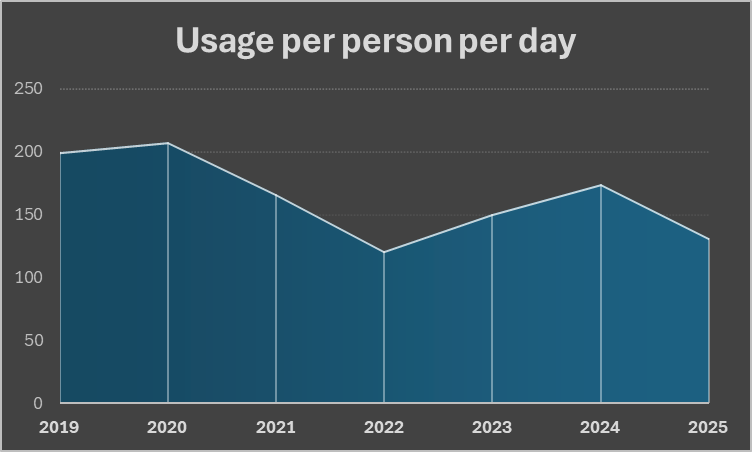
That’s quite dramatic. What’s happening and why?
Well, 2019 and 2020 were lockdown and we were doing much more cooking, bathing, washing, all at home. Every visit to the toilet was at home.
2022 our son came home, which meant the totals were between three, and actually, things like washing machines and cooking are then divided by three. Washing bodies is higher usage, but if you’re all showering…
Our son left again late 2023, moving into his own place. 2024, we saved money by not doing any holidays. Still a dramatically lower amount than 2020, but not trying hard to save water.
Which we have this year, not least because we were asked to, due to concerns about the weather causing droughts.
We’re not doing badly but the United Nations say that a sustainable level of water usage is 100 litres a day (as a maximum). So we have some way to go.
Much of what we’re doing is in terms of machine usage, harvesting grey water and using it where we can, and just being careful.
Posted: October 25th, 2025 under Driving off the grid.