I am sitting in the warm, drinking a cup of tea enjoying the beauty that is winter sun being harvested by the solar panels dreaming of skiing.
Not eco-friendly at all
I do two terrible things when it comes to the environment: I ski and I have baths. How are these terrible? Well, even if you drive, I live at sea level pretty much and mountains to do alpine skiing are anything but at sea level so energy is needed to transport me and what-ever I am taking to ski, up said mountains.
I never set out to ski. I watched Ski Sunday on the BBC with my folks and thought these intripid people were slightly mad. It looks fun but it’s cold, it’s a hard landing if you get it wrong, and growing up in East Anglia, a mad world away from my day to day.
Then I met my husband, who was a good skier. He learnt as an adult, it was easy once you learnt, he promised me, learning is the difficult bit.
So, I learnt. In East Anglia, I learnt to snow plough (also called wedge skiing) and basic parallel techniques. I have to say, it’s everything I love in a pasttime: it is completely absorbing and you get to travel fast. The clothing does a lot to make harsh conditions tolerable while expending energy. The people doing it are friendly and chatty. The views are incrediable.
There is just one thing I don’t like.
The whole being high up thing. I am someone who does not gamble about on the top of a mountain and think yipee, isn’t this great. It frightens me. I would never dream of climbing up a mountain in the warm and dry. Yet, with a pair of planks on my feet, I willingly do this. I get winched up on a drag lift (does what it says on the tin), or carried serenely up a cabin lift and have that moment.
Or that moment may hit me half way down.
Which wouldn’t be so bad, but I freeze.
Now, I can ski, you’d think that would give me a great deal of confidence, maybe even, a little elan. No, when the fear grips, I turn rigid. Medusa is hitting me from thousands of years ago.
So why do it? Well, I do like everything else about it. I do like visiting places I’ve never been before, I do like being in the mountains. It is an amazing feeling being on top of the visible world. Some trips I don’t get the fear, and it’s just fun. Who knows how long I will be able to do that, from a climate, health, and age point of view?
I’ve had a Tandem T-slim pump since January and not had a great deal of success running the “closed loop” (there are so many wrong things about that statement, that yes, I have put it in quotes, more about that later).
Coming up to my 45th diaversary, I am kinda familiar with what I need to do to ensure that part of my endocrine is doing what’s needed to keep me alive today and in the future without too much bother.
Anyway, my son believes this is “my worst pump ever” and being 22, he is quite aware of this. I got my first pump just before he was 1.
Back to the reason for this post…
There is a reason?
Yes! I have tried with letting the pump make adjustments but it’s not been very successful. I have key parts of my day (the daily commute for instance) where my blood glucose goal is a little higher than normal – 5.5 compared to 4.7mmol/l. I am sure there are some type 1 diabetics out there going “that’s low” but actually, it gives me a little wiggle room, a chance to play with a short term temporary basal rate or just have a cup of coffee to raise my levels a little if I need to. The beauty of a pump is it should allow that and, to be honest with you, that’s what I was hoping for from the Tandem Control-IQ software.
Unlike some systems, it is a self-contained unit and has some “learning capability” so it should learn what works. Unfortunately, when it came, my carefully set parameters were ignored when it was running the show – it wanted me at 6.5mmol/l. Which means I cannot sleep very easily because that is not where I feel safe. (Again, there may be type 1 diabetics out there gasping in shock, but after 21 years on the pump, I feel really quite high (hyperglycemic not, you know, tripping) if I run a that level.
Plus, it isn’t what non-diabetics do. They run much, much lower, which again was a shock when I bought a sensor for my husband to wear for 14 days.
Anyway, back to the piece. Running at 6.5mmol/l does have it’s advantages at times – the daily commute, running about at work, etc. Only to achieve that, the Tandem is very keen to stop my basal rate completely… Making me high and swinging much more than I had with my old pump: “worst pump ever” isn’t a terribly inappropriate way of looking at it.
Then there was the learning – out of the blue, it gave me 6 units of insulin as a “correction dose” which would have been a good move the day before but as my period had just started, caused an unexpected and fast on-coming hypo (glycemia). That wasn’t a fun day at all.
So, I turned off the loop for the majority of the time but especially during the night. I was tired (literally) of waking up with a blood sugar of 9mmol/l at 2am because the pump had turned off my insulin just when I needed it.
Six weeks ago, an update for the pump’s software came along and I have been re-experimenting (well, what would you call it?) with the pump.
And it seems to be working. This is the 5 day I’ve been running the loop (over night as well) and it seems to be doing a much better job. Over course, one thing I did make an effort on was getting my basals perfect, but it seems to be doing reasonable things much more consistently. It’s not perfect: there are odd occassions where I’m still calling it “Stoopid” but these are much rarer.
It actually feels like it’s workable. Of course, it cannot tell when to change my basal rates, but if the basals are good, it seems less keen on shutting down my insulin indefinitely.
What is it “closed loop”?
Pancreatic transplants are very tricky to get to last more than 5 years, so one of the ways being investigated for long term treatment is hybrid loop insulin pumps – the Tandem T-Slim is one such offering.
One of my big complaints about these and the way they are used, is they want users to ditch their hard won basals and start from scratch. As a type 1 diabetic, I think that’s naive and missing the point – I know far more about what’s going on that something looking at just my basal rate, last active boluses, and my blood glucose reading which is how all these pumps work.
I know, for example, that on a Sunday I don’t bother bolusing for breakfast if it’s my turn to cook Sunday lunch – I am running around the kitchen so much that doing my normal bolus will make me hypo about 45 minutes after I take the extra insulin to cover my yoghurt. I know if the temperature is 16° instead of 20° I am likely to need less insulin. I do this by switching basal rates not putting in temporary basal after temporary basal.
Until these pumps take our knowledge and needs into consideration, they are unlikely to be as good as their users for anything but shutting off much needed insulin. Maybe the new software for the T-Slim has finally figured that out.
It’s easy to say that Saturday is our going and and getting things done day but today, I am doing something a little different.
Having recharged my batteries last night and looking out at a beautiful, and sunny, Saturday morning, my stomach is begining to wake up and ask: what’s going on?
I made pasta on my day off last week, so instead, I’m looking at some experimenting – although based on learnings from the internet.
Microwaving sausages for lunch is my quest. Instead of heating up the oven, grill or frying pan, I am considering using the microwave. Now, I haven’t eaten a microwave sausage since my dad did them back in the early 1980s, but of course things have come a long way since then. So, I am very tempted. The Americans seem to be the ground breakers here though many of their recipes specify 800W as a high setting and my zapper is a 1000W on high and 600W on medium. A bit of a risk then…
I had to seek out advice from the internet as my microwave’s cooking tables say to grill or grill and microwave (sometimes called turbo grill). Both of these would take 10-12 minutes and use a lot of power as a result, about 320Wh or 0.32 unit.
Purely microwaving should take about 2 minutes and use less than 33Wh of power, or 0.033 unit. If we’re using 32p per unit, that’s a cost of 1p.
So why isn’t the microwave book pushing microwave sausages on us? Well, our tastes say we like sausages dark brown in colour and that doesn’t really happen in the microwave. It will be cooked, but a little different.
For you, I am willing to try. My dish will be onion gravy, microwaved frozen veg, microwaved baked potato, and two microwaved sausages. A feast.
Now, the microwave isn’t that easy to do many foods at the same time, so I’m cooking the potato, then doing the other two things in the microwave. The gravy will be done on an induction hob: and I’ve got a smart meter to measure what I’m using – although the reason this is published today is because I can’t really see that information until afterwards…
You’ve kept me waiting a day, how was it?
I’ve got to say, it was a little bit nerve wracking working it out on the fly, but as you can see, raw cold or frozen food went in, a tasty and quick meal came out. The potato was 190g and took 7 minutes 20 seconds, the veg took 1 minute, the sausages 2 minutes 10 seconds. I did them all on high, so that’s about 0.175 units of electricity, so guessing about 5p – according to the smart meter readings, running the hob for the gravy, lighting to cook and eat, extractor van, and microwave cost 16p or there abouts.
Raw sausages
Cooked sausages 2minutes 20 seconds later!
A completely cooked meal on a warm plate
The texture was fine, I think compared to what I was expecting, the sauages where more appealing than I was expecting, but maybe I had very low expectations. The taste was great. If I had my time over, I wouldn’t have started the onion gravy before the baked potato which would have made it a little easier.
A quick and easy meal for one. All the cooking utensiles go in the dishwasher apart from the pan for the gravy. I even had a hot plate to eat off as I popped that into the microwave with the veggies.
Here is the evidence of a nearly finished but enjoyed meal:
It’s Friday and as you can see from Tuesday’s post, I have worked a short week. So, why am I feeling so weary? I’m not sleepy, I am exhausted. My head injury from 5 years ago is painfully aching.
Lightweight, huh? Since I can remember, the end of the working day, exaggerated to the extreme for the end of the week, I just die.
My insulin requirements drop dramatically: between 4 and 6 I am on a tiny amount of insulin and doing anything but sitting or lying down results in a hypo.
Which is a shame – as a teenager and twenty-something, Friday is the night you go out. I love Saturday but Friday, I just want to sleep.
Working is difficult, so I use this time to either have interesting conversations (which always perks me up) or to train. Listening to https://thesafeplace.podbean.com/ is brilliant.
I know when people look at me, they do not see a type 1 diabetic who isn’t thriving but like anyone with type 1, it’s hard work. A full time job and then I do a brilliant and interesting technical role for my day job and a volunteer role looking at diversity, equity, and inclusion. Equity not equality. We’re not all equal, different things are needed by different things to enable that individual to thrive.
No wonder you’re exhausted!
Like many disabled people, I have had times in my life where I couldn’t do anything. I do like to be busy.
Friday afternoon, that means I do nothing critical, nothing more than letting my mind unwind and expand.
In an effort to get through my annual leave allowence, I booked today as leave last Friday with the aim of having a very lazy day.
Of course, that supposed that I’d manage to do all my chores last week and the two people I lived with hadn’t both had yesterday off as a sick day due to an awful cold.
I woke up this morning with a bad head cold. Lazy day it was to be then.
Only, having a bath helped drain much of the mucus. So, putting my new found energy to good use I used some old eggs in the fridge along with some salmon that had to be eaten and cooked my favourite salmon kedgeree. Mmm. We energised me even more.
I cleaned up the mess cooking always seems to cause and thought about the evening meal. Did a load of washing and the resulting ironing and set the microwave off on its cleaning programme (only four weeks to Christmas, getting these jobs out of the way now helps) and made use of the little bit of solar we we’re producing.
Emptied the recycling bin indoors to notice just how many leaves had come down since anyone had swept them up. Did that for 45 minutes.
Now I’m just writing this, reading my book (30% done today), and waiting to start making fettucine for a bolognese tonight and who knows what over the next couple of weeks.
Looking forward to a relaxing day in the office tomorrow…
I’m trying to avoid the news at the moment. Not because of an osterich type of mind, hide your head and nothing bad is happening – “ta deda tee dah” – but more because I don’t want to make things worse.
What do I mean? Well, at the moment, I am pretty lucky. Everyone in the household is earning and we are all salaried above minimum wage. We have a small amount of debt in the house (a mortgage), which we fixed at 1.22% until next year. We have some savings so if one of us loses our job, we don’t even need to sacrifice our standard of living. The energy rises have not really hurt us.
The trouble is, I have the same feeling of dread at the moment as I would if things were very different. I have been in the position where my rent has suddenly sky-rocketed, bills hurt and heavily dependent on the next pay check.
My mum is having a big clear out and it’s all I can do not to say don’t get rid of that mum, I’ll have it. I quite literally don’t need anything. I’m even fixing up old appliances rather than buy new ones and I have a lovely car – maintaining that is so much cheaper than buying even a second hand one.
In the back of my mind is my dad’s old adage about not having investments while you have debt. Settle the debt then play – if you invest the money for the mortgage and the investment goes sour, you can well find yourself homeless. Pay the debt first.
So, that’s what I’m doing. Our interest rate is low, so I am putting spare money there. It’s great on many levels as it means we’re saving interest on that big debt and we therefore save tax. When we come off the fixed rate, we should (fingers crossed) only have 2 or 3 years of debt left, even if the interest rates go above 15%.
Hopefully, they won’t. But I do remember seeing mortgages advertised for 19% as an apprentice in 1993!
But things don’t actually look at all that bad?
If I’m feeling this way and not being frivolous, who else is? What is the impact of that?
Inflation is not actually a bad thing per se, it depends on the causes. The items that are costing significantly more aren’t things that take up much of my take home paycheck. I had reduced my energy usage over the past 10 years, so we’re cushioned from that. I don’t drive far with the cars, so that’s not a huge cost. Because of lockdown, we are out of the habit of going out – we have a nice house, so it is far from a necessity.
Due to the hot summer, some foods are scarce and/or expensive, but again, not a huge impact for us.
We’ve got all the essential work done on the house and the vehicles. We have a deal not to waste money on gifts on the upcoming season, though Christmas dinner is a bit of a splurge, all round. If it’s a sunny day, well…
It’s tempting to hide away and not spend until it’s all got better. Of course, if everyone does that, we have no growth. Retail and manufacturing all suffer, leading to job losses.
Let’s look at our household budget again… And avoid the news…
We’re doing a little renovation (replacing the stair and landing carpet) and remodelling (moving my husband’s office upstairs) which has allowed me access to that room’s thermostat.
The self-builders we bought from put underfloor heating downstairs with individual room thermostats – really old, mechanical, set the temperature but no other functionality, type room thermostats and I have discussed swapping most of them out with first Heatmiser wifi programmable ones and those with Tado wired thermostats.
My husband’s office was the last hold-out. He’d opted for a programmable Heatmiser one, though not wifi programmable as “keeping the room cool is the biggest issue”!
Recovering some photos of doing the previous swaps meant that the job was completed in fairly short order. Pairing the room highlighted the fact we now have 13 of these devices or smart radiator valves in situ in the house. Lucky for us…
Which led to a conversation with my mum. She is currently living off-grid using an oil fired boiler for her central heating. I was going through the humidity sensor and the proximity features of the Tado system but found one of the radiators had detected an open window, so had shut the heating off in that room temporarily until the window was closed.
“How does it know that?” she asked. No idea, but it’s pretty reliable at getting it right and I love the feature. I think she may be considering the upgrade in her place.
Many words for little action
Cheeky, it’s only Saturday.
The last bit of DIY today, apart from this blog, was replacing a 30-year-old cable on my food processor. I was a little nervous about doing this but the internet really is a wonderful thing.
I find videos hard to follow, way too noisy. Thankfully, some-one had written down the steps: locating the right cable from our local electrical store (a simple 2 core 5 amp or “lamp” cable), I removed the old cable and put in a fresh new one. A 20 minute job and my mixer is back in reliable working order.
As I sit here, in my comfy home, lit by LED bulbs, lightly heated by timed, thermostatic controls, I’m thanking my efforts over the past 10 years to make my house as energy efficient as possible.
I was lucky in that we wanted to change energy supplier relatively shortly after moving into our current home in 2013. Our first electricity bill was over £100 for just under 31 days of usage. It was the largest electricity bill I’d had for a May (the date was the 6th June, the bill ran from 2nd May 2013 to the 1st June) and I couldn’t understand what we were doing wrong. I sat down and looked up at the ceiling and rushed to switch off the lights – I was looking at 8 brightly shining 50W bulbs lit above my head or 400W of power being spent every second. Hey, I thought (or words to that effect), that’s no longer happening.
I knew LED bulbs were coming so wondered up the road to our local store and bought 8 LED GU10s rated at 6W each instead of 50W – a saving of 88% though it cost (at the time) more than £130 – the plan was for each lighting ring in the kitchen to be done each month and by September, 8 bulbs were only £95 – we had enough 50W bulbs to use 1.5kW an hour and we reduced that to 150W. And then looked at every bulb in the house. The lowest rated ones were in the kitchen.
In that first weekend, I had reduced our consumption by 5kW and spent less than £100 doing that (excluding the kitchen). By the end of September, we had saved over 13kW just from lighting. The outside lights were up to 600W each, fluroscents in the garage, another 400W!
I looked at everything, the heating controls, the insulation, the curtaining. I didn’t do the work in one go – a big and expensive task, but broke it into small, timely jobs for weekends. Venetian blinds were swapped for curtains and thermal blackout blinds, starting in the bedrooms where they’d give the most benefit. Manual thermostats were swapped for wifi controlled timed ones. Holiday mode was used when we were away, summer programmes were subtly different to winter ones.
I use the microwave when I can – I am a big fan of microwave roast dinners for a fraction of the cost of a traditionally cooked roast chicken. Teamed with peak generation from our solar cells means we can cook for free and donate electricity to the grid for others to use <3.
The hob was eventually swapped for an induction one. The convection cooker for a significantly more efficient one.
One big step was the adoption of the smart meter in 2015. Like the electric vehicle, I don’t really understand why these haven’t been taken up more widely. During the summer, I time the cooking to coincide with the sun generating the most electricity and now that’s teamed that with the vehicle to grid, and our electricity bills are not only zero but paying for most of our gas use.
According to https://www.bbc.co.uk/news/business-63483668, people with smart meters can take part in a new scheme to help ensure we reduce the reliance on burning gas and coal – critical as gas supplies have been made prohibatively expensive by Vladimir Putin and his campaign on the Ukranian people.
This builds on the https://carbonintensity.org.uk/ which highlights when there is a glut of renewable energy on the grid against times of greatest use. We’ve been collating (and sharing) this data in the UK for a while now and canny people can use it to help reduce our carbon footprints. This allows them to capitalise on that saving through cold, hard cash.
Now, even during the summer, between 4pm and 7pm, there is a big draw on electricity in the UK. During the winter, that’s exacerbated by needing to turn on lights for the journey home and moving about darkened houses. By using microwaves and induction hobs instead of gas and electric convection ovens, we can reduce power usage dramatically. Don’t have a hot drink on turning up home in your car – instead use a flask for water boiled at lunchtime and wait a bit for that hot drink.
I hear many people talk about having batteries but there are some simpler ways of making the most of solar energy during the winter. Traditional storage heaters worked by warming “bricks” during the night time to give heat out during the day – flip that technology to solar heating and solar voltaics, and your house can be giving out heat as you walk through the door from work or school from energy stored at lunch time when there’s a glut of power from solar sources. For a much lower cost than installing a heat pump or solar thermal heaters…
As is my wont on a Sunday, I’m drinking a hot cup of Earl Grey (black), watching the leaves drop from the trees (it is October in the UK), putting off my set of chores. I’ve been doing this for the past 24 hours, like most weekends, and the grey sky outside is not inspiring me to do anything else at the moment.
Excitingly, we’re moving my husband’s office upstairs which means the last thermostat in the house can be swapped out to a Tado one. It’s quite the reno (to borrow the Property Brothers’ parlance) with a Study bed becoming my husband’s new desk and collapsing a wardrobe in the old spare room up to the attic ready for my son to move out.
We’re big believers in reusing furniture. There’s a 4-6 seater dining table and chairs, a futon sofa bed, a double bed, 2 wardrobes, some flat pack chests of drawers all waiting to go.
What we’ll have left is my husband’s old desk which will move out to the landing to make a hoby desk for me. My sewing machine and all the tools and gadgets will nest in bedside tables ready to spring into action when we need something. The landing cupboard holds the ironing board and a handy socket will allow me to press fabric quickly and easily rather than squeeze in to the lounge and set up temporarily there and need to immediately clear away.
The old office will house the futon as an extra spare room and the gym equipment we bought for lock down. A spare monitor will have the Wii fit plugged in ready to go and that will all mean we have a slouchy, gymy area downstairs that can flex if we need it to.
Sundays, time to dream, drink tea, put off chores, and cower from the drizzle. Have fun with yours :).
No! Electricity and gas prices went up this month – we were away when this happened, which made it a little more surprising than it perhaps should have been.
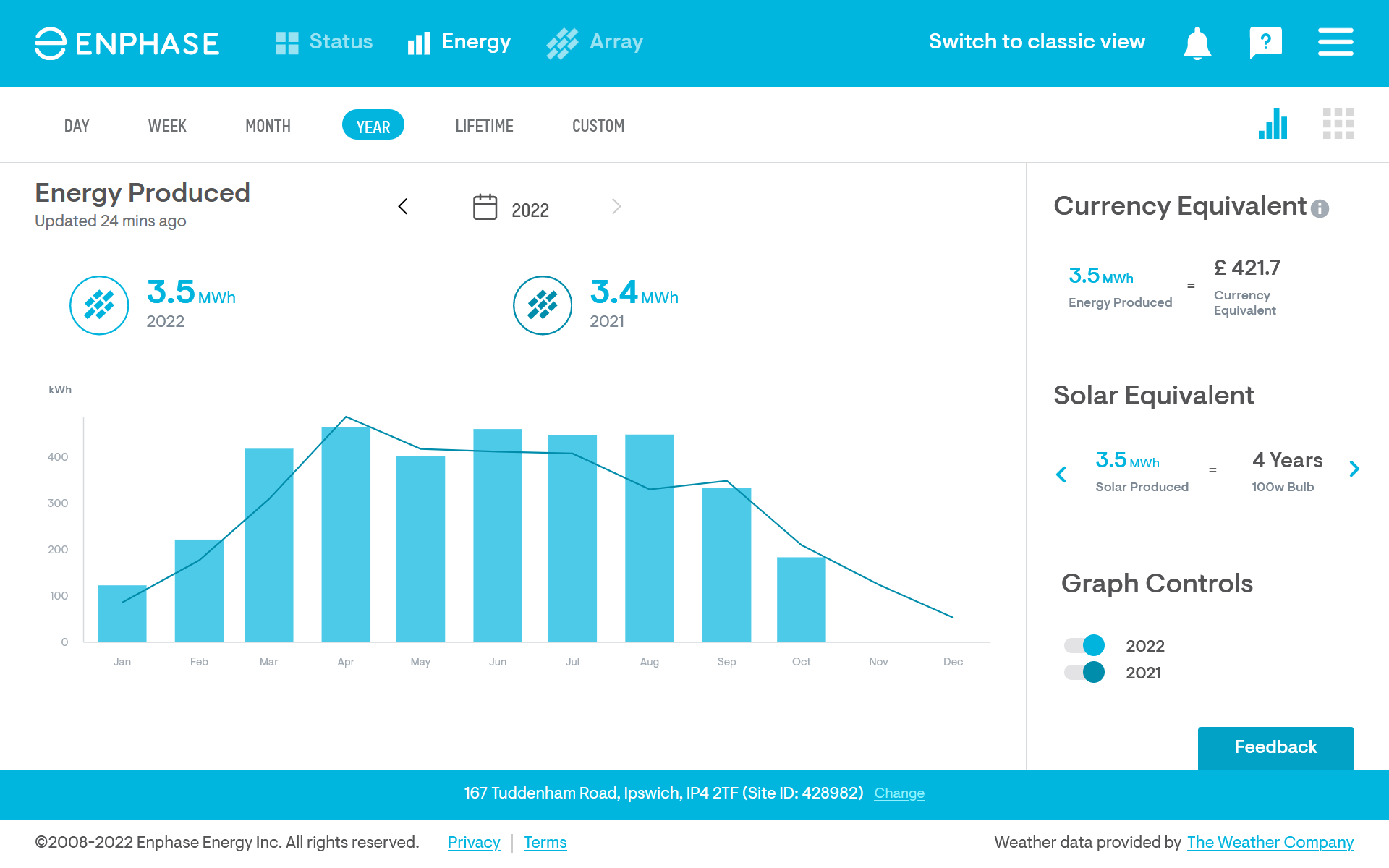
But, like many who made the move to solar power and EVs early, it’s really not that bad. This year has been a good solar generating year (as per fig 1 below) compared to last year and on top of that, our SEG or smart export guarantee means we get 11p over the cost of buying a unit for every unit we export.
This is important because a big change happened once solar panels became relatively cheap: one of the benefits we got from doing the install early was a means to recoup some of the investment by feeding in our excess energy into the grid.
However, that and our export rate were initially fixed which meant with the high rates of inflation due to gas prices rising we were potentially left out in the cold. In April, our energy provider gave us the floating SEG – which allows us to largely fund our heating and electricity through the use our V2G and solar exports.
Of course, it also reduces our pull on the grid. Our consumption is lower (though V2G does skew the figures) because of our investment in lowering our carbon footprint.
Of course, there are other benefits as seen in the UK’s Carbon Intensity monitor last night… We can see that wind and imports (like our car donating its stored energy) far outweighed our need for electricity generated by gas.
These figures show why its important to retain the SEG and enable more people to invest in solar and get a fast return on investment. For the next 20 years, it would enable the UK to become one of the lowest users of fossil fuels for heating and energy.
Hang on a minute, doesn’t this just mean poor people are buying rich people’s electricity?
I am saying, we shouldn’t be using this mechanism to regain inequalities in our system.
I’m a higher rate tax payer and have been for the past 12 years. I strongly believe that tax for me should be higher and for those earning less it should be lower. Why not? I can afford this to make the UK better.
By keeping the “green levies”, we can make this technology available to more people, especially in the middle earning tier, those paying higher rate tax but who have no wiggle room to make such investments.
The high rate tax bracket should be raised and then the rate put to 45% and the highest tier should be back at 50%. I also think a spouse who isn’t working should be able to gift their tax allowence to their partner but that really does stray off topic…
If more people use solar generation during the day and V2G over night, we can reduce our need to burn fossil fuels to those who cannot do either, reducing the cost – where there is no demand for something it either becomes very cheap or very expensive.
We need to change people’s view on the technology. Tesla’s power roof hasn’t really come to fruition and is very expensive where you can get it. Round where we live, solar cells are almost seen as a badge of honour. All the cool houses have them but that isn’t the case everywhere in the UK. Which is odd.
If we team the technology with smart meters of course, you start to be able to tune their usage. My parents were early adopters and now my mum is widowed is running her car, cooking, green house, and house for less than £30 a month at today’s prices (her heating is a little different as she’s an oil fired house off the grid). During the summer that pretty much drops to zero even though she’s heating the hot water from the solar panels too. She will be well below the price cap of £2,500.
Will you?
It’s a good question. Our EV is now doing a 25 mile round trip during the day which means we’re not quite doing as well as we did – it’s knocked £10 a month off our earnings from V2G bringing our total in at £160 per month compared to £170. We get around £600 a year from our FIT. So (12*160 + 600=) £2,520 from the panels and V2G is nearly the price cap. Our electricity use is typically 7287.70kWh and our gas is 19176.29kWh.
At 33.38p per kWh for electricity and a standing charge of 37.08p per day, that makes the electricity bill = £135 (standing charge) + £2432.63 = £2567.97 for electricity.
Gas is charged at 9.81p per kWh and a standing charge of 27.12p per day. So that’s £1,882 near enough. So our bills have gone from £300 per annum last year to £1,930 although that’s a poor estimate as it has done this as a big bang and actually the prices only went up in October. That’s £8 per m2 in our home.
Our usage has dropped considerably thanks to our Tado valves and thermostats and using our smart meters to make better choices. We’ve also knock 1 tonne off our carbon footprint, which is reducing our costs as well – typically we’ve reduced our usage by 100kWh for electricity and 450kWh for the gas it month. It has, after all been a much hotter year and we did go from using gas all year to turning it off over the summer. We made use of natural mechanisms to reduce our need for cooling over the summer.
Interestingly, we started up the boiler for heating and hot water this month. Compared to last year when we were both working from home and didn’t have the Tado thermostats in place (though I had installed the radiator valves) our gas usage in October was 1112.95kWh where-as this year, halfway through, our gas usage is only 259.94kWh – a drop of 24% – and there have been some really cold days. My son and I both travel into the office each day meaning my husband is only properly heating one room when he is in the house. Turning the heating down automatically when we’re all out makes such a difference!
Our current direct debit is £150 a month (which is £1,800 and we have a credit to cover the rest with our supplier) , which is reasonably cheap living these days, especially as there are now three of us contributing, £50 each a month…