Main menu:

Site search

Categories

February 2026
M T W T F S S
 1
2345678
9101112131415
16171819202122
232425262728  

Tags

Blogroll

Route 51, part 2

I cannot sleep: with my last set of training, I learnt how my body performs muscle filling, so I went to bed at 22:34 and fell asleep pretty soon after having set up a 70% temporary basal rate.

When that completed at 01:36, I woke up, found I was a little low and treated with a Soreen Lunchbox malt loaf.  I’ve been awake ever since.

Eh?

Yesterday, I completed a 45 mile(ish) trip on Route 51 between Ipswich and Bury St. Edmunds with a partial return trip to Stowmarket.  Call it silly, but I really didn’t fancy covering the ground where I’d had my accident last year.

I’d had a chat about my plans to go to Newmarket and my husband asked “why not just do a round trip to Bury?”  He had a point, so with the sun burning brightly yesterday morning I got on my bike at 10:10.

Essential kit – clothing

While it was sunny, it was not warm.  I wore a cycling long trousered dungaree, a cycling top and a new piece, a “showerproof, breathable” cardie ?  Socks, helmet and cycling gloves completed my look along with a snood.  I had a waterproof poncho in my kit along with my testing kit and phone (for testing and directions).

Essential kit – the carbs

Again, learning from last week, I planned stops every 10-15 miles.  I had my Camelbak “hydration pack” (basically a 1.5L water bladder which slips into a ruck sack), 5x150ml cans of coke and 2 Soreen Lunchbox malt loaves.  I had 92g of CHO in my panniers ready to go and an extra bottle of water.

Very prepared.  Can I go back to bed, please?

We’re getting there.  Same as before, I stopped at the community centre in Onehouse for a coke break (just the one) and a quick check of my blood sugar.  All was well.  The 14 miles had taken 61 minutes.  I didn’t bother stopping the clock.

The route, part 1

I also didn’t use the fit bit for anything other than my heart rate.

That meant not only did my phone use less battery (I turned off the blue tooth), but I have the whole route saved as you can see.

Excluding the break, the journey took 2 hours 39. Not bad. The return to Stowmarket, 15 miles, was considered to take 1 hour 15 minutes.

I tried to take my blood sugar: “glucose not available, sensor too cold” came up on the reader! I was a little chilly and soaked through with sweat but really? I’ve been skiing with a sensor and it has been fine.

Given what I knew from last time, I took a pair of the cokes and a malt loaf. And tried to retake the reading. Finally it gave me a grumpy result of 7.6mmol/l. That would do.

Only, I couldn’t quite find my way back to Route 51. I was so glad I had the phone with me as the signs in the opposite direction just weren’t as well laid out. Or I was too knackered to read them! I got back the Onehouse eventually and followed my nose to Stowmarket, giving my husband a quick call to let him know I was OK.

I had trouble going back through the church yard and onto the cycle route and difficulties in the first few villages.

The second stint took a painful 8mph average but I finally rode in to Stowmarket’s railway station.

That’s when the pain struck. Since receiving my first insulin shot one evening in December 1977, I’ve had a few high readings and needed to do exercise, but that was nothing compared to the shooting, deep muscle pains I had waiting for the train (delayed because of trespassing on the track round Bury) in Stowmarket.

My sugar wasn’t too bad, so I had my second malt loaf and my penultimate coke. I had to make it back from the railway station in Ipswich after all.

I got on the train. Thankfully there was a space on the carriage and I set up my bike and pull down the seat to keep an eye on it. Just outside of Needham Market, the bike toppled on to my left thigh. I gave a small exclaimation. Two of the guys on the train rushed from their seats to help me, but I’d already pushed the bike back on to its wheels and instead they checked I was OK. I told them what I was doing and why. They told me how brave I was and how impressed they were with my progress. They wished me luck for the 7th and pointed me in the right direction home.

How kind?

The next couple of days will be recovering (hopefully with some sleep!) and then hill training until Monday. 5 days off before the 45 miles on Sunday 7th October ?

Route 51, part 1

Scary gravelly bit

Don’t you mean route 66?

No, National Cycle route 51 is a part shared, part dedicated cycle route from two of the larger towns in Suffolk, Bury St. Edmunds and Ipswich.  In fact, at either end it completes within a mile or two of the railway station, allowing you to complete the circuit by letting the train take the strain.

Actually, it’s a little more than that, covering five counties, but lets start with the bit I did on Wednesday.

Ipswich-> Creeting St Mary -> Needham Market -> Stowmarket -> Onehouse -> Woolpit ->Tostock -> Drinkstone -> Thurston -> Bury St Edmunds.

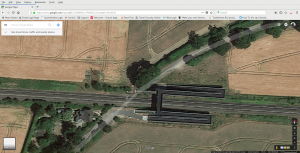
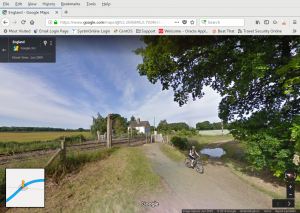
With the wind howling from the South, the first bit of the journey was not trivial.  Especially when I found myself up a gravelled bridle way outside of Creeting St Mary (red marks the gravelly bit!).  Not too bad for the first 100 meters but just off screen it starts to go up hill.  My road tyres were not up to the task!

But I covered 14 miles in 61minutes (OK, it was mostly flat and downhill) and was ready for my first break in a small village just outside of Stowmarket called Onehouse.

I grew up in the area and Onehouse has grown a great deal in that time.  I chose to have a quick break, check my levels and have a couple of cokes, check my bearings and ensure I knew the rest of the way.  That’s the moment my mobile’s screen went blank.

Oh dear (or words to that effect)!

You’re in the middle of no-where without a mobile?

Or cash.  I’d packed a credit card but I tend to use my mobile as cash so I don’t carry that much with me on the bike.  I took a full 120 seconds to decide that I wasn’t going to go back the way I came.  It would mean my support system (my brilliant husband) would not be updated and next time I would definitely carry a power pack with me, but if there were signs the whole way I could get to Bury.  I had water and a coke and a testing kit.

If I could get to Bury, I could ask directions and I could get to the railway station and get the train back.  The train station might even have a phone.

I’m a cyclist in possession of the native tongue, I could do this, if I needed assistance, I could get it.  After all, the past 14 miles had flown by very smoothly; apart from the scary gravel bridle path and how many of those would there be?

I set off and was surprised at the quality of the cycle path.  In some places, it was a dedicated path away from cars and in others it was along single track roads of good quality.  Largely, pedestrians and motorists were friendly and despite the wind, it was dry and reasonably warm.

As I came to Woolpit, it all felt good.  It’s not a short distance and I wasn’t going that quickly: just an average 11mph: but I was covering the miles.

I did consider jumping on the train as I saw a sign for Elmswell (off the cycle route) but hung on for Thurston and the signs that said Bury was only 4 miles away.

Thurston has the most amazing railway crossing bridge that was possible to ride up so the only bit I hadn’t cycled was the bridle path outside of Needham.

In Bury proper, as I didn’t know where the cycle route would land me, I sought directions and found that I would exit the route outside the Angel Hotel.  I have fond memories of that place, but that’s a very different story!

When I got through the door at home, my husband said he’d lost track of me on Thurston which was odd because my end, my mobile was dead.

What’s next?

Route 51, part 2

Newmaket is my next stop on Route 51.  It should be 46 miles but relatively flat so I’ll do some hill climbing as my supplementary training.

I could always avoid the bridle path next time!

Sponsor me please at https://www.justgiving.com/fundraising/samj-watkins.

What does exercise do to your blood sugar levels?

The first time I do an exercise, especially if I am heavily learning skills and techniques, will drop my blood sugar while I am doing the exercise. If I have had a big break for an activity that also holds true.

But that only holds true for that one time. After that the following happens:

Small amount of exercise, especially short duration

If I’m having food, that food needs to be bolused fully as while I am exercising, my body is digesting the food and releasing stores of sugar from my muscles.  I may even need slightly more insulin short term.

The second I stop, it helps to have 16g of carbohydrate (CHO from now on) in a quick acting form – once the muscles stop releasing there may be insulin floating round my system that needs to be fed.

Nothing more needs to be done typically, but keep a close eye on everything – if I’m not using a CGMS, I test every 45 minutes,

Moderate amount of exercise, longer duration

Again, food is dealt with normally, but hydration is key.  I like water and that reduces the stress on my body.  As a middle aged woman, I sweat and that liquid needs to be replaced.  As I have a western diet, water works well.

On the hour, I take 16g of CHO.  150ml can of coke is ideal for this – takes me 10 seconds to drink and works almost as quickly.

On the 2nd hour, I also have 17g CHO in a slower absorbed form: I like Soreen lunch box malt loaves.

I sip water constantly.  This seems to level out my blood sugar without having to resort to basal rate adjustments which just seem to make me incredibly high a few hours later.

This works well for cycling continuously for 45 miles with a half hour break before doing a further 1.5miles to ride up the hill to get home.

Next day

I breakfast 50g CHO without needing to give extra insulin to cover the meal.  I keep an eye on everything until the evening.  Typically, overnight I don’t seem to have any issues if I run on a 70% basal ceasing at 5am. (It alarms which is really annoying, definitely wakes me up and even though my sugar is normal, I cannot get back to sleep).

I don’t feel hungry for lunch.  I keep my fluids up and my salt intake – peanuts are a could source of protein and salt if you can eat them.

And the next day

Last week I could see the impact for three days: my insulin requirements were much reduced.  I will play it by ear rather than planning round that – as I said, the first time I do something, it makes me low the second time doesn’t have the same impact…

Apologies

Internally to our network, we’ve had some issues with the routing to the webserver.
You have our sincere apologies for the interruption to this service.

Verbal contracts

Balancing act – high and low blood sugar

In the UK, a verbal contract is binding. If you say something will work in a certain way, that is binding.

That makes presentations vital. It also makes what is said to you equally important as what is written down.

When it comes to my diabetes, I use a Powerpoint presentation (other tools are available) to explain some of what happens to me and my body because I cannot make my own insulin and I use a pump to give me my insulin.

One of the key slides is this one, discussing the balancing act:

If a non-diabetic has high or low blood sugar, the imbalance is really small and easily corrected by giving a micro-dose of insulin (in the case of high blood sugar) or glucagon (in the case of low blood sugar) to get things back where they need to be.

Non-diabetics can have a clinical hypo’ with some types of blood pressure medication or if they fast (but still have water) for more than three days.

The reason this slide has the title “Why bother: just take the levels prescribed by your doctor, surely?” is because I tune my insulin to the amount I eat and my physical and mental activities.

I won’t talk about how I change my dose depending on my food intake and activities or how I cope with stress.  It’s five minutes of talking I give with this slide.

After that discussion, I discuss what physically happens when I am hypo’ (aka low) or hyper’ (aka high).  These are the extremes, 80% of my readings are between 4mmol/l and 10mmol/l when I am testing my blood sugar and 63% my interstitial levels.

Hypoglycaemia

Physically, I have more insulin than I need and my blood sugar drops below 3.9mmol/l (although I can feel ill if my blood sugar 8mmol/l if I have a large amount of insulin on board – that is I have bolused for a meal or food and got the amount wrong, I can feel hypo even though, at the moment, my blood sugar is within an eyglycemic range – that range is generally considered to be between 3.9 and 7.2mmol/l as per ).

It can make me feel drowsy, a little “spaced”, docile.  I can have difficulty concentrating and even putting together a sentence when talking (usually that doesn’t happen unless I am below 3.2mmol/l).

I can be disorientated.  I do not like to sit down, it’s actually better for me to be standing or even walking – physical activity can mean my muscles are releasing sugar stores and that can mean I can tolerate a lower blood sugar than if I am sitting down.  If I don’t have sugar to hand, I may act excited, again that’s to get the fight and flight responses in my body to work and they will release sugar stores to allow me to be active.  That is not good practice but can get you out of a hole.

I find it quite easy to doze when I am low and if I am tired, that can be a real pain.  Food tends to wake me up!

Because I inject insulin, the second the insulin is in my body, it is working for the next 4 hours.  If I inject an unit of insulin (1/100th of a ml), I use 0.25 units every hour until it has been used up.

This means if I get my dose wrong for a meal, I am dealing with the consequences up to four hours since that last dose.

Likewise, unless I am very low, it makes no sense to switch my pump off.  My pump gives me a microdose every 3 minutes and the insulin I had 3 minutes ago (up to 3hours 57 minutes) is still working.  For a prolonged, overnight hypo, that’s a good thing to do but doesn’t generally help if I am 3.8mmol/l and my last bolus was 4.5 hours ago and it’s 3pm.  The pump being off will only raise my blood sugar an hour after it was switched off.

If I have the hypo overnight, I can wake up to sodden sheets where I have had the sweats.  I can fit in these circumstances – I usually tell if I have a mouth ulcer after I wake up.

Hyperglycaemia

This is my natural state as I don’t produce my own insulin.

It is caused by a lack of insulin: not giving enough insulin for my food and drink, caffeine, doing sport (while I am doing sports, my blood sugar will be raised by my muscles releasing their stores of sugar and fat), not doing sport, an infection (especially colds), not getting my insulin delivery for food correct (pizza is the obvious example – if I give a single dose for a pizza which is providing 30g of carbohydrate just before I eat the pizza, I will be hypo in the first half hour and my blood sugar will be three or four times normal in an hour’s time), not bolusing for protein (more than 100g of steak for example), stress and worry – exams, job interviews, moving house, etc, issues with my insulin or my pump and of course trauma.

When talking to a non-diabetic, I ask if they do long distance running: being high is like hitting the wall in a marathon.  Every movement is an effort, it’s like walking through mud.

It makes me feel awful: the excess sugar builds up in my blood stream causing blockages, called microaneurysms, in the eye, brain and kidneys.  I produce ketones when my blood sugar gets above 11mmol/l.  Ketones are normal in non-diabetics when fat is burned for fuel – if you are losing weight, you will produce ketones.

In my case, that happens even if I am not dieting and my blood sugar is high.  I produce β-hydroxybutyrate, which is unique to type 1s.  Because my blood cannot use the sugar in my blood (as there isn’t enough insulin for it), it needs to burn muscle and fat to function.

Even low levels of β-hydroxybutyrate cause me pain: headaches, nausea, pain when moving my long muscles (walking and lifting) and thirst as my body wants to get rid of this toxin.

When I am above 8mmol/l at night, I cannot sleep.  I am not producing a huge amount of β-hydroxybutyrate, but it’s enough to cause insomnia.  If the cause of the high is my pump’s cannula failing (bent or blocked tube inside my body), damage to the tubing, damage to the insulin, the insulin being old, heat damage to the tubing or insulin then the high can take hours to come down.  It’s not uncommon in these circumstances for me to get only 3-5 hours of sleep.  As a kid, I used that time to read (it’s just a waiting game to get the levels back to where they should be) or do home work.  I listened to a lot of radio.

Feeling this bad can make me quite irritable and much less articulate.  If there are other stresses, I am likely to seem unreasonable and may be aggressive.

Wow!

Yeah, not a great thing to have.  Then you get the combinations: I had a prolonged hypo in April (jet lag and residual long acting insulin) following a high 14 hours earlier and had to be in work, once in a lifetime learning opportunity.

The next couple of days, I ran high to get my stores refilled (pretty standard approach) but couldn’t shake the headache and was not sleeping well because of the highs.  Work-wise, I was put into a difficult meeting situation.  Not a great combination.  Of course, while they know I am type 1, they forgot the discussion we’d had about high blood sugars.

C’est le vie!

The great thing about the UK is that type 1 is recognised in the Equality Act 2010.  In the USA, it’s a disability full stop (we’re missing an organ so classed with amputees).  That should give us equality of opportunities, only in practice this is largely ignored and our educational and employment opportunities can be dramatically reduced even though we only need a small accommodation.

What is protected

My bike ride yesterday made me think about recovery, both physical and mental.

I had a serious accident and I needed surgery to recover from it.  The bones then needed time to heal.  In practical terms, bones take six to eight weeks to heal enough to be whole.

The soft tissue damage takes much longer.  When I snapped my radius in half, I only stopped the physiotherapy five months after the cast and k-wires were finally removed and another 13 or so months before the bone stopped hurting.

18 months plus the 8 weeks in a cast.

Because the radius is a major bone, capable of supporting weight, I naively thought that the bones in my face would take much less time.

Guessing that’s not the case?

Obviously, I had the fixation plate for the zygomatic removed (actually the plate was between the cracked line on the image from Wikipedia and the “frontal” label), which has stopped it catching on my facial muscles round the eye while re-injuring the bone.  It’s healing really well though I am very conscious of it when I am tired.

The maxillary sinus break was a bit more of an impact initially.  This has probably healed the best although there is some nerve damage.  When I close my jaw, I get a stab of pain which is again much worse when I am tired.

The muscles and nerves seem to have recovered (again the op’ to remove the fixation plate has put things back a little but now the swelling has gone down, my smile is much more even without having to concentrate on it).

The thing that still bothers me in my upper set of teeth.  All my own, although the front incisor broke its root in the accident, so my first filling ever was root canal work.  My dentist is a marvel.

My skin seems to have healed well, a couple of white patches from where I lost a couple of layers of skin on my back but otherwise not too bad.

Not 100% sure I see the chase of this post?

With hindsight, I should have taken a couple of months off to heal.  During this period, at work a colleague new to the team asked the question, “how old do you think I am?”  He is less mature than he looks and when you feed back your estimate, he offers to “rearrange your face”.

I don’t remember my accident, but having had my face rearranged, I think that’s quite a nasty thing to say to someone for something so trivial.

At least I now know that wasn’t a personal threat to me as he did this to someone else while I was present a couple of weeks ago.

Getting going

One of the downsides to the Palace to Palace ride is that it is happening in October.

October is properly autumn; the weather could be anything from a balmy 20℃ to a chilling 2℃.  Then there’s a chilly north sourced gale to a gentle shower with little or no wind.  Or, of course, fog.  It could be foggy.  Or sleeting…

Climate’s what you expect, weather is what you get?

Exactly.  Yesterday I was cycling in 13℃ and it was much harder than cycling a couple of week’s ago when it was 15℃, not least because of the rain.

I bought a poncho a couple of months ago and while great when walking, unless it is going to be very cold, I’m going to cook in it.

I’m considering eye wear too.  I have some ski googles and am tempted to wear them while training to see if they offer protection from the elements and dust.

I was cold.  I could carry a hot drink so I don’t lose energy to keeping warm, but need to give that some serious thought.

You’re not disabled

In the UK, type 1 diabetes is recognised as a disability in terms employment law.

When my blood sugar is normal and predictable, this seems a little heavy handed.  By colleagues, I have been given a look to say you must be joking.  It’s all in your control and it doesn’t need protection under law.

I love this post, which  introduces the idea of type 1s embracing the disabled term.

With medication, though, you’re normal

We should talk about the medication in a bit.

This introduction from, https://www.ncbi.nlm.nih.gov/pmc/articles/PMC3867999/, states what we’re dealing with:

“The plight of people with type 1 diabetes changed dramatically with the introduction of insulin therapy in 1922 (). Type 1 diabetes was transformed from a uniformly fatal disease in the preinsulin era, with mortality occurring either acutely from diabetic ketoacidosis or subsequently from inanition owing to a chronic catabolic state, to a chronic degenerative disease. In the first 15 to 20 years of insulin therapy, a host of complications that had never been seen before was discovered in people with long-term diabetes (). These complications, affecting the eyes, kidneys, and peripheral nervous system, were collectively called microvascular complications, to distinguish them from the less diabetes-specific but highly prevalent macrovascular disease complications. Microvascular disease and peripheral neuropathy resulted in blindness, kidney failure, and amputations (); and macrovascular disease, exacerbated by renal dysfunction and autonomic neuropathy, increased the risk for myocardial infarctions and stroke to levels that were 10-fold or more than in the age-matched nondiabetic population (,).”

Type 1 Diabetics produce no insulin, so our blood sugars, without treatment, cannot fall in the euglycemia or normal blood sugar range, which is 70 to 130 mg/dl or 3.8mmol/l and 7.2mmol/l.  Above this range is call hyperglycaemia (anything above 7.3mmol/l) and below it is called hypoglycaemia (below (3.8mmol/l).  With a mix of CGMS and insulin pumps, type 1s are meeting that normal range: I’m not quite there, I pretty reliably keep my blood sugar between 4mmol/l and 10mmol/l, 80% of the time.  That gives me a glaciated haemoglobin reading of between 6.2% and 7.5%.

I have an autoimmune disease.  It has these consequences:

  1. I am on my fifth type of insulin.  For various reasons but mostly because the insulin produced by human beings will only last for 10 minutes or so before it breaks down.  I have been on bovine insulin, porcine insulin, “human” insulin and finally I’m on an analogue (think left handed sugar).
    After a while, the insulin stops working as well.  Probably because my body starts attacking it.
  2. I went through the menopause, completely, at 37.  I am now on HRT because the stress of it caused may background insulin requirements to be 4 times what they had been before I stopped producing oestrogen and progesterone.  I had an evens chance of that happening because I was diagnosed before the age of 5.
  3. I have a 13% chance of diabetic retinopathy despite my blood sugars largely being normal.  if they were not normal, I would have a 87% chance of that developing.  The diabetic complications control trial in 1993 demonstrated the benefits of good blood sugar control.
  4. Sleep patterns.  I talk about my ability to sleep when my blood is above 8mmol/l.  I find it really difficult and I am not the only one.  If my blood sugar is around 6mmol/l before I go to sleep I tend to sleep well, if it stays that way.
    If my cannula gets blocked, or I’m stressed about something, or there’s a knot in my pump, my blood sugar can rise dramatically.   I tend to wake up at 9mmol/l.
    A hypo can also wake me up.  Above 3.7, I tend to treat with a temporary reduction in my basal rate (70% instead of 100% works really well), otherwise I treat with 150ml can of coca-cola if above 3mmol/l or 250ml if I am below that.
    I try not to give glucagon unless I am below 1.7mmol/l, but that is by far the easiest way to bring it up even if it makes me feel sick and not like sleeping.
    Some diabetics talk about their diabetes as if it were a small baby.  It demands attention late at night and won’t rest until it’s done.
    If I’m above 12.3mmol/l, I have to wait nearly 2 hours for it to drop low enough for me to be able to sleep.  I try to test before 10, so I can guarantee that by midnight I can sleep.
  5. Friends and lovers: people do not like being round sick people.  We’re not considered fun, clever or energetic.  At times we’re not.
    It’s 24/7 every day.  No breaks, no remission, there are easier times but there are also crippling bad times.  There are times when my blood sugar can climb (bad site, bad cannula, bad tube, bad insulin, infection, stress, got my bolus wrong, forgot to bolus…) and I haven’t spotted it quickly enough and I am now bringing my sugar down from 20+mmol/l at 2am and it won’t come down.  For whatever reason, the insulin just isn’t doing what it should.
    I can pass for normal if I really want to but I always think that’s mean.   If anything goes pear shaped, that would be a bit of a shock.
  6. Work: assumptions are weird.  What do you need?  I don’t know.  If I knew, actually I wouldn’t need it because I would know what was coming and I could model it correctly and get my blood sugar perfect.  The pump gives me a lot of flexibility but it is much less tolerant if insulin is interrupted for any reason.
    I’ve had long acting insulin injections fail, but only a couple and some of the insulin from the injection before were still active in my system.  When a cannula fails, the consequences are much more dramatic.
    I’ve gone home with normal blood sugar and been fighting highs or lows less than four hours later.  Then I’m at work with fair less than my planned 6 hours sleep to do my job the next day.
    One manager asked me for consistency.  I’d love that!  My condition is not a consistent entity and the impact is not consistent!

I’ve busted 1000 words so I am stopping for a breather.

Running a Leaf (when you own the battery)

Running the Leaf between the 10th August 2017 to the 9th August 2018

If we’re talking about power consumption, we need to discuss the Leaf.  How much is it costing us to run, bearing in mind we are now funding every mile from our home electricity supply?

Month Distance travelled

(miles)

Energy economy

(m/kW)

Power consumption

(kWh)

CO2 (kg) Cost at £0.1507 per unit Cost per mile
July 251.5 4.2 59.7 70 £9.00 £0.04
June 200 4.2 47.6 55 £7.17 £0.04
May 260.4 4.2 61.5 72 £9.27 £0.04
April 146.2 4 36.8 40 £5.55 £0.04
March 388.1 4.2 92.8 107 £13.98 £0.04
February 395.4 3.9 103 109 £15.52 £0.04
January 413.4 3.9 106.5 114 £16.05 £0.04
December 353.2 3.6 97.2 98 £14.65 £0.04
November 348.3 4 87.7 96 £13.22 £0.04
October 375.8 4.4 84.9 104 £12.79 £0.03
September 303.9 4.4 68.9 84 £10.38 £0.03
August 198.9 4.3 45.5 55 £6.86 £0.03

At 15.07p a kWh, being more efficient makes a difference to our pence per mile.

There doesn’t seem to be much we can do to reduce our costs below 3p a mile without dramatically changing our “Energy economy”, where as doing 4.4 kWmiles  or using our solar panels to charge the car.  We do reasonably and often earn a “Platinum” badge from Nissan during the winter months but fail to regularly get above 5miles/kW (although I did that today 🙂 ).

We generate about a third of what we use: we live in East Anglia, not one of the really flat bits, but there’s not a huge gradient on my normal journey to work.

The majority of my journeys are to work: 14 mile round trip for 56p or £2.80 for the week.  I work 47 weeks a year, that means I spend £131.60 on my annual commute.

Getting 5.2 miles/kW

Concentrating on smoothness, planned acceleration and no sudden braking mean 5.2miles/kW is achievable.  I was lucky with the traffic – we live in blue light central with ambulances coming from the hospital along the main routes pretty much throughout the day.  Many drivers stop to allow them past.  I would get that as a great to do if it weren’t for all the traffic islands dotted about the A1214: if a driver doesn’t pay attention and remove themselves completely from the carriageway, the poor ambulance is not helped at all but stuck fast like the rest of us.

You need traffic islands to help pedestrians cross busy roads so there must be a better way for the traffic to work in these situations.  If you’re able to do the speed limit, isn’t the ambulance better off moving with the rest of the traffic?

The other option to getting more out of the Leaf could be to see if we could make use of Ovo’s offer as per this article.  Having just got out of a leasing agreement, not sure I’d want to sign up for another!


High life?

How on a minute, is there something you want to tell me?

What do you mean?

Well, you’ve blogged once in a blue moon the past year and this week, this is your fourth…

Oh, I had an operation last week and while I am not up to my usual fettle (I am sleeping nearly 9 hours a day at the moment), it’s a bit boring.  I am not up to the normal hurly burly of my job yet, but it is nice to catch up…   May I get back to the story, please?

OK, yes, please do.  What do you want to talk about?

Culinary adventures

I’m going to let words paint a picture (as I didn’t get my camera phone out in time): steamed salmon fillets with egg fried rice.

The solar cells are outputting an average 1kWh and our smart meter (and my blood glucose meter) suggest now is the time to cook this feast.

Sunday lunch is a big thing in our house.  We cook from scratch, something we love.  If there are three of us (as a min) we do the whole roast thing, but my husband is out and about today.

So what?

I’m setting the scene.  The great thing about this meal is that it takes less than 15 minutes, has some manual intervention but is otherwise simple.

Boil the water, add the rice, 5minutes later add the frozen peas and chop up some baby sweetcorn and add that a minute later.  Put on the microwave steamer with turbo cook: salmon for two is typically 220grams,so takes just under 6 minutes.

Fry up some spring onions or a finely chopped small onion.  When pinger goes for rice, drain rice and veggies and add an egg to the onions then tip in the rice and peas and baby sweetcorn.

When the pinger goes on the microwave, serve up the egg fried rice and salmon.  Tasty, simple, quick.  Not too bad on the washing up, especially if you do it while the plates are still warm.

So what?

This peaks out at 3.5kWh!  True the whole thing only takes 12 mins in total to cook, but that was a bit of a surprise.

3.5kWh for 10 minutes is 0.6 of a unit (8p), but still!  Boiled rice and vegetables would have been a maximum of 2.2kWh.

Should restaurants and ready meals take this into account for each dish to help us make ecological choices?  Should we do that ourselves on top of our other eco choices?

Microwaves are incrediably efficient – they do not heat anything up, but vibrate water.  I love them for cooking fish, I can cook a trout in 2minutes in my microwave and it’s delicious perfection.  As a student, this gave me high nutrition (especially protein and low in fat), was a bit special and simple to do.

Compared to a chop, it’s a bargin not only to buy but also to cook.