Main menu:

Site search

Categories

February 2026
M T W T F S S
 1
2345678
9101112131415
16171819202122
232425262728  

Tags

Blogroll

You’re not that green

Flower in our garden

Being diabetic, I have a bigger footprint than the average person on the planet.

As a household, we’re making an effort.

The Electric Car

According to the New Scientist this week, in the UK, a fully electric car has a much lower carbon emission footprint than a hybrid petrol/electric car this year and on-going years.  This is as the UK moves towards more nuclear and renewable energy generation compared to gas and petrol.  This is aside from microgeneration.

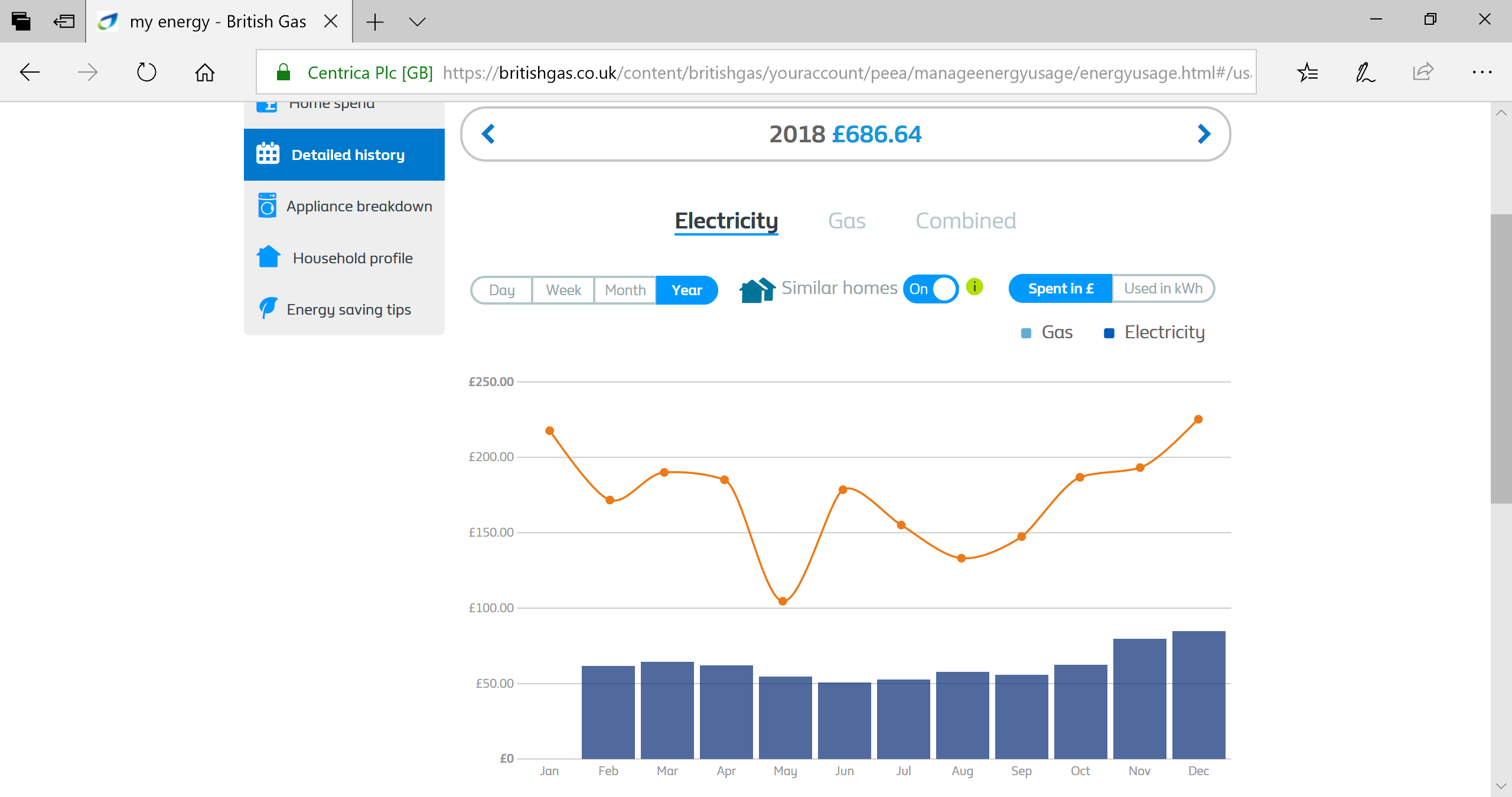
The Leaf is one of our big consumers for electricity.  Each mile costs us less than 4p at the moment (especially during the winter) if we charge from the mains rather than our solar cells.

Household usage of electricity

The majority of the halogen lights in the household (and most compact fluorescents) have been replaced by LEDs.  We’re also using remote controlled lights to keep the footprint down as much as possible.

Cooking and refrigeration are the two areas we’re still struggling with: we have a plan over 2019 and 2020 to swap out our older units with more efficient ones.  We did the microwave last year and using that in place of the main cooker is keeping our generation usage down considerably.

Thought goes in to how everything is cooked.  When saving food for reheating, we cool the food completely before putting it into the fridge and the same for reheating.

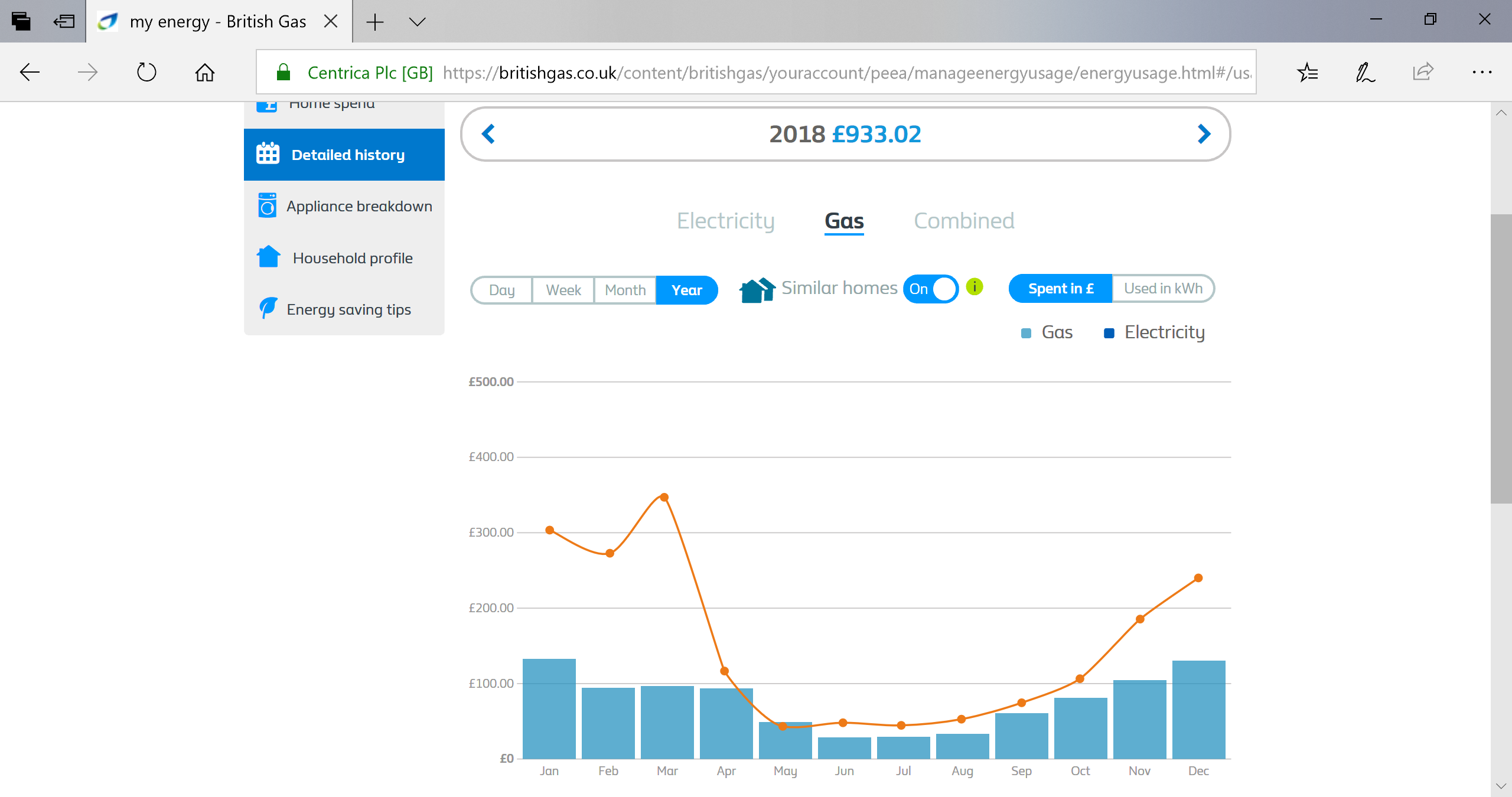
Heating and hot water production

The room thermostats downstairs make a big difference to our heating usage.  If we don’t use a room, we cool it by a couple of degrees – I don’t turn it off completely, but drop the consumption.

I’m looking at swapping our upstairs thermostatic radiator valves to programmable and remote controlled ones.  That would give us the same capability upstairs as downstairs for a fraction of the cost of putting in a system like we have downstairs.

Honeywell do an interesting system for this called EvoHome.

I’d expect a 30% savings as we got from swapping out the downstairs thermostats as a minimum and a much more comfortable living environment too.

Recycling

We do what we can.  Obviously, some things cannot be recycled, but all paper, cardboard and glass is recycled.

We do the vast majority of our plastic through our kerbside collection.  That doesn’t cover plastic bags, but well before the 5p charge, we reused all plastic bags at least 40 times before using them as bin liners.

All of our garden waste is recycled by preference or completely dried out and burnt as kindling for our log burner.  Irritatingly, our log burner will not burn multifuel.  We use the log burner over the weekend, only when the temperature outside is below 15°C and only fuel and kindling that has been matured for 12 months.

Consumables

Aside from CFCs there are various toxins and chemicals used everyday in a western lifestyle.  The toilet is bleached at least once a week.

But that’s the only thing.  We use a steamer to clean the floors and bathrooms.  That uses water.

I do use isopropanol alcohol as a pre-injection cleaner for my blood glucose sensors as they are in my skin for 14 days.  For my other sites and blood tests, I tend to just keep clean.

We paint at least one room in the house a year.  This year, my husband has painted the windows sills round the house.  All the paints we use are water based and we use water to clean out the brushes where possible.

We use aerosols for our deodorants and I use a spray three or four times a month for my hair.  I use a solid stick for sports on top of that.

Garden

We’ve planted 52 tress over the past three years to form a hedge.  We’ve also planted a peach tree.  We use an electric lawnmower.  We collect water to keep the plants hydrated.

The drought this year saw some of these new trees hit hard but we’re waiting to see what recovers over the winter.

Not bad…

No doubt, we could do more.  We’ve insulated without stopping rooms being ventilated and upgraded extraction fans which keep things dry without burning up more electricity than necessary.  I’d like to fit curtains in more of the rooms as that really helps keep the heat in.

We’re trying to keep things simple and not break the bank: we are not early adopters as a result.

Once the kitchen appliances and the TRVs upstairs are sorted, the obvious next things for us to do are upgrade the solar cells (put more in) and potentially get a battery system.

We could also look to lose our diesel car.  If we did that, the obvious thing to do would be to swap the Leaf and the XFS for something like the F-Pace.  We’d really need to clear the mortgage before doing that though!

Why does high blood sugar impact my mood?

I love when people talk about things that have happened to them.  My mum was telling me how she had been driving for a long time and got dehydrated and made a mistake in a parking lot and reversed into a car.

Being tired and dehydrated affected her ability to react to her surroundings.  It also made her react badly to having the crash, she swore and it’s really unusual for my mum to swear.

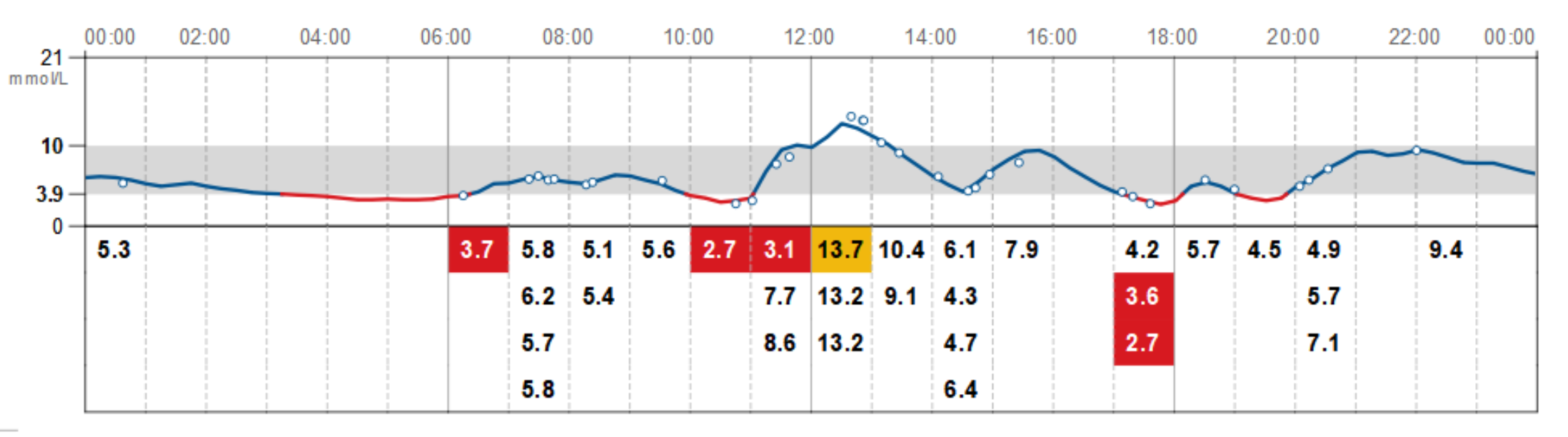
When my blood sugar is above a normal or euglycaemic range (in the UK, that’s 4-7.9 mmol/l according to the American Diabetes Association), I get fatigue and dehydration.

The longer the high blood remains or the higher the value of my blood sugar, the worse the dehydration and fatigue get as my body is desperately trying to wash out the toxin, because that’s what high blood sugar is to me if I don’t have insulin to convert the sugar into energy I can use.

I am always reacting to my blood sugar much more slowly than a non-diabetic person does, because my insulin goes in subcutaneously not directly into the blood stream.

If I’m being grouchy or snappy, let me know.  It’s not normal, it’s not acceptable, but I may be a bit high and need to correct that high.

Dream, plan, achievement

Now some DIY is out of the way, I am catching up on my blogging.

One of my dreams for 2019, apart from my son getting a university place, is to achieve two long distance cycle rides.

The first is 100 miles for the Juvenile Diabetes Research Fund.  The Prudential Ride London, 3-4 August 2019, is that little bit further than the palace to palace this year, but as a type 1 diabetic, I would be a direct beneficiary not just in terms of getting fitter.

The second is the Palace to Palace run, and the 47mile ride I did in October.

Thought you were mad the first time back in 2017…

I do enjoy it.  I already know I can do 47 miles.

This is my training plan for the Prudential Ride.

  1. November – January: 20 miles in the gym 2-3 times a week.
  2. January – March: 30 miles in the gym 3 times a week, 10 miles in the gym once a week.
  3. March – May: 1 x 45 mile ride outside over the weekend, with 20 miles 3 times a week in the gym.
  4. May – June: 1 x 75 mile ride over the weekends (or during holidays) and gym work 3 times a week.
  5. July: 2 x 80-90 mile rides, probably over weekends and gym work.  1x 100 mile ride.  A week off w/c 29th July, apart from one session of hill climbing.
  6. 4th August: do the ride. Possible start at 05:45!!!

At this level, I need to ensure my diet supports the effort.  I am likely to lose girth and fat but actually put weight on, probably round my legs.

I need to guard against infection and injury.  It’s too far to do on a wing and a prayer.

I heard Sir Chris Hoy speak at IBM’s Think 2018 event and was impressed by the measures he took to ensure he kept physically healthy not just at peak fitness, things I just hadn’t considered.

One of the key learnings I had from this year’s palace to palace was that while my bike was perfect for training, I need something different for the day itself.  How do I achieve that?

Palace to Palace 2019

  1. 3rd-4th August: achieved 100 mile run for Pru
  2. w/c 5th August 2019, a week off to recover.
  3. 12-18 August, 20 mile runs 3 times a week, mostly gym work.
  4. 19-25 August, 30 mile runs, outdoors twice a week.
  5. 26-1 September, hill training three days a week.
  6. 2-8 September, 20 miles in the gym three times a week (aiming for 45 minutes) and then 1 x 40 mile ride
  7. 9-15 September, 1 x 40 mile ride and three gym sessions of 20 miles.
  8. 16-22 September, hill training 4 times a week.
  9. 24-29 September, mix hill training, one long distance and swimming.
  10. 30-event, week off.  Sleep keep muscles loose, get mind in focus.

Diabetes day: my life in numbers

There’s a meme going round showing a young girl with a syringe in her body representing each of the injections she does a month.  She’s on multiple daily injections a month and conservatively the photo represents 120 syringes.

I am on a pump and this is what it is doing for me.

I have a microdose of insulin delivered every three minutes as a background or basal dose. (Each microdose of insulin, once given, is working in my body for the next four hours.)

If I were doing that with a syringe, that’s 480 odd injections a day.  On top of that (if nothing goes wrong) I then bolus for the food and drinks I have, call that 5 boluses a day.

So that’s equivalent to 485 injections a day and let’s say that are 30 days in a month, so that 14,550 injections a month.

That delivers between 57 and 87 iu (international units) of insulin or between 0.42ml and 0.67ml of 100iu/ml a day.  A month, that’s 18 – 30ml of insulin.

I use 3ml cartridges in my pump which deliver the insulin via a tube to a cannula inserted in my body.  The cannula is replaced every 3 days and the cartridge every 5th day on average.

On average, if I’m not using a Freestyle Libre, I do between 4 and 10 tests a day.  A month, that’s between 120 and 300 tests a day – I get 200 testing strips a month from the doctor.  Each testing strip needs a lancet.

If I’m using the Libre as a constant glucose monitoring system, that goes down to 20 tests a month on average.  I use two Libre sensors a month.

This is if everything works like it should.  My dose changes due to infection, stress, what I eat, how much sleep I get, how much exercise I take, if it’s colder, I need less insulin than when it’s warmer.  My period makes a big difference, not least to how my food is absorbed.

I was on injections for a long time, but when the pump and the Libre, I am managing a 4 hour window for how long my insulin lasts compared to 48 hours with long acting insulin.

I’m doing all this every day just to breathe.  No days off, no remission, no break.  When it goes wrong, I have to fix it.  Going wrong can be an air bubble in my pump cartridge or tubing due to changes in air pressure, a kink in the cannula underneath my skin, deteriorations in the plastic in the tubing, cannula or cartridge.  Temperature changes can damage the insulin (though my insulin is pretty tough compared to what I used as a kid).

I was diabetic from the age of 4, that means the majority of my time as a type 1 diabetic has been as an adult.

I have had prejudice, from being deemed not interested in career progression “because [I’m] ill” to people not wanting to be friends because of the responsibilities it incurs.

Some people believe:

  • I shouldn’t have had my son because of the risk of passing it on (which is tiny by the way, compared to 0.2% risk of the general population having type 1, his chance of being type one is 0.8%).
  • I should not have treatment because “it’s not natural”.  They believe I have no feelings because I inject and BTW, I shouldn’t do my injections at the table because it’s disgusting.  Or in the street or where anyone can see.
  • It’s my fault my autoimmune system decided to knock out something critical.
  • I should not talk about it because “it’s my health”.
  • I’m not disabled because I can walk and talk.
  • I’m not affected by high or low blood sugar outside of the inconvenience and distress it causes them.
  • I’m in control of what’s happening to my blood sugar.
  • It only affects me while I’m awake.
  • I shouldn’t have free prescriptions, because I’m healthy.
  • My doctor is constantly monitoring and making the decisions about my insulin.
  • I’m too sick to do all sorts of things.
  • I can’t live alone; I need looking after.
  • I’m too busy with this to live.
  • I need to concentrate on my health every second of every day (80% of the time, things just pretty much work.  When they don’t, it’s awful but most of the time, it’s OK).
  • I should lose weight, not eat carbs, not eat meat, etc, and “[that] will get me off the insulin”.
  • I’m too lazy at looking after myself properly (I get told that when I’m fighting the hardest to get things back to a normal keel!  Not by my family or friends who see what I do 24/7, but people at work do that a lot.)

I’m running a crucial part of my endocrine system on a four hour lag at best.  I’m doing really well but I am always reacting and always with that lag.

Even doing really well, there are consequences to the constant stress, medication and development of the disease.

This is what it’s like to live with diabetes.

Thank you, google

Go back to last week and it became obvious that while I’d been backing up my data regularly I hadn’t actually tested that backup.

That has been rectified, but I had suffered some data loss.

Thankfully, not a huge amount not least down to Google taking a cached copy of my site reasonably regularly.  It may look like I’d been a busy bee today but that is all thanks to Google keeping their cache.

I’ve lost three pages, as far as I can tell.  Not too bad considering I’ve got 20 back through Google.

Looking at the world in a different way

One of the things I do everyday as a software engineer is look at solving problems.

That skill comes in handy in real life too.  We’re having our bedroom remodelled – we’re taking out a dressing room, which isn’t very useful and freeing up some space in the main entrance way for a large cupboard.  We’re also taking out a Sliderobes unit and replacing that with some matching units.

Of course, our existing cupboards are holding our things.  While the building work is going on, what should we do?

Well, a while ago, we reconfigured the dressing room to double the hanging with a double rail mobile clothes racks, with some wheels.  Buying a matching pair at the time, means my clothes came out relatively simply.  But the beauty of a cupboard is that it keeps light and dust off your clothes.  I still have suits that are classics and do not show a year of their age.

Buying some dust covers that are UV protecting means the clothes racks are fine temporary homes while the bedroom is being worked on.

Closing the loop

I’ve been using tools and mathematical models to establish my insulin requirements for a while.  I keep the links to these calculators on my pump pages and thank my lucky stars for first wifi and then 3 and then 4G mobile networks.

Most of them I have produced myself while allowing them to be tailored for any other insulin user.

The most useful one, IMO, is the basal rate estimator.  By fasting (and testing) you can tweak your basal rate in the tool until you get a smooth line. It’s a beautiful piece of code.  It’s also why I use my Roche pump as it has a basal programme that sets the amount of insulin I have each hour.

I use a simple spreadsheet to record my basal and the blood sugar results and do the comparison.

But it is not closing the loop.

For me, using interstitial readings with a subcutaneous pump is not closing the loop because the insulin I had 3 hours and 57 minutes ago, whether by basal or by bolus, is having an impact now.  If I stop my pump, it is going to hurt me in an hour’s time and that impact will last for four hours.

That’s if the interstitial readings are correct.  The sensor is not meant to be used for clinical decisions.  Indeed, if I get an unexpected result, I do a capillary blood test to see what is actually happening now rather than 10 minutes ago.

Time is the killer?

Exactly.  I would be happy if my pump were not a constant subcutaneous insulin infusion (CSII) pump but a CIPII (continous IntraPeritoneal insulin infusion) could allow the loop to be properly closed.  The Accu-Chek Diaport looks really interesting for that – with the insulin going straight into the stomach wall rather than subcutaneously.  The action of the insulin is sharpened considerably because the insulin isn’t going into fat.

It’s not quite as good as IV, but it would be enough to close the loop easily.

A rose by any other name

In the case of diabetes mellitus, a rose by any other name does not necessarily smell as sweet.

As a young child growing up in the seventies, very little was generally known about diabetes mellitus and in many ways the definition of type 1 and 2 helped identify that age was not a factor in the condition being diagnosed.

Since then, our knowledge of these many and varied conditions has increased dramatically. But the classification and naming of these conditions has not helped in allaying some of the biases and struggles we encounter everyday. Not least for the less commonly occurring conditions such as type 1, MODY, neonatal and LADA.

I am proposing a new naming convention that should remove some of the confusion, help medical personnel form appropriate treatment plans and help diabetics across the world. It would help the media to highlight important research to the target audiences. I appreciate I am in 0.2% of the world’s population, but the consequences of misunderstandings by medical and lay personal can have dire consequences for me.

I have experienced such issues myself, in hospital environments and in the work place. Many type 1’s are in similar situations given the media confusion over type 1 and type 2. This is my idea on how to remove such issues. What are your thoughts, please?

Autoimmune acquired diabetes (AAD)

Currently this would be the vast majority of type 1 diabetics. For some reason, often triggered by a virus or other infection, our beta cells die along with our ability to create insulin. Which causes us to die if we don’t have insulin replacement therapy.

LADA (latency or latent autoimmune diabetes of adults) would come under this classification too.

Gene function diabetes (GFD)

Typically this is called MODY (maturity onset diabetes of the young) but would also cover neonatal diabetes. Depending which gene is causing the issues impacts the effective treatment options, sometimes diet or tablets, sometimes insulin assistance therapy.

In neonatal circumstances, the children may only have this for a short period and recover full function depending on the genes in question and effective treatment being given. Calling them type 1, even if they require insulin for a short period, may do them more damage than help them long term!

Insulin resistant diabetes (IRD)

Largely, this is the majority of type 2 diabetics. For whatever reason, they cannot produce enough insulin for what they are doing when diagnosed.

It can be transient: so dieting, exercising and losing weight can mean drug treatment may never be needed. But it never goes away.

For some IRD, medication may be necessary, not least insulin, not because they were “too lazy to stick to the diets” which isn’t the case for many. In the case of GFD, it is obvious why! But naming the two differently makes it easy to distinguish where the diabetes sits and the appropriate treatments.

Gestational diabetes (GD)

This is another transient form of diabetes and may completely go away or evolve into IRD, even if insulin was required during pregnancy. Again, the names can help determine the appropriate treatments.

Physical injury related diabetes (PIRD)

Some people with diabetes mellitus are that way because their pancreas has been affected by injury or disease.  Unlike Autoimmunity Acquired Diabetes, the cause may be due to removal of the pancreas during treated for pancreatic cancer or the pancreas being injured through sport, gunfire or road traffic accident.
Very rare but a different physiology to AAD and usually requires insulin and other hormones to be replaced.
I don’t know a great deal about this but I’d imagine pancreatic transplants work better for these patients as they lack the autoimmune response of AAD.
Because of the mucus Cystic Fibrosis people secret, they can need insulin because they have damaged β-cells so they would fit in here too.

The beauty of these terms is they are tangible, if someone is overweight but GFD, the weight is not the cause! No doubt losing weight would help the diabetic but they do not need to be stigmatised for their diabetes because it is not their fault.

It is obvious that IRD does not develop into AAD because the causes are different. I appreciate that some forms of IRD may be present in AAD, especially where weight is an issue, but again, it is easier to have the conversation with patients when symptoms occur.

The names also suggest that effective treatments for PIRD would not give hope for a cure for AAD.

Diabetes is rarely fully transient, and this can be communicated to more than just the endocrine specialists by use of these terms.

These terms aim to be short and to the point.  They describe what is happening to the individual concerned.

Would this help?  Does this help you to understand what is going on, please?

Procrastination is the thief of time

Since the long ride last week, I’ve been focusing on sub 10 mile runs but my training plan says today is my last day and given most of my riding has been in East Anglia the past six weeks, I need to ensure I am ready for them there hills of Berkshire.

Where I live is not bad for that, given a stop watch and a direction to head off in, I should be able to fill two hours easily.

But I am finding things to do instead.  What is wrong with me?

I’ve proven I can do the distance, I’ve lost some weight with the training, I’ve even got a small spring in my step.

Today though, my brain is prioritising other things.  Focusing on minute details that normally don’t matter.  I even washed up lunch rather than get in to my ever so comfortable cycling shorts.

The sun is shining, I seem to have kicked my cold, to quote Lemmings™, “let’s go!”

Things I have learnt the past four weeks while riding

Route 51 has taught me a few things, not least how to make best use of my bike and its gears.

There are a few facts I have picked up on the way which I would never have found out otherwise.

Great Barton railway crossing

Is surprising: not least in how cyclists and horses make their way into Bury St. Edmunds.

Route 51 crosses the A14 as it heads west from Thurston towards Bury and Cambridge.   It also crosses a railway line and has an amazing crossing bridge for use by riders of cycles and horses and pedestrians.

The satellite view shows it beautifully.

Amazing bridge, screen grab from Google Maps.

Stuck in the middle of no-where, horse riders are asked to “please dismount” and there is a raised platform to assist.

Old crossing, screen grab from Google Maps.

As a cyclist, the ramp of the bridge and the corners are gentle and easy to ride up.  No cars are approaching from the east, so it’s an easy ride up, negotiate the turns and end up 4 miles east of Bury.

The first time I did this, it was a bit of a surprise, but even as a novice it’s simple to work out.

But it’s such a weird structure in the middle of no-where.

Thurston is a reasonably sized town, population of 3,300 odd people and presumably, allowing people a simple, safe means to get into Bury (pop 41,000) cuts down dramatically on congestion and hence pollution.

I mean that literally.  The bridge replaced this crossing which looks much more precarious.

Looking into this on the web, I found the The Anonymous Widower, a great blog covering, amongst other things, unusual railway crossings.  He has some lovely pictures of this structure. Their blog highlighted that in the centre of Thurston, a simple traffic light system is in use by pedestrians. The “monster bridge” is dedicated to cyclists and horse riders.

The Anonymous Windower links off to a report in the East Anglian Times, which dates the bridge opening to just after November 2014 and quotes the cost of construction being £1.5M.  Indeed, the project’s closure was proudly written up in January 2015 by the construction company, Kemada’s civil engineering team.

I’m guessing the cost of this bridge will ensure it remains reasonably unique!