Main menu:

Site search

Categories

February 2026
M T W T F S S
 1
2345678
9101112131415
16171819202122
232425262728  

Tags

Blogroll

Two months of training left

This is a quick update, not least because of cold/hay fever, I’ve had to take a couple of weeks out of the schedule.

On paper at least, I’m ahead of the game.  I am up to 60miles in 5 hours 35 minutes and doing that pretty confidently.  I can actually cycle.

The first hour sees my body dumping out sugar.  That needs to be replaced after that.

Heat has not been such a problem though I do tend to run out of liquid the first 50 miles.  Both of these issues can be fixed.  Torq gels give me 30g of CHO in a form I can use while riding.  There’s one that tastes of cherry Bakewell tart only no texture or crumbs or anything.  It’s very odd.

I’m still favouring coke and Soren mini loaves for my breaks and meals.  That stops me getting the shakes.  Weirdly, I have normal blood sugar (that’s to a suitable basal), but no energy which makes it really hard to cycle.  The glucose definitely helps at this point.

That’s nice, so what’s next?

I’m spreading my wings a bit.  100km is next or 67miles to you and me, along a country route.  That’s 60 km short of my final run, but I should be up to doing that in 5 hours 33minutes according to Ride GPS.

It’s still cold out there: only getting up to 14ºC and there’s a bit of wind, but that should mean I keep cool.

I’ll carry 2 litres of water with me, six 150ml cans of coke and six Soreen.  4 gel packs.  From the first 15miles, I’ll alternate coke and Soreen with gel every 10 miles.

I wear padded shorts and use a gel pad on the bike.  Together that should keep me comfortable.

I carry a spare battery for my phone too.

One thing I’ve noticed as the year has progressed is I’m still having trouble with air in-take.  Even my nasal douches aren’t touching the sides and I just drip from the first couple of miles out.  I guess paracetamol would help, but if I do that, I cannot use my Libre for my blood sugar measuring and that has been the best tool yet.

Not only during the ride (it can get so cold that it won’t work!) but for the recovery afterwards, preventing the muscle filling hypos.

Better stop typing, I need to get cycling 🙂

Making the most of what you have

Over the past few months, I’ve been discussing reducing our energy footprint and especially our bill.

Really this is about achieving the best bang for your buck and is one of the reasons the world is looking to incentivise reducing our carbon and other emissions.

We were lucky and did this early enough that we get a good return on our installation from August 2014.  That means our installation costing £6,000 has generation between £500 and £800 per annum which means they have covered half they’re installation costs.  That’s ignoring what we’re saving in terms of reduced electricity costs (and we’re possibly not sweating the assests enough because we’re not using any spare electricity in a planned way – if we’re in excess we tend to cook bread, doing a load of washing or charge the car.

Take this month, May 2019.  We’re 11 days in and we’ve charged the car once, done 10 loads of washing, cooked normally and switched lights on when it’s dark.

Let’s compare that to what we’ve generated.

Date/Time Energy Produced (kWh) Energy used (kWh) Difference
01/05/19 14.604 8.000 6.604
02/05/19 11.752 9.000 2.752
03/05/19 3.444 20.000 -16.556
04/05/19 15.851 7.000 8.851
05/05/19 9.414 10.000 -0.586
06/05/19 7.875 6.000 1.875
07/05/19 10.735 7.000 3.735
08/05/19 4.858 12.000 -7.142
09/05/19 7.185 9.000 -1.815
10/05/19 11.686
11/05/19 9.544
Total 106.948 88.000 -2.282

You can see from the numbers, we are generating more than we are using but because we’re not making use of our energy, we are having to pay around £40 a month for electricity.  That’s the case between April and August most years.

Which makes a battery very tempting.  At full utilisation, we generate 850Wh for a number of hours.  If we compare that to the cooker or microwave, 3 hours charge when it’s sunny would give us free electricity for cooking during the day.

But such a battery would need to cost in.  We’re paying £600 a year for our electricity.  We could go down to near zero with a battery without having to go off grid: but a Tesla Powerwall 2 has a suggested cost of £7,900.  That would take 13 years to pay off and that’s if it lives up to the promise and we do not charge the car at home (we’d be looking to double the money otherwise!).

It promises to cover us for a week of no sun, if the battery is fully charged but then it is assuming we use 12kWh, which means no charging the car.

We’ve gone for a system with inverters built into the solar cells which means we make electricity if only one cell is generating unlike systems with a single inverter.  We’d be binning part of our solution and may risk our feed in tariff by making such a big change.

One of Tesla’s competitors in the home battery market is Nissan whose X-Storage system can use old Nissan Leaf batteries.  This brings the cost for a 12kWh battery down to £6,750 (though they do not quote installation!).

Of course, it would be much cheaper to reduce our energy costs with a solar heater for the hot water and heating…

Progress, me thinks

We moved house 6 years ago (almost to the date) and got a bit of a shock when our first month’s energy bill came in – our electric bill was £101.  For a month.

My friends are all groaning at this point, as I tell of how I sat in the kitchen looked up to the ceiling and realised what was burning the electrons.  27 50W halogens in the ceiling and 12 20W ones under the cabinets.

As you know, we swapped out the halogens for LEDs and gradually made a number of changes including getting solar panels 5 years ago.

Today, we can tie our electricity use to our charging – a smart meter is allowing us to tune our usage which has brought our monthly consumption down to £40 during the period we were using £100.

Sitting in the dark then?

Not at all.  Smart lighting comes on as the sunsets in two rooms: the hallway and lounge.  Partly, as this is where we live but also as a welcome to us as we come home during the winter but also to show the house is occupied.

Task lighting in the kitchen is now all LED as is the cooker hood.  If we have all the LEDs on, they use less than 2 of the old 50W halogens, but to be honest, you never need that much light!  Task lighting for working and overhead lights for chilling.  Lights power down automatically at night ensuring little waste and no stubbing of toes.

So what about the other power source, gas?

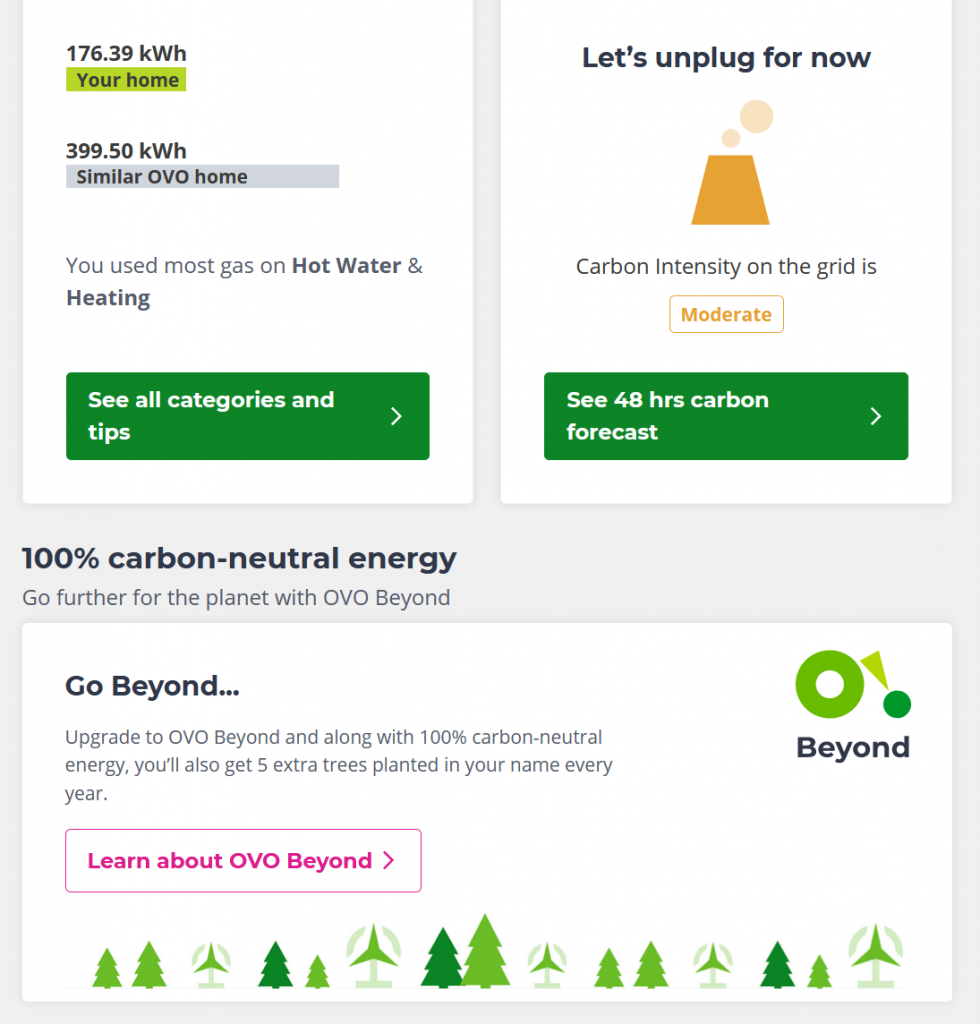
Good question.  Swapping out the Honeywell analogue thermostats for programmable ones, we have full control over all our zones.  I haven’t had the chance yet to swap out our radiator valves upstairs but compared to other similar houses, we running about 25% of their costs as one of the things our supplier does is show you that comparison!

To help with air quality, we are using the log fire less.

Not so bad.  Doesn’t the electric car hurt all this?

Not at all.  When we do charge the car, we spend £4 a day instead of between £1 and £2.  On a dull day, when we cannot charge the car from the solar power we are generating.

That’s a hundred miles for £2 max or 2p a mile.  That’s cheap motoring compared to £1.33 for a litre of diesel.

At home, we have used 430 kWh of energy for the car over the past six months for 46 charging sessions: that’s roughly 8 charges a month or two a week at 18p a session or £84.28 for six months of driving for a 1,000 miles (we have charged else where, but that’s been for free).

Doing OK then?

I think so.  I’m not saying being off the grid wouldn’t be great, as would be using solar to heat our water during the summer, but we are definitely doing out bit.  In 2018 we used 3.9MWh in electricity and 21MWh in gas.  Annually, 805kWh of that was used to travel 4k miles.  We cycle and walk where we can to help keep congestion down too.

Our fridge may be coming to the end of its life, which would help us reduce the daily costs too.

Bone crushingly tired

My name is Sam J Watkins and since I was diagnosed with type 1 diabetes in 1977 at the age of four I have been bone crushingly tired.

This phrase was used by a politician returning to the Scotish Parliament after the birth of her child.

I had a baby in 2000 and the lowering of my blood sugar caused by breast feeding meant that for once, I always had normal blood sugar when I went to bed which allowed me to get substantially more sleep than my average 5 hours.  For four months, I had continuously good sleep patterns.  Then I stopped breast feeding.

High blood sugar (hyperglycemia) for me is anything above 6.8mmol/l when I am trying to sleep.  It causes dehydration, brain swelling, lack of energy, mood swings, frequently needing to visit the toilet and when higher, physical pain.  This is because glucose in my blood is being forced out not used by the body.

Ironically, not sleeping can then raise blood sugar as it causes stress (dehydration, brain swelling etc).  I test more after 8pm than any other time of the day because getting that right increases my chances of getting a good nights sleep.

But along with high blood sugar, low blood sugar (anything below 4mmol/l) causes its own issues including night sweats, panic, fitting, headaches and the need to treat which can lead to high blood sugar.  Treating a suspected low before sleep is easier for me as I’m on a pump than it would be if I were injecting but a sudden drop in the night can lead to a nightmare which wakes me up.  Typically that’s between 2 and 4am.

Sleep deprivation

Lack of sleep has been studied: it damages health because this is the key time the human body repairs.

It harms the brain, causing cognitive impairment and depression.

It impacts learning.  This is before we take in to account the whole impact of high and low blood sugar on the brain.

Many low term diabetics state the condition is like having a demanding toddler on their back 24/7.  Because until we get a good period that’s what it is like.

What can you do?

Generally, I roll with the punches.  The summer is always bad for me as I have hayfever – if I don’t use antihistamine, I have high blood sugar and if I do use it, I have very low blood sugar, so in the spring, I have a major adjustment to my insulin levels.  Again the pump helps me do that.

I use a fit bit to track sleep (which is how I know about the levels.  5 hours is very typical, a brilliant night is anything over 6.5 and a very poor one is barely 3hours and that’s without the physical impact of the high and low blood sugars).

I also use a Freestyle Libre to continuously monitor my blood sugar and painlessly check what’s going on.  It also doesn’t need callibrating.  Unlike other CGMS, it doesn’t beep at me which means, if it’s got it wrong, it doesn’t beep incessently and doesn’t beep to require callibration.

Which means, even if I cannot sleep, I can at least see what is happening.

Last night, by the way, was perfect.

Crossrail chief describes the position we are all in

On Friday, Mark Wild, Chief Executive from Crossrail spoke these immortal words – while we understand the engineering, the software is completely new and is performing a complex task. We don’t know how it is going to perform.

Today’s computer systems are hugely complex and consist of interlocking pieces which need to work together perfectly.  Each interface is defined and tested but the tests are usually incomplete.  Why?  Well, as a programmer, I test against what I have designed and delivered.  That’s a flawed test compared to its experience in the wild and all the multitude of things that can happen.  Crossrail’s software is a complex set of algorithms ensuring trains cross other railway systems, roads and paths without any collisions.  There are weather systems that can impact how that performs alongside other parameters.  It’s not trivial and often will have built in overrides: if it doesn’t get right, who will save the day?

I’ve been designing interfaces that allow the experiences of the users to be evaluated and then we can go back and ask whether the tools provide maximum benefit.

This is an important step: as a designer solving a problem, I can answer as much as I can but that’s not the same as it being of most use and benefit.

What are you saying?  Is the job never done?

I don’t think it necessarily is: the more I interact with users, the more I learn but that is not what many companies are doing.

For me, the more you use computers, see the good, the bad and the downright ugly, the more you improve your output and environments.

So, that’s £430 quid saved

On our recent ski trip we discovered we’d lost the driver’s side dipped beam lamp.   Which is not exactly a legal position to be in but we were heading home and didn’t have a spare bulb – plus, I think I saw it go when we checked the orientation of the bulbs on our return from main land Europe.

Thankfully, we don’t need to use the car very much so my husband had a good look and declared the bulb was fine!

I love the fact I studied diagnostics as part of my HNC back in the early 90’s (1990s not any earlier than that ;)) and having researched what replacing the wiring or headlight unit ($435.44 plus VAT), I thought that with a few unallocated hours on my hands, I might check we were in that position (a diagnostic by the dealership is £168).

I looked in the handbook, took my volt meter and checked the wiring.  My headlamp unit is not a sealed unit: I went for the halogen bulbs back when I bought the car.  I can also switch on the headlamps from the keyfob.  Taking my volt meter and by passing the bulb, it was obvious everything else was working, just not the bulb.

Great, take the bulb out and check it’s not the bulb holder.  Only I can’t remove the bulb.  Check the user manual again and a couple of You-Tube videos.  I am doing the right thing.  I head back to the car.

It still won’t budge.  OK, let’s leave it all alone and get a spare bulb as everything else seems to be OK.  I head to the dealer ship.

Bulb kit

I bought my car in 2010, I have the option to buy a bulb kit which is a complete set of user changeable bulbs.  Even in my ancient car, some of these are sealed units so if a bulb goes you need a complete light unit 😮  Remember the £435 +VAT quote…

Anyway, I make the request.  The lady servicing the service desk hands me off quickly – I may look a bit of a mess, I dropped the roof on the car I drove over and I’m wearing trainers and a jean jacket.  I look like I paid cash for my car in 2010, you can tell – it’s actually one of the reasons I bought the car, the salesman treated me like a lady even though I had turned up to the dealership on a hyperbike: George treated me like I was a human being interested in buying an interesting car not a girl who was looking for her husband.

Anyway, a young gentleman from parts came out and did not understand the term bulb kit.  I explained that for some countries, especially in mainland europe, it’s a legal requirement to carry a full set of spares.  If you are pulled over with a dead bulb (this happened to me once in the UK and I bought and fitted a bulb in the next service station proving why you know how to do that, althought to be fair, in the dark, I did put the single bulb in 180º the wrong way round way) it’s a good to have, helps the police understand you’re a diligent and caring driver.

Anyway, after some wrangling and explaining, we get the right part ordered, although “there’s no guarantees they will work!”.  My car is completely standard, so I’m not that worried.  The bulb kit is turning up on Saturday.

So I head over to Halfords and buy a pair of H7 55W 12V bulbs.

Back to the car.

For the life of me, I cannot pull out the old bulb – while the fuse survived (and I do have a pair of them turning up on Saturday, just in case) I am increasingly thinking the bulb has over heated and bonded to the holder, not terminally welded but definitely a small ionic bong.  A simple jolt might be enough to break the bond, so along with the socket sets for removing the headlight unit, I fetch a large flat head screwdriver.  I am going to use that to prise and wiggle the unit.

Very gently prising and wiggling, it begins to shift and when it does, I ditch the tools and yank that baby out!

Fitting is the reversal of removal, I push in the new bulb and put back the fuse and switch on the circuit in the car and press the button on the key.

Success.  Turn off the circuit and refit the unit retest and I deem that a success.

To wit, my husband said the above 😀  He could buy me a good meal and a piece of jewelery 😉  That seems to be my going rate 😀

Equipment necessary

  1. 10mm socket set, preferably magnetic (for removing the bolts holding the headlamp unit in place)
  2. 10mm torque set with a small head and angled for the wheel arch bolt.
  3. Head touch (in case you’re doing this in the dark)
  4. Optional – large flat head screwdriver
  5. Gloves to keep your grease off the halogen bulb (leather or plastic preferred, washing up gloves are ideal).

Method

  1. Drive the car forward with full lock on away from the side you are changing.
  2. Undo the bolts, including the wheel arch one.  That will stay in place the top ones have a habit of dropping so use a magnetic socket to ensure that doesn’t happen.  You will feel daft losing one and it embedding in your tire.
  3. Wiggle out the unit and undo the dipped beam back cover.
  4. Twist the lamp holder out and prise out the bulb.
  5. Push in the new one and rotate back the lamp holder into its home.
  6. Replace the back cover and carefully refit the headlamp unit.
  7. Replace and tighten the bolts.
  8. Retest the lamp.
  9. When working, close the bonnet.

Should take 10 minutes.


There’s something in that fashion

Having finally straightened out all of my finances (no real debt just gaining some wiggle room) and looking at what we’ve done round the house the past 6 years, I’ve bought some blinds to replace the venetian blinds we had everywhere.

We’re reasonably lucky: every window upstairs in identical in width and height, so the previous owners had a very coordinated look with identical blinds everywhere.

We’ve gone for something a little different.   5 of our upstairs windows are south facing which is great when it’s sunny in the winter but makes keeping the house cool in the summer a bit difficult.

We also have light pollution from the main street lights.

So a set of black out roller blinds has seen us proud.  I’ve even got one in the bathroom.

What I wasn’t expecting was how much better they are at thermal insulation.  It’s quite something to the extent I’m thinking of turning down the morning temp on the thermostats.

Are you sure that’s not just summer coming round the corner?

It’s not been warm the past week, at all.  Barely 5ºC first thing in the morning, so I don’t think so.

It’ll be interesting next winter.

Sounds like you’ve been busy…

I’ve had some unexpected time on my hands and along with the home furnishings, I’ve been doing quite a bit of spring cleaning, garden maintenance and finishing off some DIY.

I’ve been getting on with my training for the cycle ride too, up to 62 miles in one go (over 6hrs 12minutes) so building up my average.  Indeed it’s going well enough I might actually train for a longer ride so that the 100miles in August seems a little easier.

I love the start of a new financial year at work, things are quiet enough to let you plan outside of the office for what you want to be different going forward.

Money for nothing

and the chicks for free is the line from Dire Straits.

Totally unPC these days but with Brexit and interest rates in the UK finally making a difference to our exchange rates, it makes sense to invest some free time into something productive.

Eh, what are you on about?

Many moons ago, we asked our son if he’d outgrown his Buzz Lightyear curtains and got an affirmative grunt.

A trip to John Lewis and we found some curtains he liked that were the right width for his dormer windows.  Great, only thing was the length.  Our dormers are short, 91cm wide but only 127cm tall.

It took me 5 years, but a couple of months ago, with the help of youTube, I trimed off 43cm from the top of each curtain and reattached the curtain header and low, half a days effort we all had made to measured curtains.

And a load of fabric.

You binned it right, or recycled it?

Today, I used 90 minutes of my time (don’t ask, I don’t do this very often) and finished this task.

Step 1:

Buy cushions from Hobbycraft, Ipswich – I chose a 43cm square one as that made the most of my spare fabric.

Step 2:

prep fabric – I took out the black out lining still attached to the off cuts.

Set up your iron ready to iron in the hems for the cushions.

Step 3:

measure out the fabric as specified on Home stories a to z envelope cushion cover.  43cm is 17″, so I measured out 40″ by 17″.

Cut it to length.

Step 4:

iron in the hems for the short edges.

Step 5:

sew in the hems and fit the fabric to the cushion and pin where the overlap is.

Step 6:

do the long edges as per Home stories a to z envelope cushion cover.

Step 7:

take your photo 🙂 and place in room for a very coordinated look.

A big thank you to Home stories a to z envelope cushion cover and N Kinsey. This would have taken me forever to figure out without your help!

I think I still have enough fabric to recover the lampshade…

For those in the UK and Europe

If, like me, you live in the UK or Europe, we do not measure in inches and so our cushion pads are not sold in inches.

This means Beth’s measurements are not directly transferable.

This is her method in metric:

Size of square cushion Size of fabric required
32x32cm 32x79cm
40x40cm 40x95cm
42x42cm 42x99cm
43x43cm 43x101cm
45x45cm 45x105cm
52x52cm 52x119cm
57x57cm 57x129cm
67x67cm 67x149cm
72x72cm 72x159cm

The very sharp eyed will see that basically it’s the width of the cushion by twice the width and 15cm (width by (2width+15)).

Or you could try my cushion tool.

Time waits for no-one

If you’re like us, you woke this morning to find some things had magically changed their time and some things haven’t.

It’s been a very long time since you couldn’t rely on your computer and phone to align to the change in time but if like us you have some smart/programmable systems in your home, they are for a period behind the times.

As a ritual, I do my testing meters and pump together – having one out of alignment is not at all what you want.

Then I do the kitchen clocks (cooker, microwave and wall clock).  The DAB radio sets itself but the land line phone will wait for someone to call us – I sometimes call home early to jog it to the right time.

The TV and boxes now all change automatically as do our radio clocks.  The cars and motorbikes though tend to be done in one sitting.

Fun times 🙂

While I was hypo

I’m trying to write this while I’m still hypo becasue I’m kinda interested in what comes out.

My blood sugar measured 2.3 mmol/l on my freestyle libre about 3 minutes ago. I’ve had 2 mars bars and they are going to take a while to kick in.

My head hurts – the pain is over my left hemisphere, about the size of my palm. I’m full of mars bars and I’m having a little difficultly focusing.

I must try to edit this after wards – that would break the point.

I’m functional, I could probably say some proper sentences though they’d be a little slow. I can still think – I have some mess in my life at the moment, and that’s pretty prominent but mostly I just want to sleep. I just want to close my eyes and drift off.

I’m focusing better, water seems like a good idea. I’m up to 2.7 mmol/l on the libre so probably about 3.4mmol/l via blood – it takes a while for the sugar to seep out from the capillaries in to the fluid the sensor measures. Mars bars are a bit slow but they’ve got a serious punch.

Yes, feeling much more normal (whatever that is anyways). Night all 😉

Why do this?

Good question; because when I was very small, I could never remember hypos.  That changed a little when I got into my twenties.  Never anything useful, but some of the psychedelic nightmares did stick.

I sometimes get an enormous amount of peace when I’m hypo, but sometimes the physical short falls are terrifying.  I had one hypo in 2007 where I was completely paralysed down one side and that was awful.  Even when I came round.

Some people do a great deal to never be hypo.  Thing is, however bad it feels, this is preferable to being high.  Every time, I’ve never had a great high blood sugar, it always hurts like mad.