Main menu:

Site search

Categories

August 2026
M T W T F S S
 12
3456789
10111213141516
17181920212223
24252627282930
31  

Tags

Blogroll

A Coat for the House, part 1.

Entrances and internal walls.

We’ve looked at roof insulation being a warm winter hat for your home. Insulating your floors has given you a pair of cozy slippers to isolate your feet from cold floors. We can think of doing the same for your walls as giving you a heavy-duty winter coat.

Before I dive in, I want to go through our house as a case study. On paper, building started when building standards were still pretty lax compared to the latest edition. Yet, as a self-build, it was a different beast to our 2000 CE built house.

For a start, the external walls are 30cm in depth – a brick layer, the breeze block layer, the cavity wall filled with rock wool insulation, the plaster lined with foil to protect against infrared losses and gains. Upstairs, the dormers are lined with thick celotex and the lower plaster backed by the same material. Chalet bungalows should be notoriously bad at keeping warm, but our house isn’t.

Our 141m2 “proper” house built in 2000 cost around 18,000 kWh in gas to keep warm with a programmable thermostat. Our 244m2 chalet bungalow finished in 2012 cost 17,950 kWh in gas to do the same with the same level of controls. Once we tightened up how the heating controls worked, we got that down to 12,950 kWh.

Why did it cost, comparatively, so much less to keep the bigger house warm? Wall insulation. That’s the biggest difference between the two properties.

Internal walls.

This could potentially be a DIY job. To start with, measure the depths of your walls. Ours are 18cm in depth, and like many houses, we have stud walls. In the past, studs were left largely empty. But lining between the studs with materials like celotex (a DIY task), or foam filled insulation (needs to be fitted by a specialist).

Even just applying rock wool (a DIY job) gives real benefit. I happen to know our house has celotex between the plaster, which gives a U-value of 0.21W/m2K.

The U-value measures the rate at which a material transfers heat. It is measure in W/m2K or Watts per (metre squared multiplied by Kelvin). In other words, the energy divided by the area multiplied by temperature. Remember, the lower a material’s u-value, the better. Very few things are close to zero.

But there are other areas to consider. Doors can be replaced with versions with much lower U-value version. Let’s look at an internal solid wooden door. Its U-value is around 2.5 W/m²K. We do have gaps at the bottom of our doors, but otherwise, they are doing a reasonable job. The house does need to breathe before we start sealing up such gaps.

I’ve heard foam spray foam insulation can cause issues with damp!

A reputable company will ensure that all work complies with best guidance, but ironically, air gaps and spaces are required to allow air to move and stop condensation against plaster and internal pipes and wiring. Some buildings may not be suitable for being tightly insulated with foam insulation as a result. The right materials for the right building is essential.

If you can’t swap an internal door for any reason, buying a thick velvet curtain or thermally lined one for the door can dramatically help improve heat retention. Door curtains can be engineered to open automatically when doors open – eyelet curtains attached to the door itself are ideal ways of achieving this for little effort, or more traditional curtains teamed with dormer or door rods.

Such techniques were used in medieval castles, but the right fabric and mechanism for your room can bring this right up to date!

It’s curtains for you, my friend…

A properly dressed window finishes a room. But we don’t just use curtain for privacy. Good quality curtains can dramatically improve the thermal retention of a room when they are closed.

So it is always worth getting thermal blinds and/or curtains. Venetians are great for controlling light, but it is much harder to get ones that have a decent heat retention score.

If buying ready made curtains, thermal linings and pelmets over the top can really help keep in the heat. Team styles with your decor and rather than looking dated and pastiche, you can end up with a clean and modern feel. Light colours not only reflect infrared but visible parts of the light spectrum, helping keep rooms feeling light and airy during a dark winter.

Ready made curtains can be expensive. Teaming up layers can help improve performance and lower outlay: team cheaper thermal roller blinds with cheaper curtains to give the benefits without the cost. In our dormer rooms, I used single curtains from a pair, and a bent curtain rood to allow the curtains to be drawn back against the dormer wall – when drawn, they provide an external layer to the dormer cheeks, which can be difficult to do otherwise. A dormer rod is a more traditional way of achieving the same goal but costs dramatically more.

Coming up in part 2.

This is a big subject, and this part has focused on what could be achieved internally. Next week is all about the outside.

Help in the kitchen from a surprising source.

Learning how to make good use of our microwave to reduce our power consumption while cooking has highlighted just what we were missing out on in terms of the unit being an extra pair of hands in the kitchen, almost a sous chef.

It should be noted we bought the microwave in 2017, as our previous combination microwave had failed after 15 years. I have had three Panasonic Inverter microwaves and wanted one with a steam function. When it came to this replacement, I bought the NN-CS894S.

I had made use of stage cooking with the microwave and standing time with our previous models. You know those ready meals from the supermarket that have heat on high power for 3 minutes then stand for 2 minutes. But this was not exploiting it to the full! You can put a delay start and a delay end: when I do fish and vegetables. This is how I get to do this in a single pass: when the potatoes go on to start boiling, I set their timer for 12 minutes. I then delay stand the microwave to come on with the second stage of high and the time the fish is going to take, with a two minute stand to time the fish to be ready as I drain the vegetables and serve up the meal.

This version came with a manual with some pre-prescribed “recipes” that combined different functions, such as multimode and delays. This is not uncommon in more recent machines, but the beauty with ours is we get to do this ourselves, we just had to work out how to do this.

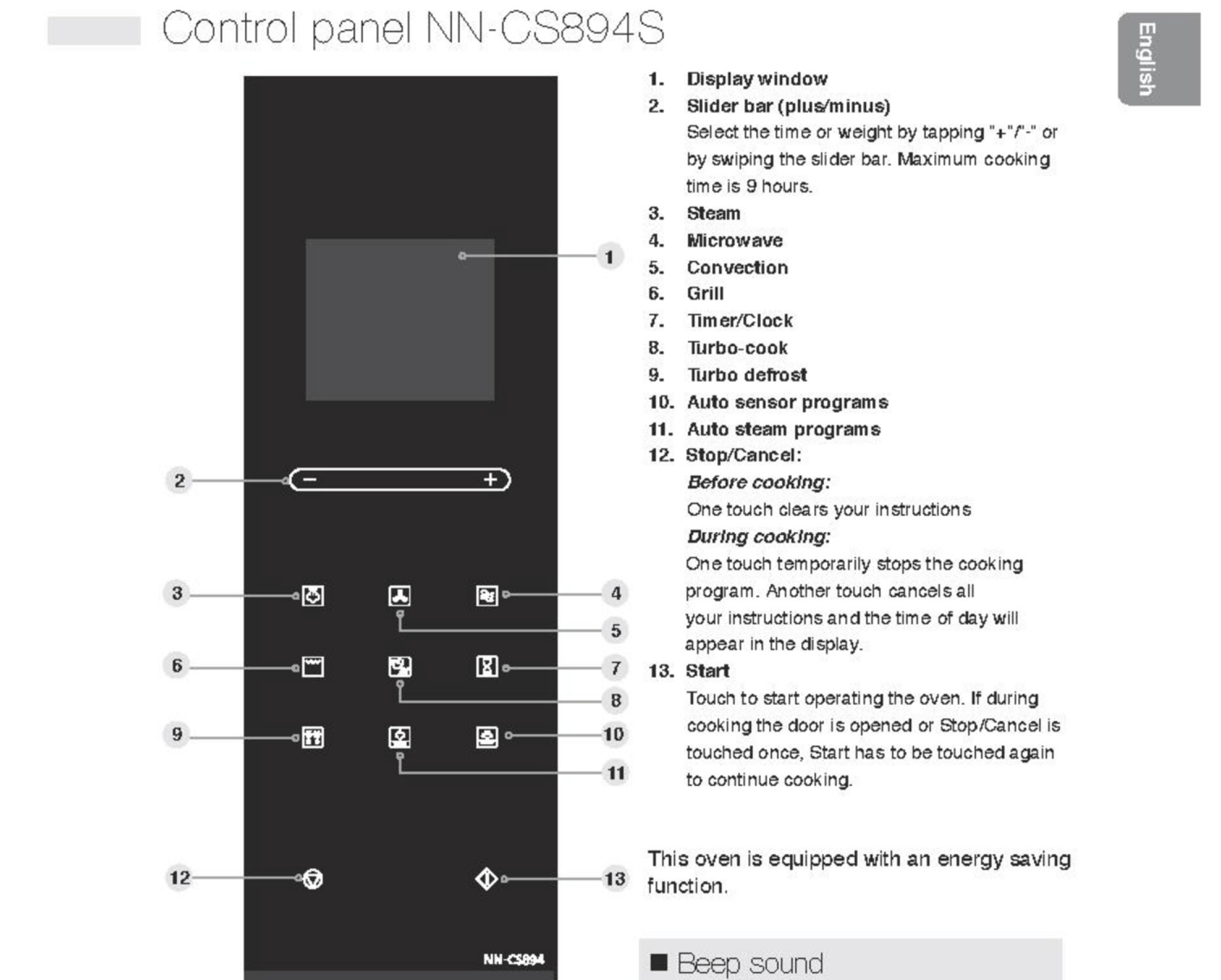
One of the things that is quite tricky, is that it has icons instead of labels for the controls. If you use the microwave daily, that works well, but we didn’t use the microwave frequently when we first got it and setting the clock is buried under a couple of menu choices, as are the self-cleaning functions!

Control panel from our microwave.
The control panel for our microwave.

I’m not convinced that you should need to have the operating manual to work out what is going on!

But it was worth persevering, and I did that by working through the recipes in the back of the manuals. Each microwave is an evolution and this latest one we use instead of an air fryer. It is convection oven has a big fan, so with the right basket, you have all that functionality and capability too.

Newer versions have included far more predefined recipes. The roasting method I use for our Sunday roast chicken is now such a recipe, all you need to do is pick the “Auto sensor” recipe for a Roast Chicken and enter the weight for your chicken.

Cooking a 600g lasagne is done in 8 minutes. Some of these recipes work without the need to preheat first. Like a lasagna recipe, fresh pasta is your friend if not pre-heating.

It all looks like a great deal of faff! And for what?

If you are working full time, raising small children, and can afford to do differently: such tooling may be optional, a nice to have.

But if one of those things is missing, money, a little free time, then the rewards cost in.

Running the microwave at the same time as the convection oven instead of just a convection oven costs in for doing a roast chicken. I did a 1.625 kg chicken today with roast vegetables for 43 minutes. That’s as quick as doing it spatch-cocked, for a fraction of the effort, and the vegetables were done at the same time. Doing the same chicken traditionally in a fan oven would have been 1 hour 36 minutes.

Plus that chicken was moist in the middle and brown, crispy skin. Just like a traditionally roasted chicken. We had it with roasted carrots, potatoes, broccoli, peppers, tomatoes, leeks, baby marrow, and baby corn. That’s 8 vegetables and a portion of meat served from out of the fridge and on to a plate in less than an hour for three adults and loads of left overs for the week.

Then there’s things like pies. We’ve moved to cooking from scratch, but if there’s one thing that kind of food is, it is quick. One pot to wash up, multistage cooking but otherwise, painless. 21 minutes of cooking, and 10 minutes of prep, if you peel the potatoes.

Soups are revolutionary. A stick blender and a litre pyrex jug, and the washing up is minimal. The stilton and celery soup I made last week was brilliant in colour, texture, flavour, and scent, in 18 minutes of getting the vegetables and herbs out of the cupboard and having soup to eat. Carrot and coriander soup in 13 minutes, and that has much less prep time. No faffing with a tetra-pak or bottle or can, just fresh vegetables.

All the washing up disappears in to the dishwasher too. Midweek cooking is nutritious and easy.

I make the most delicious flans, but what with standing the pastry then baking the entire flan is looking at 80 minutes of hard cooking. With the “turbo-cook”, a Quiche Lorraine can be baked in 7 minutes instead of 35-40! This brings our 5 minutes to make the pastry, 30 minutes to stand in the fridge and 35 minutes to cook down to 42 minutes. It does help if the proportions are right, that took more time to master. (Pre-packed pastry means it’s significantly less time, I just like doing everything from scratch).

Even if we’re not using the microwave function, the small oven heats in nothing flat. When there are fewer than four people in the house, it is our preferred method for cooking one thing in the oven. Yes, it will do a 2kg chicken comfortably, but there is not enough room for a few racks above or below it. Size does have its limitations.

We chose not to build it in. That gives us a service to warm plates on with wasted heat. I do this for the roast dinners and flans. When we get the kitchen done, I am really keen the microwave has that space to warm six plates.

A warm pair of slippers.

A cartoon image generated by Gemini of a pair of slippers on a rug next to a chair, in front of a log fire.

While roof insulation can easily be considered a hat for your house, treating the ceilings and floors is a harder concept to articulate…

Just get on with it!

Indeed! Insulating the roof does so much to prevent you losing heat outside is obviously a good idea. The floor and ceilings are a harder concept to see as being beneficial. Yet they account for 10-20% of losses on the ground floor. Yet ceilings lose around 25% of heat loss from a room. This is all about maintaining the temperature zones between rooms that preventing losses into the outside world. Slippers are internal shoes…

OK but upstairs, we benefit from the roof insulation!

Not really, because this is an extra layer in many new builds. The ceiling of the ground floor is essentially the floor upstairs. A floor may be easier to get to, than a ceiling. But if we don’t do the ground floor itself, we are missing an opportunity.

It may seem insane to discuss insulation during one of the hottest summers in the northern hemisphere. But while the news talks about insulation making it harder to lose heat (perfectly true), the journalists do not say that good insulation can keep your house cooler for longer. Insulation gives heat stability.

Let’s start with upstairs.

Whenever you take your carpet up for any reason, take the opportunity to look at what you have. Like the roof, care does need to be taken. If you have some rock wool between the ceiling downstairs and the floor upstairs, that’s likely to be done in more than one place.

If not and you can unscrew the floor boards, this is not a difficult job. You simply run rock wool between the joists as per https://www.youtube.com/watch?v=UCGpRpKKGV8. Now, it is much easier to do this when the house is built. But there are other opportunities: any room being refurbished can have it applied.

Having the floor up for plumbing or heating pipe moves, is such an opportunity. In bathrooms, always install a water proof membrane to protect your wooden or steel joists. Just remember: unlike the ground floor shown in the video, internal mid-floors live inside the warm envelope of your house, so they don’t need external ventilation blocks or air bricks to stay dry.

If that’s really not an option?

There are other things you can do if that kind of insulation is not applicable. Any floor, any where can have an insulating underlay installed. https://www.youtube.com/watch?v=nwdbRTrtjQY shows one approach and there are many products out there, all with pros and cons. Do look for materials with a foil or reflective face, as this helps with infrared shielding. The higher the R-value, the better the performance is likely to be.

Using carpets upstairs can be much warmer than using wooden floors. If putting in a new laminate or wooden floor, do ask your supplier about the thermal properties of the materials you’re using and what their recommendation is for the underlay. Will they fit it? Will they ensure floor boards are sorted out, if you can’t get to the boards before hand?

If you fit the underlay yourself, do follow the manufacturers guidelines for ensuring there are no thermal or condensation bridges formed. Tape is often recommended to ensure rolls or blocks of insulation are as close as they can be. Stapling the material to the floor may not be suitable for that very reason, as metal staples can introduce a thermally conductive hole.

Remember, just doing underlay is not perfect, but can have an R-value between 0.5 to 1.5 m2k/W and save 30% to 40% in terms of preventing loss between rooms or the floor compared to uninsulated floors. This simple change can reduce localised heat loss down to roughly 7.5% in an upstairs room.

OK, will that underlay approach work for the ground floor too?

Yes, and it will help, but there are bigger opportunities if you are doing renovations. Again reducing your loss to 7-14% instead of 10-20%.

Every little helps, even just an extra layer of insulating underlay, if there is no opportunity to do anything else. Wooden flooring and carpets tend to have a 20 year life, so the insulation needs to last that long too. It may seem like adding extra to the bill, but you will get it back.

A survival guide to living in arid times.

A drought has been declared here in the UK. At least officially.

What does that mean, when do such declarations get made and is there an end in sight?

There is no definition of what a drought is. A sustained period of no rain, seems vague. Yes, we have had several ‘heat dome’ situations in the UK over the past 12 weeks. Yet ‘hose pipe bans’ only came in late June, early July. Why is it only a drought now?

Even if it wasn’t a drought, is there more I can do to control my costs? I’m one in one of the 60% of homes in England fitted with a water meter, so every drop counts.

Lovely winter.

It was wet and grey, an archetypal British winter, at least here in East Anglia. It meant that our reservoirs were pretty full, with both April and May having their usual amounts of rain. From the end of May through to August, it has been hot. But winter and spring meant the hot weather was buffered by stored water.

We don’t tend to water the garden from mains water. I feel that potable water is for people not for plants. Yet the grass was still green in early July. I remember driving to my parent’s place when I graduated in 1997 and the fields, verges, and gardens being brown in early June. Because of all the rain over early this year, the fields turning brown happened much later this time.

What can I do to help?

Here’s some of the things we’re doing:

Cooking.

Any wasted cooking or drinking water can be used for plants. Cool down water from boiling vegetables to room temp to water plant. Not only saving the waste water, the trace elements from the vegetables help give plants a bit of a boost.

If you have modern pipework, fill glasses and pots right from the start of letting the water flow. If not, catch that water for plants and cleaning.

Cleaning.

Washing up typically uses more water than a dishwasher, but there are things you can do. Washing knives, cooking utensils, and cutlery first in shallow water. The water will be very soapy, so rinse off into the bowl or sink. That provides more water for the bigger items. Save up to do a day’s washing up in one go, rather than many smaller washes during the day. Save a jug of cleanish dish water to wipe down the surfaces from cooking.

Fill up machines. Or use half loads. Keeping yourself clean, and deodorised, keeps your clothes clean.

Windows and cars just need to be useable not spotless and shiny.

I use a steam cleaner. One litre of water cleans four sinks, one bath, 2 windows, 5 floors, and one shower.

Gardening.

If a plant is already dead, water is not going to help. Do try to hang in there, what looks dead may just be asleep for the rest of the year. Plants have survival strategies like us.

Do not water grass, it is incredibly resilient, and is likely to pop up green with the next major shower. Be patient. Do not walk on it unless you weigh less than 10kg (22lbs – 1 stone 8lbs).

Hygiene.

Do not flush if you just urinate. When South Africa had a long drought a few years ago, they had a motto. ‘If it’s yellow, let it mellow, if it’s brown, flush it down’. It sounds gross, but we’ve been doing this for a while and it does make a difference to our water consumption.

Showers over baths, goes without saying. But turning off the water while you soap and shampoo can save just a little bit more. Waiting for the water to get hot is time I use to wash my feet.

Don’t shower or bath if you’re going to the gym later. If you think about it, you’re getting clean just to get dirty… Your skin will thank you too.

We’re not at the stage where you put a bucket in the shower to use to flush the toilet for when it’s brown… But ‘grey water’ from baths can also be used for this purpose. Before you empty the bath, collect a couple of buckets. Half a bucket covers the yellow flush, three quarters, a brown flush.

Hands do not need the tap running while you soap. Levered taps allow you to turn off the mixer or single taps to lather and rub for the recommended 20 seconds, before rinsing. Same for brushing teeth, though of course that’s two minutes!

NB: South Africa brought in many measures as the country survived a two and half year drought. When a drought starts, it becomes difficult to predict when it will end.

There has to be a better way?

Harvesting water yourself to be able to use at such times is not a new idea. Some take this to the final stage and purify the water for drinking, but toilets can use grey water with little processing required for rain water collection. I know one family who used the grey water for washing their clothes too. All you have is a storage tank, often underground, with your drainage going in to it from your roof, then a grey water circuit feeding the toilets and utility area. The owner was passionate about sustainable living, so sunk a water storage tank into the back garden.

If you really have the space, you can process your sewage too. Often seen in rural, off-grid, Grand Designs (Channel 4 in the UK) homes, they can filter it through SUDS (sustainable drainage systems), which then feeds reed beds to ‘polish’ the water to near potable standards. I saw a great example of this during the Carbon Charter Summer Event 2026, held at Pilgrims Barn, in Haughley, Suffolk.

But with a 6,000 litre tank, seems out of reach of many. Actually, such tanks are only 5.5m2 in area, and about 1.2m deep, often buried underground, this is an easy task for many new builds. What is difficult is their reed bed and swimming pond, which were bigger than our back garden and many of the plots previous houses have sat on!

But doing this for several houses in a new housing development would be achievable, much like ground source heat systems.

I love living in East Anglia, but we have very little rain in a good rainy year. We’re classed as semi-arid. Many more homes are being planned in the area, and without real thought about how that works in terms of SUDS and water reclamation, it is not going to be possible. Were you aware that water and sewage companies do not get involved in planning decisions until very late in the process, in England?

Apart from saving water waste, you haven’t talked about how you are doing?

Our smart water meter was fitted in March, and we have used it to try and be careful with water. We clean ourselves, our house, our plates, and our food, cook with it, etc.
Two adults over July used 6,976 litres. That makes our usage per person 112.5 litres a day.

The average usage in the UK is 139 – 142 litres. To ensure we have enough water for everyone, the Environment Agency is aiming to get down to 110 litres per person per day. We’re approaching that target but still have a way to go. Our usage was 117 litres per person per day in May. It’s not as good as June, which was 85 litres per day but we did spend 6 days away from home on holiday.

What do you do to save water? Any tips or tricks that keep life comfortable while reducing your needs on the essential liquid for life?

Living off the grid

Yesterday was the first day this July we were using electricity supplied from the national grid.

In fact, since the middle of May this year, we have, where humanly possible run ‘off-grid’.

Where humanly possible?

Some things are scuppering this philosophy. This sounds so ungrateful, but our electricity supply company gives us free hours of electricity and I am sorry, but I am going to try and use that.

We’ve also had three days where we just haven’t had enough of a chance to harvest and store enough from our solar cells.

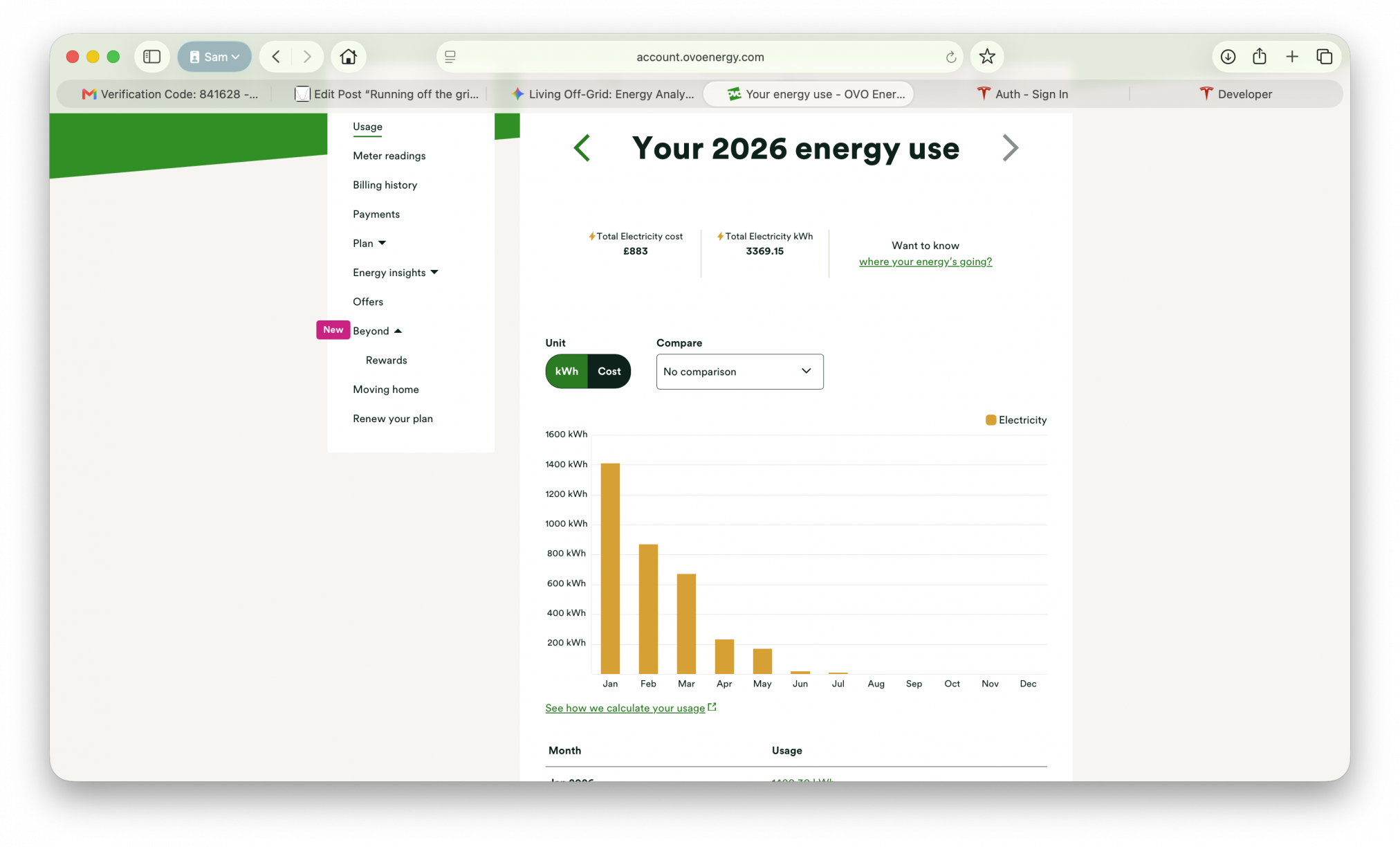
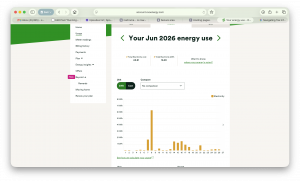
But in June, we only spent £3.81 on electricity consumption. Our electricity is £0.2375 per kWh (aka as a unit), plus VAT of 5%, so £0.249375. So we used 16.2kWh from the grid. We also pay a standing charge of £0.5138 +VAT (£0.53949) a day.

Surely you would be better off with a cheaper contract!

I love doing this analysis, because our £20.22 in June was mostly the standing charge. Full stop exclamation mark. We could go for a contract with a cheaper per unit price.

Every single one of those has a much higher standing charge. When we’re producing our own electricity, it makes no sense to do that.

In many ways, I am not against that. In the UK, our energy companies are privately owned, and they are trying to make money. We are not a cash cow for them, exactly the opposite. I also like the fact we have the grid to fall back on. It needs investment to keep it working and up to date.


So, I willing accept a charge of £0.249375 per unit, so that my monthly bill in the summer is as low as possible.

How low did you go?

Good question, and you know I love my figures. Let’s do a month by month walk through.

May 2006.

I realise that to reduce our bills, I need to ‘go off-grid’. This means the Tesla Gateway is operating in ‘island mode’, so it is not feeding power back into the grid or taking power from the grid.  

In fact, this seems by far the best way to ensure we do not use anything more from the grid than we have to.

I have set up various rules on the Tesla Gateway to fit in with our energy provider’s rules on the free electricity (zero rated), but the Powerwall logic is really basic. We are limited to 1 kWh for an hour, the Powerwall seeing it as a cheap way to charge the battery means we have to buy electricity.

Self-powered mode again doesn’t really help if it sees protecting the battery from running too low for an hour as not being worth the effort during our ‘peak time’.

Telling the battery to only charge off the solar also doesn’t work. Being in island mode does. And keeping an eye on it.  When the battery gets to 100%, the gateway stops consumption from the solar panels. It effectively turns them off, safety passive cooling which isn’t helpful. At those points, I need to reconnect to the grid.

As I said, we didn’t start doing the off-grid thing until late-May. Basically, in terms of our Tesla Powerwall’s analysis and our electricity bill, you can see the difference it made.

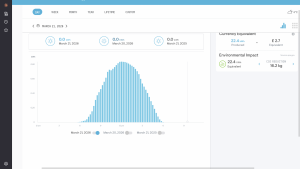
A graph showing our energy usage in May in terms of whether it is sourced from the grid or the solar or the battery.
Our daily consumption in May from our supplier.

I learnt a great deal during this time on how the Tesla made decisions. None of them seemed geared towards us, and the fact we wanted to reduce our carbon footprint, and take advantage of cheap electricity albeit with some rules.

June 2026.

I’m still fairly nervous about all this: forget the business imperative, I use insulin. During a heat wave, the most valuable commodity I own is my fridge which protects my insulin and keeps it effective. Without insulin I die. I would die from starvation, but not as quickly or as painfully.

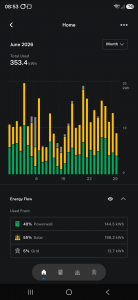
But this is the first month we pretty much manage it. We have not had a stellar month compared to last year. But generating 401.6 kWh absolutely covers everything we use, and some. 401.6 – 353.4 = 48.2 kWh. Although it doesn’t appear on this month’s bill, we even manage to donate some spare energy once I realise we have to manually do that. The SEG payment was £0.23.

A graph showing our energy usage in June in terms of whether it is sourced from the grid or the solar or the battery.
Our daily consumption in June from our supplier.

July 2026.

I am happy enough that, while there is a week to go, we have enough evidence to say the case is proven. This has worked for us. Again, compared to last year, we are not generating as much electricity from our solar cells. Their performance is still high, at 12 years old, we still get days at 21 kWh, it is just that is dependent on the weather. We’re also not ideal for mid-summer, the equinoxes are our peak generation time. The summer highs are purely down to how long the sun is in the sky.

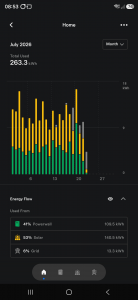
We generated 298.9 kWh as I write this article and we have consumed 263.3 kWh. To quote Mr Micawber: annual income twenty pounds, annual expenditure nineteen pounds nineteen and six, result happiness. Annual income twenty pounds, annual expenditure twenty pounds naught and six, result misery. We are using less than we’re earning, so we are very happy bunnies.

A graph showing our energy usage in July in terms of whether it is sourced from the grid or the solar or the battery.
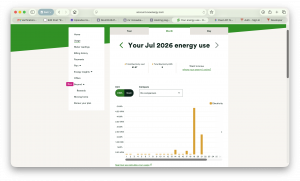
Our daily consumption in July from our supplier.

I’m noticing July is more than June, and your usage is really high.

Yes, there is a whole extra day in July, and that makes a difference.

Yes, we power an electric car. This makes electricity much more valuable for us: every unit we use to drive the car means we’re not buying petrol or diesel. We haven’t had gas heating our rooms or water since 2024.

We cook, clean (washing machine, hot water, vacuum, dishwasher), have powered vehicles, have lighted rooms when it is night, work, and entertain ourselves from our electricity. Electricity is doing everything for us.

It’s more than many people use, but it might explain the difference. When we’re asleep, our background usage is between 100 and 300 W an hour. Before we got the batteries, I worked out what was taking electricity, and if possible, changed the devices or our behaviour to bring our requirements as low as possible.

Before April, our base usage was 200 – 400W but we swapped out a router and its wifi extenders and that has made a huge difference.

The big question is, how long does your battery last?

We answered this question many times when we first had the EV!

During the summer, the 27kWh batteries provide two and half days guaranteed. Longer if we make an effort or are out of the house. I have connected to the grid for our free hours of electricity today.

This blog is now a podcast!

Well, “Driving off the grid” is.

Excited to announce that our journey towards sustainability has been transformed into a Spotify podcast!

“Driving off the grid” explores the steps we took to decarbonise our lives and the insights we’ve gained along the way. You can listen to the podcast here: “Driving off the grid” on Spotify, or on Audible or Apple.

This podcast is built from the research material I compiled for my blog. I hope you find it interesting and gives you with valuable insights into how we took our home from EPC C to EPC B, and beyond.

Keeping your head while…

Unusually, I got thermodynamics in physics. Heat is all about vibration of molecules rubbing together or hitting each other. Small amounts of friction taking and giving off energy.

Which brings me to today’s subject. It is inspired by a throw away comment my husband made this morning. Would the recent heat waves would change the priorities of home builders in the UK, i.e. build them to keep them cool as well as warm?

I live in a temperate country, we have seasons. The things that help us keep warm in the winter are terrible for keeping us cool in the summer. I’m talking of the principles of solar gain, trapping heat indoors, and heating via hot water,

Except one of those. Trapping heat is actually a preventative measure in keeping cool. Good insulation is terrible for losing heat, but if you maintain your thermal envelope, a room can keep up to 5°C cooler than outside. This is how many architectures work in deserts and the tropics. Long before chemical and mechanical heat exchangers were used.

If we look at how more traditional methods work, we see highly efficient and mechanically simple designs appearing all over the world. Carpets are not placed on floors in Middle Eastern countries but are used as a barrier to prevent the heat stowed in the wall material from heating the air in a home during the day. Exactly the same idea as cavity wall insulation in a modern UK home.

I’m not hanging carpets and rugs up on my wall this weekend!

I’m not suggesting you do. I am saying, appreciate that you may be lucky enough to have some help already built in to the fabric of your home.

What about solar gain? I have to say I’m closing my blinds and curtains but it’s not making much difference!

You have to combine it with other passive measures. If you have good insulation – once the heat is in there, it needs a channel to escape from.

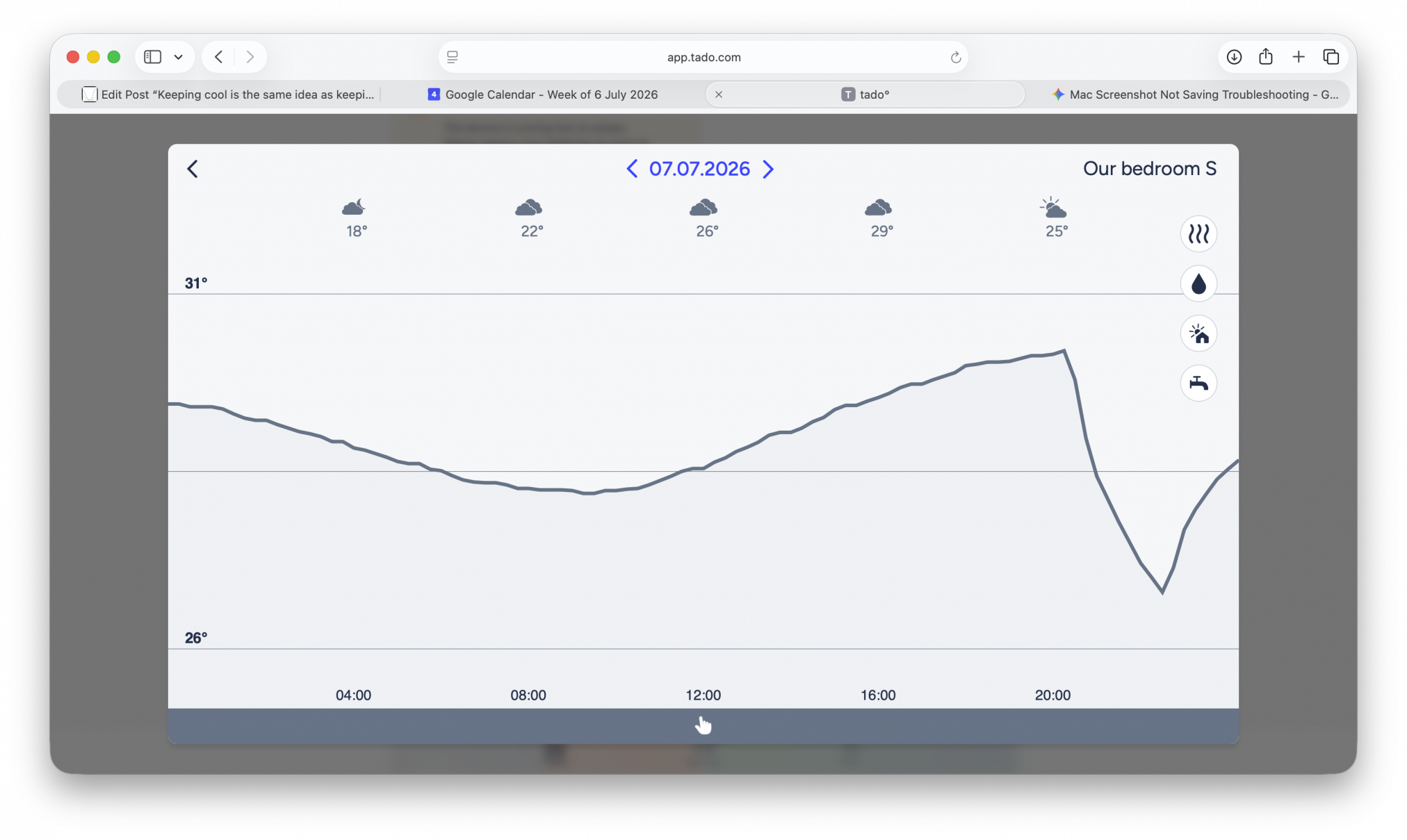
Let’s look at our bedroom, it faces due south so bakes in the afternoon sun. At 20:00 last night it was 30.2°C.

I opened the windows at 20:25 (east facing and south facing) in the room and the temperature got down to 26.8°C by the time we got to bed at 22:30. Because we’ve been using this approach regularly, we are now comfortable sleeping that warm. We have a flat sheet between us and the world that helps our bodies wick sweat away. My skin temperature is maintaining its usual levels. According to Samsung Health, my sleep is off good quality.

We are not even using a fan at the moment, overnight. Our offices are the only places where we are using such devices: the office machinery driving up temperatures during the day.

But that still sleeping in a room whose air temp is 26°C!

That is 9°C warmer than the WHO recommends for most people. Actually, for older adults the recommendation is up to 25°C. We are heading to those warmer temperature needs.

But my husband’s comments are valid. Air to air heat pumps providing “heat and air” would give the UK inhabitants the freedom they need to respond to the weather.

Retro-fitting is non-trivial. To prevent heat channels (both losses and gains) and condensation paths, such measures need to be built in to the fabric of the structures. As they are in office blocks.

Not what you are doing today then?

Like many, we’re looking at fabric blinds to shield from the sun over the summer. Our triple glazing will give us insulation during the winter, But if you lack triple glazing, external, insulated shutters can boost your U-values for your windows and doors.

Our sail downstairs helps to protect the lounge from direct sun in the day time.

We then use passive cooling to remediate any gains made. All for significantly less than running air-con in terms of installation, running, and maintenance costs.

Steaks in the ground.

We have a rule in our house since 2020: if you buy another kitchen gadget, something has to be given to a charity shop or sold.

So much to unpack here, don’t you mean stakes in the ground?

No, I don’t, we’re talking about food. Let me continue.

OK, but wait, you have a ginormous kitchen. You don’t need to do that!

Maybe, but we’d soon run out of room. Plus, how many gadgets sit in cupboards unused about the world?

So what makes the cut for you?

After my years of cooking and living in a kitchen, these are the basics.

Food processor.

I started off with a food mixer, but actually, if space was short, I would have a smallish food processor. You can make pastry, meringue, stuffing, mayonnaise, salads, soups, even bread if you get one with a dough hook.

Combination microwave.

From roasting to soups, to flans, rice, puddings, proving dough, cooking fish, and eggs. I’ve had a microwave since I was 20, and am now on my third – they typically last 15 years. Sterilising baby’s bottles and warming the milk. Making toast. Warms up instantly and when I am on my own provides tasty meals in minutes. Cost effectively too.

Mine has a fan oven, so it doubles as our air fryer. The microwave function means they self-clean too.

Bread machine.

This is my luxury tool but mine gives me so much. Fresh small loaves that last a week and are done while I sleep. I do pizza doughs, baguettes, and rolls, which I finish off in another oven, and tea cakes.

Mine is ancient, but is still going strong. I have a fund to replace it when the time comes, if it can’t be repaired.

Hand blender.

So, if you have a food mixer, the question I have is do you really need a hand blender? Probably not. But a very basic unit with a metal blade allows you to make soups in your microwave with so little washing up.

Of course, many have attachments, so if you are not sure you want a dough hook on your big food processor, forget the big food processor and get a grater and slicer attachment for your hand blender. Most of it goes straight in the dishwasher too.

When my son buys his own place, I am getting this as a house warming present. For those on a budget, a fully kitted out Braun Multiquick 9 can be bought in 2026 for £130, e.g. Curry’s offer.

You can even get a potato ricer in this kit!

Food mixer or no food mixer?

So, I don’t have a dedicated food processor because I got a food mixer (Kenwood Chef) when my grandma down-sized. There’s an argument I don’t need the Bread Maker, because I have my food mixer.

What being given this did for me was allow me to add attachments over the years.

  1. Mixer – the basic function, but you can buy different tools and bowls to give you more options. I have the whisk, dough hook, k-beater, and creamer. I don’t have the folding tool yet.
  2. Pasta roller – to make spaghetti and lasagna.
  3. Blender – to make soups and shakes and mayonnaise.
  4. Mincer – I make my own mince. For burgers and meatballs or sausages! And gives the name of this article, a grounding in what you need as I make steak mince into delicious custom burgers.
  5. Pasta shaper – for linguini, macaroni, and orecchiette, and fusilli.
  6. Food processor – which changed my life. All of it goes in the dishwasher. Dicer, graters, “mixer blade”, and adjustable blade. It’s a great tool as you can make pastry with from the freezer butter!
  7. Continuous Slicer Grater Attachment – which allows you to do the slicing and grating option of a food processing but without limitation – I got this before the food processor. Technically, I may not need this any more…
  8. Fruit Press Attachment – juice seeded fruit to get something without the seeds. Not an essential.
  9. Blend Xtract Sport Attachment – love this, I use it for milkshakes. Everything goes in the dishwasher!
  10. A coffee grinder.
  11. A smaller grinder for bread crumbs. I use this where a pestle and mortar is required.

It is a very capable tool and I have used everything. Over the summer, I use the sport attachment a great deal with produce from the garden.

The continuous slicer told me a food processor would be worthwhile, and I use the food processor four or five times a week, though the grater and “mixing blade” more than anything else.

It helped me work out what I needed and if someone offers you one, get it if you can squeeze it into you kitchen. But if space is an issue, a hand blender will give you 80% of the functionality.

Toaster.

If you have a grill, you can make toast. Our combination microwave gives us this capability, so maybe.

Kettle and coffee maker.

I am going to be controversial and say, maybe. The modern kettles are incredible, 95% efficient. The same could be said for the modern coffee maker. Both take room on your counter.

Induction hob.

This is a fourth place item – teamed with a combination microwave, this gives you the ability to cook multiple things at once in a variety of ways. As efficient and with timers and programmes can be a real aid. If you have a hob, this is the one to go for.

I have cooked on old element electric hobs, gas, induction and halogen. For quick food, and real controllability, induction wins hands down. Halogens I think do some things better. Gas is versatile, but nowhere near as efficient. If you miss the “flame” cooking, a hand held cooking blow torch does the job.

If you had to have four things?

Food processor (with all the attachments), stick blender for soups, induction hob, combination microwave. I could live with these. The others give me flexibility but these are my essentials.

As I’ve said, my bread maker is my luxury item. I could live with the four above, but the bread maker brings a smile to my face.

Going from surviving to thriving.

I’ve had my own website since 2008 (long story, not relevant here). It was compromised in 2009. I was away from home, and while I had backups, there was no way I could get to them. It taught me a few things though: the compromise was completely my fault, so my website had to survive the human element.

In some ways, it led to my career in cybersecurity. It taught me to listen to what was going on in the world in this regard, and to be professional and intentional in my actions if it was for personal use. It’s also allowed me to recover from three attacks against my personal web site.

I’m sharing with you what I now do, and how I got there. But to summarise, my defence in depth is:

  1. Firewall zoning: only letting legitimate traffic through.
  2. FireHOL level1: blocks entire known-bad netblocks at firewalld, never reaches the webservers – I have seven, don’t ask, some proxying others.
    Also protects the other end points: secure shell, VNC.
  3. Web application firewall: CrowdSec community + third-party blocklists, pre-emptive IP bans from collective intelligence
    • samj/ban-browserless — catches browserless scrapers on first hit
    • samj/path-throttle — catches aggressive crawlers even with a UA
    • CrowdSec built-in scenarios — SSH brute force, CVE probing, bad user agents etc.
  4. My webserver’s security modules.
  5. Backups. Always take backups. We’re talking about “business continuity” here, so things can happen and you need a safe place to get back to.

Each of these has a dedicated purpose. Each is simple to set up initially, the tuning can be finicky. Claude and Gemini can be your friends here, as can the community sites.

Let’s look at what each one does and some tools that can help you. My server is a linux one (what are clouds made of? Linux servers mostly!). Windows and Mac often have ports of these tools.

Firewall zoning.

This looks like gobbledygook when you first see it, and in some ways it is. There’s a lot of jargon for some simple ideas that are really powerful when used well.

My server has a “software firewall” running on it. If you use PCs, this is what Windows Defender is. In linux, there are two common ones in use: ufw and firewall-cmd.

Each of these allow you to specify rules. The rules I have on mine allow services in and out depending on the zone (or area) the traffic is coming from or going to.

I run various tools: webservers, webservices (subtly different), remote access, etc.

But I also want to allow my machines to receive mail messages, chats, and web traffic in general. So, the firewall not only allows information to be requested and sent, but make requests and receive traffic. We call this one way traffic (in or out) or bidirectional (both in and out).

Every server is unique and you should sit down and think about what you need or are trying to achieve. What are you sharing and what are you protecting? What is shared with the world or with your family and friends or with no-one?

FireHOL level1.

The next part of this software firewall is white listing and black listing. Believe it or not, there are “black lists” available out there which hold the IP addresses of the bad actors.

That’s a big statement, let’s break it down. An IP address is the location of a machine on the internet. Every machine has a unique address, and there are families of addresses, called subnets. A “bad actor” is a person or programme that is trying to perform a cyber attack. We don’t tend to use the term hacker in the community because we all creatively find solutions – some are for good purposes, some for bad. “Bad actor” says what the aim of that individual is.

This was one of the first things I ever did for my server. I formed a “black list” from the people who were trying to break into my machine. Now-a-days, I download a published list from https://iplists.firehol.org/files/firehol_level1.netset, hence the name of this section!

This forms a “drop list”, when a machine (it could be a person or a programme) talks to my server, if their IP address is in the drop list, their connection is dropped. They can’t do anything more than ask “can I connect” and be told “no”.

I automate the application of updates to this list.

Web application firewall aka WAF.

OK, there are a few ways to do this, and many people choose tools like https://dash.cloudflare.com/ to protect their websites – these often do more besides, and as a beginner, I would recommend them.

I choose not to do that, using https://app.crowdsec.net/ running on my machine.

Either option gives you protection over what anyone, anywhere, is allowed to do on your website and what they can’t do.

This is limited to website traffic. Very powerful tools, very complicated, but can protect your site from being downloaded on to someone else’s machine and used for their purposes.

WAF form their own “drop lists”, so if an IP address has been compromised and an automated programme (a “bot”) is trying to cause mischief, the WAF will block them.

The webserver’s security modules.

Webservers often have security modules and “hardening techniques”. Hardening techniques are setting things up in the most secure but accessible way possible.

In my case, I only let some functions of my wiki and this blog be available to registered users who have logged in.

If you are trying to do something you are not allowed to:

An image showing access to the URL is blocked.

But a user who has logged in can.

An image showing access to the URL is now allowed.

Backups.

Active defence is ideal, but do not rely on it. A power cut could render the disks on your server unusable: I had this happen to me today, which prompted this blog.

Thanks to my backup I was able to recover the site in less than 20 minutes. I have some offline and some online, the offline ones protect against a ransomware attack.

Or if the powercut rendered all the disks in my server unusable, the offline backup means I can quickly launch a new server with most of the work retained.

There are two approaches to backups:

  • Total: application, its configuration, and its data.
  • Data and configuration only.

Data and configuration can mean a new install of an application or service takes 10 minutes, but you have a full service available.

A total can be as little as 2 minutes – depending on how big it is – once you have a working machine.

If you do nothing else, do backups! Test them regularly – are they doing what you need them to and allowing you to recover your service as quickly as possible?

A closing note

There’s so much here I haven’t spoken about. Operating system, application, and service hardening, virus checkers, security policies, user management, zero trust…

But this is a good starting point to, hopefully, whet your appetite for exploring those subjects.

Wait a sec, you spoke about three attacks on your home web site? What happened?

First one in 2009, I left open a priviledged ssh access with a weak password. Someone got in and deleted all the files making up my website. They couldn’t do anything else because I have always performed zero trust policies on my server, something you get for free in linux. Backups allowed me to restore everything, but first I removed the account, ensured people needed a certificate to get into any account, and put in a zoned firewall with intelligent blocking. If you kept trying to get into my machine with ssh and kept failing, your ip address was blocked. I still get 6,000 odd tries a day, but without a key against an accessible user, you are not getting in. The router firewall also protects by shielding probes against all the machines in our network.

Second attack was on the 16th March, a distributed denial of service one: multiple bots were trying to access my site at once. I tightened up my web server’s security module definitions. Service was resumed.

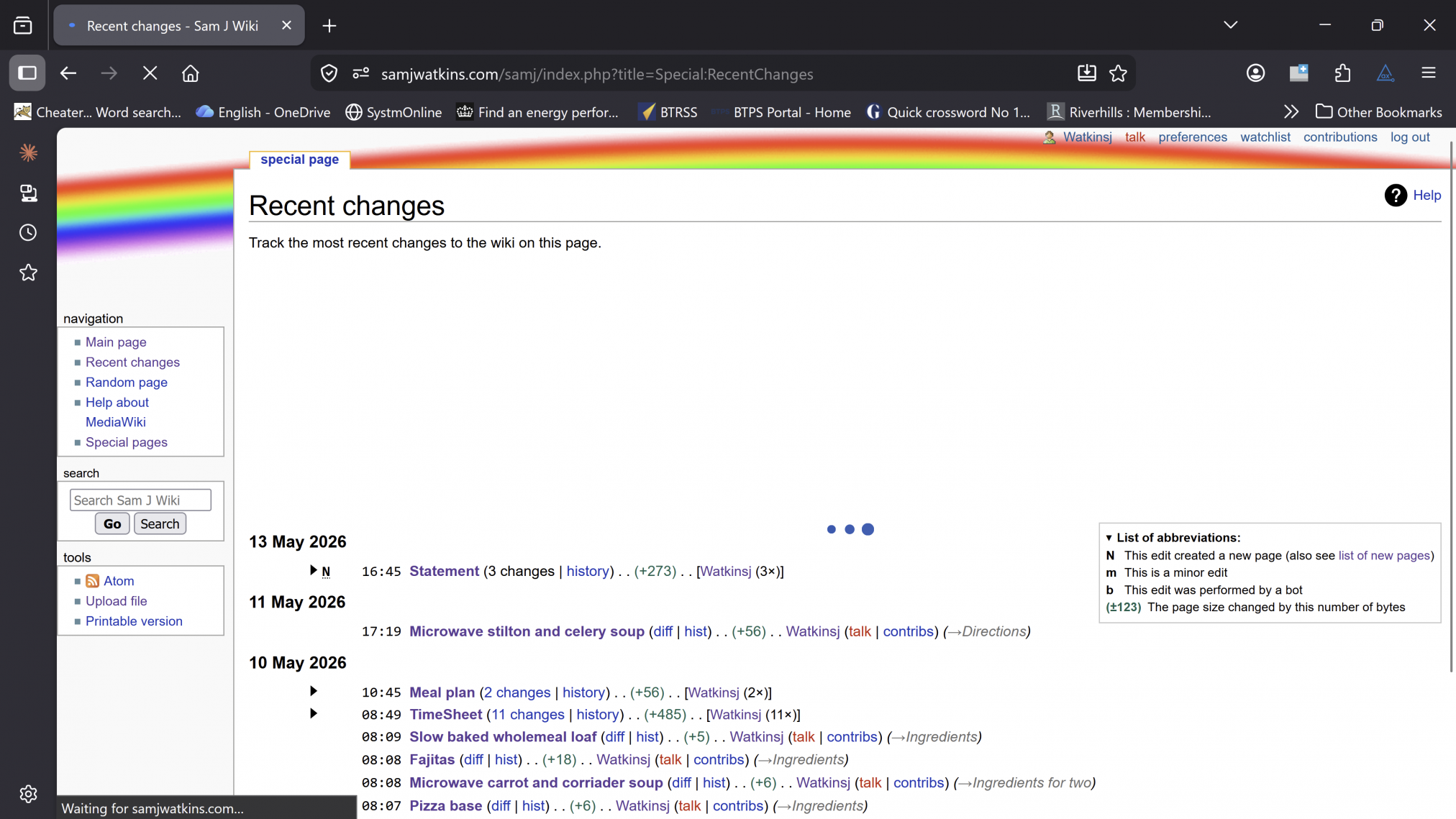
Third one was the 13th May, another denial of service attack with more than a 1,000 hits per second. This is when I brought in the WAF. I am still being hit that hard, but the WAF means it doesn’t hurt my server.

The subjects we’ve explored in this post are all the things I have had to do to secure my site. I hope they help you secure yours.

Making stock…

Surely, you are taking stock…

No, absolutely not. I am taking the carcass from our roast chicken and making a pint of stock. All in 28 minutes. Got to love microwaves.

In fact, from an eco point of view, it’s not been a bad few days. After four brilliant solar generation days, we have had some cloud the past couple, and we still have some power in our battery. All thanks to the power house of a cooker in the corner of our kitchen.

The heat pump is doing its part and keeping the water warm: our room thermostats and insulation mean that the radiators do not come on again until the rooms cool down considerably. Our water is a barmy 57°C, all thanks to the heat exchanger in the heat pump. So far today we have spent (including VAT), 5p on heating our hot water, only we haven’t because we have been using the battery and our solar generated energy to do that for us.

Which is the thing at the moment. We’re not the only ones benefiting from the investment made in renewable energy sources. A south facing system 4.5kW in the UK generally saves you £575 per annum in 2026. Such a system, including fitting, typically costs around £8,000: which gives you a pay back of 13 years. Probably less, as energy prices are likely to rise in reaction to the cost of petrol.

We were asked by our neighbour if our battery was worthwhile. My husband said no over the winter, largely because we have made the decision to keep a tariff with a lower standing charge. That makes sense to us because we get a number of days where we are powered without drawing from the grid for much of May, June, July, and August. It’s silly for us to be on a tariff that gives us cheap electricity per unit but charges us more standing charge. The average standing charge is £0.5721 a day, we pay £0.53949 or £197 a year. Many battery or heat pump focused tariffs, the standing charge is over £0.65 a day or £237 a year.

We get around 123 days where we don’t us much from the grid at all, so having a cheap rate for what we do use makes little sense to us if it drives up our non-using day charges.

It makes perfect sense if we didn’t have the solar panels and the batteries. Which is why it really pays to understand what your core needs are and where investing in panels or batteries or both makes sense.

Of course, our solar system has now “come of age” or at least would be celebrating its bar mitzvah were it a person. Because of FIT, it paid for itself relatively quickly and we are considering getting a second system to give us to wider generation options. During the winter we get around 7 hours of generation time on a good day, in the summer that goes up to 12 hours, but putting panels facing east and west could extend that to nearly 16 hours. It would improve how much we could generate in the winter too, from reflected photons.

As global warming is here, other considerations need to be made. Summers in the UK are likely to be hotter and drier, and the winters wetter and cloudier with biting cold snaps. We are considering passive cooling systems, especially window shutters.

Making stock, then?

Making stock. Reducing the food we waste and turning our generated and stored power into something we can eat. A soup during the week, may be a chicken pie or a chicken risotto too.

Simple, really.