Main menu:

Site search

Categories

February 2026
M T W T F S S
 1
2345678
9101112131415
16171819202122
232425262728  

Tags

Blogroll

Economies of time

It’s a beautiful, sunny Sunday afternoon in early October and I’m sitting in the kitchen with my feet up.

It’s the first time today I’ve had a chance to rest and I’d like to explain why.

Doesn’t sound in the least interesting!

Harsh, but true šŸ™ Here’s why I’m writing this.

We’re still in the newbie phase of owning our new cooker and one of the things it has is a meat probe – the idea is, however economical your cooking methodm, stopping the oven dead once it’s cooked has to be better. By economical read spending less energy cooking your food, which means less carbon produced.

Sounds interesting… ish…

Hey, let me finish. Now cooking books and oven manuals of yore

Really?

Hush! Stated the times needed to cook meats to the point where they tasted great and all the bugs were killed. This is possibly most important with pork as our DNA is very close to that of a pigs

Seriously?!

Yes, so we need pork cooked well to stop things jumping the species gap.

OK

So, I played with this for the first time. Now the difficult thing is that the meat is not the only part of a traditional British roast dinner. Taking the “traditional guidence” in mind, I started cooking.

Only to find my little joint that should have taken 1 hour 26 minutes

Spurious accuracy!

Don’t knock it, if it’s one thing I can do, it’s roast a joint to perfection.

My little joint only needed an hour and that was in a cold oven. Which meant a bit of a rush at the end and no chance to do things in my usual order.

But that does seem to be the lesson. Put the roast potatoes in with the meat and then everything will be ready together, no effort without the need to rush at the end, whip the meat out, turn up the oven and rush to get the vegetables cooked. Including apple saue, did I say I had a great recipe for apple sauce…


Recanning the worms

If you’ve ever watched “Deck the halls” with Matthew Broderick and
Danny Devito (alphabetic order of surnames), you will understand how seriously out of hand outdoor Christmas lights can get.

Thankfully, our neighbourhood is significantly saner than that movie
suggests it can get. It does lead to the question – how do you make the task of setting up next year an enjoyable job rather than a miserable chore spent on a damp late November or early December Saturday untangling never ending cables and drops of LEDs?

I know some favour cable ties or bread ties for the task, but I have found an old-fashioned approach works for me.

Don’t be tempted with a “wound coil” approach. Split the light run
into three sections and “concertina” them into a bundle. Ā Fix the top of each with either a simple granny knot and bow, or if you’d really like to make the job easy for next year, do a clove hitched ā€œspineā€ – three or four clove hitches make it easy.Ā  Repeat for the rest of the lights.Ā  You should have three bundles tied together.Ā  (I leave the gutter ties on it, again so it’s
easy for next year, but that’s definitely your choice).

Then put the far end of the lights in the box first and the end with the plug last.Ā  Seal the box up ready for next year.

Always test the lights before you uncan the worms – nothing worse than laying them out in situ and finding they don’t work which happened to us last year!

Thankfully, our neighbourhood is significantly saner than that movie
suggests it can get. It does lead to the question – how do you make the task of setting up next year an enjoyable job rather than a miserable chore spent on a damp late November or early December Saturday untangling never ending cables and drops of LEDs?

I know some favour cable ties or bread ties for the task, but I have found an old-fashioned approach works for me.

Don’t be tempted with a “wound coil” approach. Split the light run
into three sections and “concertina” them into a bundle.  Fix the top of each with either a simple granny knot and bow, or if you’d really like to make the job easy for next year, do a clove hitched ā€œspineā€ – three or four clove hitches make it easy.  Repeat for the rest of the lights.  You should have three bundles tied together.  (I leave the gutter ties on it, again so it’s
easy for next year, but that’s definitely your choice).

Then put the far end of the lights in the box first and the end with the plug last.  Seal the box up ready for next year.

Always test the lights before you uncan the worms – nothing worse than laying them out in situ and finding they don’t work which happened to us last year!

Lying in bed, dreading getting up

Isn’t it a Saturday? Time of fun and joy and more importantly, the weekend?

Yes, but I’m listening to the news…

Ah, that’s where you’re going wrong!

There are a few major takeaways today.

Numero uno

A couple of weeks ago now, a cable importing electricity from mainland Europe into the UK had a fire than has meant it’s going to be out of action until mid-November at the earliest. That means the wholesale price of electricity has gone up AND the UK’s carbon intensity is significantly higher as we’re now using our gas power stations to generate our electricity rather than import when our green generating supply is lower than our requirements

What this is likely to mean is a spike in electricity prices.

Anything I can do to mitigate that, from a personal paying the bills point of few and a helping the planet obviously?

Good to see your priorities are straight.

If you haven’t already, look at your light bulbs. Any halogens and even CFT could be replaced by LED bulbs. Consider task lighting and lamps rather than lighting a whole room. We have a large lounge but if there’s only one person in it, we tend to use standard lamps rather than lighting the whole room with several central lights.

Turn off lamps and appliances if they’re not in use. If this is hard due to location of switches and your use of the house, consider smart bulbs that you can switch on and off with your phone. I use smart plugs in my home office – when I finish for the day, everything in there is switched off with a ā€œsceneā€. Smart plugs sit between my monitor and the wall socket.

Remember to clean lampshades, especially glass ones. No point putting in a brighter bulb into a dusty or dirty lamp!

How are you heating food? Could your diner be cooked in the microwave or fan oven? Do you need to use the oven and the hob? Not only is it more energy efficient to cook everything in the oven but can be a real time saver too. We no longer cook the yorkies for a roast beef dinner in the top oven but cook them for 10 minutes longer in the main oven with the roast potatoes saving power. If we’re only cooking for one or two, a microwave or induction hob can be amazing. Soups take less time on the induction hob.

Do you really need as many pans on the hob? We do our veggies in one pot. The carrots go in with the timer set to 15 minutes and then we add the baby corn, beans, broccoli as their cooking time allows. Energy efficient and saves on washing up.

Er, ok!?

The 2nd piece of news

that caused concern was the news of rising gas prices which will also impact electricity prices. This is due to price hikes from Russian gas suppliers. 22 million homes in the UK use natural gas central heating which means this will impact many people across England, Northern Ireland, Wales and Scotland.

Over the past few years, we’ve all been encouraged to turn the thermostat down, insulate better and exercise more.

I can’t afford to replace windows or put in more insulation…

Double glazing has long been seen as the only way to insulate windows. Even if you have double glazing, windows can still be a major source of loss but there are some relatively cheap options out there.

Put in blinds. Sounds nuts but a blind between the curtains and the window provides an extra layer. Choose a plain coloured blind to tie in with your main walls and it can look like a fashion statement rather than a canny insulation strategy. https://www.blinds-2go.co.uk/roller-blinds/32556/chromium-satin-white.html is a thermally protective blind from £11.60 retain heat in a room as well as providing privacy and sun shading.

Venetian blinds are not as good at that dual purpose, great for privacy but less good at insulating. Removing our venetian blinds made a huge difference to our heat retention during the winter months and they keep us cooler in the summer too.Ā  Roller blinds have come a long way in terms of light and heat blocking capabilities.

Service your radiators, even if it is just bleeding them (removing air from each and every one). Get the boiler serviced too, if these are all working well, a timed thermostat with a remote control can ensure you are only heating what you need to. What do I mean by a timed thermostat? That’s one where you can set not only when the heating comes on but at what temperature. We have an older set but it means we don’t have to heat the upstairs during the working week unless we need it. We’re comfortable but our heating bill halved doing that. We also set the thermostats according to the zones: bedrooms should be between 16 and 19°C, the lounge (while we’re in it) between 18 and 21°C, the kitchen between 18 and 20°C (especially if you eat in there too).

If your thermostat has a remote facility, you can use that to turn off the heating when you go out of the house.

Using our timer, we have the bedrooms at 16°C from 23:30 until 06:00. We then warm them to 19°C until 08:30 then back down to 16°C until 20:30 when they are up to 18. It means we’re warm when we need to be but not wasting gas heating empty rooms. We have a different schedule for the weekend.Ā  A new thermostat can often be fitted yourself to replace an existing one for about Ā£50 including VAT.Ā  If you have traditional radiators, you can change the valves on them (which often have a “heat setting feature”) for thermostatic ones too: a bit more expensive and involved to fit but worth the investment if you have a single thermostat in your house.

The most energy efficient thing to do is spend time with the other members of your family. Each person radiates heat. During the three-day week in the 1970s, if we got cold in the house, we’d wrap up warm and go for a walk which speeds up the metabolism and gets you warm. The house feels so much warmer when you get back home!

Right, so if I’m on a limited budget, you’re suggesting I go for a hike?

I’m saying libraries are warm as are shops and pubs. It’s cheaper to warm a hot water bottle than a whole house. It’s cheaper to heat a house to 17°C than 22°C. Close the blinds and curtains as the sun sets rather than leave them open until the last minute before going to bed.Ā  Every little helps.

That time of life

My father died a few weeks ago, so I’ve been a little distracted by the shock of his sudden death and appreciating that life really can change at a moment’s notice.

It’s been a pause, a chance to catch my breath and think about the questions my mum has been asked in past few weeks and she is asking herself.

I’ve love where I life: the location, the building and what the potential we still have to realise. We’ve been here 8 years and have been working on a room of the house or a major feature each year. That has made our lives more comfortable as we’ve gone on. We’ve been lucky in that the bones of the house were pretty much there.

On our wish list, we have several major tasks to do: en-suite to our room, the windows, kitchen, main bathroom, carpets upstairs and the wood flooring downstairs. That’s in no particular order though the en-suite planning is probably the furthest along in planning.

The main aim is to clear the mortgage and ensure we have somewhere pleasant to spend the next 20 years. When we first owned a house, we used to watch the House Doctor who had a ready reckoner; you should spend 10% of your house’s value on improvements every year. Given today’s prices, we think 5% (unless you’re doing a big project) is a good guide.

0.5-1% should be maintenance: fixing the issues that come up, cleaning products and tools to help, for example. Burst pipes, serving the boiler and replacing worn out items, cleaner and window cleaner.

That leaves 4-4.5% to spend on renewing decor, furniture, lighting etc per annum. Or at least saving that money to reinvest at a later date. Including the garden and any garages etc.

The average house price in the UK (excluding London) is around the £250,000 mark, so 10% of that is £25,000 and 5% is £12,500.

Are you investing that in your house each year?

Of course, there are limitations in what you should do: fitting a Ā£50,000 kitchen in a house worth Ā£250,000 probably isn’t going to be recouped in the long run. You cannot make a Ā£250,000 worth Ā£300,000 unless the house was desperately run down. In which case, the investment should be in the structure and modernisation and may indeed cost that Ā£50,000.

There are also limits in the cycle. A kitchen should last 20 years: from ecological point of view, replacing the units of a kitchen more frequently than that is extremely wasteful. So ours is scheduled for 2026/7. We’ve had a couple of the big appliances fail in that time (ones we’d had for 20 years), so they have been replaced and will be incorporated into the new kitchen when it comes ready for their cycle to be incorporated. We don’t build in the fridge or dishwasher – they can be switched out or repaired without risk of damage to the units.

Some guides reckon the kitchen should have a budget of 15-20% the value of your house. Given our average house price, that’s Ā£37,500 – Ā£50,000!

Given the average earnings in the UK, that’s obviously not practical for most people and appliances will be switched out more frequently than the 20-25 years.

We’re planning on retaining many of our appliances when the time comes. Keeping the basic layout, means the floor can be retained as we’ve got tiling. If we do lose the flooring this time round, we’ll ensure the flooring goes under the cupboards so that in 25 years time, we can just change what needs to be replaced not what doesn’t.

That’s a long-term commitment. We’re lucky, our investments so far have been on ensuring our carbon footprint and energy usage have come down as far as we can get it. We’ve taken our consumption down to an EPC rating of B compared to C. From solar panels to curtains that improve our insulation. Carpets that ensure minimal heat loss as well as feeling comfortable and keeping the boiler in tip-top condition to ensure it is as efficient as possible. (We service the cars and motorbikes for the same reason).

We’ve planted a tree hedge to help capture carbon and planted flowers and fruits to ensure the insects, mammals, reptiles and birds we share the planet with have food and shelter. Although, I do wish the squirrels would stop digging up some of the plants we are growing for a tasty snack šŸ™‚

Best laid plans…

The funniest thing about discovering the joys of not commuting every day (or indeed travelling for business at all) has been doing our own cleaning.

Eh?

Well, to ensure we were protected, we lost the cleaner and started doing it ourselves. Because of the cleaner, we knew the absolutes basics that needed to be done each week and thanks to the time we’ve got back, we’re also scarily on top of the “extras”. Indeed, I’m sitting typing this listening to my husband start the decorating process in our bathroom – unfortunately, it’s much quicker if he does this as there is a window ledge 7’6″ up a wall that needs to be rubbed down and painted every so often and it takes me a good 45 minutes on the day to psyche myself up to do it…

And the point of this is?

My apologies. The chicken and egg scenario is all about our vacuum. With the money we saved from having a cleaner, we got a new cordless vacuum cleaner and have really enjoyed using it. The person who’s turn it is to cook Sunday lunch each week inherits the floor cleaning duties in the kitchen and with the vac and the steamer, it’s a 45 minute job.

When we had the cleaner, I had an alarm on my calendar reminding us to clean the filters on the vac, thus prolonging the life and maintaining the performance of the gadget but somehow, this has fallen by the wayside.

I can still do the steaming in the kitchen but it’s going to be a while before the filter is dry enough to use in the vac. Doh!

Time is of the essence

OK!? What are we talking about today, please?

OK…

I was born in 1973 and that year there were 3.912 billion people on the surface of Earth. In the 1970s the oil crisis was on, the 3 day week, frighteningly high inflation and difficultly in making ends meet for many in the UK.

Today there are 7.674 billion. That means much of what we do today needs to adapt to ensure everyone has a share of water, power, heat, land and food. Some may say power and heat are the same thing but power, such as transport and medical care, needs to come from assured sources rather than heat which can be generated by simply burning materials.

We digress. Thing is, people like hot food. It gives us more accessible nutrients and it may partly be how humans have achieved so much. An earl in Sandwich put things between two slices of bread but since then such meals have been roasted and toasted all requiring power.

I am putting together a small picnic for tomorrow and much as my mum would have, I’m using as much home cooked fare as possible. This is kind of the point of this piece.

Oh? There is one, is there?

Yes: should you blind bake a flan? I have three cook books from various eras all saying different things.

I do know that my mum doesn’t bother. Given the fact there’s so much call on electricity and gas these days, I’m inclined to agree with her.

The pastry does indeed need cooking – raw flour is not easily digested in the human gut. But if we’re doing that, shouldn’t we only do the job once?

The recipe I’m following to make a quiche lorraine says to roll out the pastry then fill and cook for 35-45 minutes. ( We’ll eat it hot tonight and then as a cold dish tomorrow lunch time with salad). But many (many) others say to cook the pastry for 15 minutes first then fill and cook for 35-45 minutes.

The idea of blind baking is to make a crispy base – for a quiche or lemon merringue pie which is when I tend to make flan bases, I don’t think that’s vital. I use a fan oven, which should also help the hot air to convect all the way round the pie dish too. The fan oven generally means you can cook at 20°C as the fan needs less power to achieve the same result.

So, for the planet, I am not going to be blind baking.

Not convinced this is where I thought this would be heading…

Cooking up a steam

Having heard about induction hobs in 2006, they have been on my radar but not something I’ve considered more than a “when I fit my dream kitchen, I’d like…”

Our recent forays in the garden and making burgers have brought on a different issue though: how can we do the onions etc that we love with only a camp stove when we have loads of energy coming down from the sun?

Induction hobs work by using magnetic currents to generate heat in pans – no pan, no heat.

As such, they are not wasting power generating heat and light which is then conducted and convected to your pan and then your food. This means they can be 85% efficient which is really wow! A truely efficient car or motorbike is only managing 35-40% efficiency and a microwave is about 70% efficient.

But induction hobs are not an easy leap of faith – starting at Ā£255 for a lower range one, it’s a bit of a gamble if you’re not sure that’s the way you want to cook.

And we’ve got our camp stove business case, so part of this year’s bonus went towards a “Tefal everyday induction hob”. At Ā£49.99 for a single hob, it’s a big price for an outdoor piece of kit – but I’m keen to see if it can make a difference to our fuel usuage figures.

I got it yesterday and am using it to cook our carrots, beans and broccoli for our Sunday lunch.

I’ve made sure I have a small pan that will induct (stainless steel in this case) and put in the water and the carrots and wait the normal 15 minutes before I’d normally start to heat the water.

The pan starts to boil less than a minute later, so turn off the hob and wait 7 minutes and repeat the process. Once the water is boiling for real, I set the timer for 8 minutes on the hob.

I add the beans and broccoli and turn the hob down – only that stops the simmering so end up on “Power level 3”. At the proscribed time, the hob beeps and the power stops.

Have to say, I’m impressed – true the halogen I normally use would have been set to level 1 rather than 3 but the speed of boiling is awe inspiring. I also didn’t have any over boiling, the power response is instaneous.

The pan I used was not the “right size” to make use of the “boiling water” mode. My pasta and soup pan is ideal though and the stew mode should make an interesting soup later today; the plan is a butternut soup.

The hob is a chunky piece of kit – a little bigger than I was perhaps expecting but it is ready to use out of the box and the instructions are really straightforward.

What it may mean is we make the change indoors a little earlier than originally planned.

Working and fitting in life

I’m thinking about putting some of my recipes down in a cook book as I’m sitting watching Saturday Kitchen.

The past few months, Saturday morning has been spent making my pasta for the week with Saturday Kitchen playing in the background while I’m hands on and my focus while I’m doing the waiting.

I’m 48 and I watch these recipes thinking, such a lot of effort. Not just the shopping, the prep and the cooking but dealing with the aftermath!

As you get older and try to fit everything into a day, you find the short cuts. I make scrambled eggs with only dirtying the pan and the spoon – but it’s delicious.

I cooked rissotto on Thursday, but to save washing up, I cut the chicken breasts up with scissors. It means I don’t need to deal with a meaty soiled chopping board. One board is used for the veg but not for the meat. Saves space too.

I love fish – I cook fish in the microwave. It’s quick, tasty and ready in minutes. As a simple tea for one, trout, peas and boiled potatoes with horse raddish sauce is ready in minutes.

Last week I made a microwave cooked tomato soup from tinned tomatoes. In 15 minutes, I had a tasty soup for 1 with a “bung-em-in-the-oven” baguette for some carbs to help give me the energy. Using a hand blender to mash it in the litre jug used to cook the food means it’s an easy wash-up.

Eh?

Fill up the jug with water and switch the blender back on in the water – while the soup is cooling, that makes and a cleaner jug and blender wand as the food clinging to the blades are thrown in to the water and the food stuck the jug is pulled off into the water.

When you’ve finished the soup, the washing up is very simple.

Oh, making it simple?

Absolutely. Bon appetit!

I woke at 3:14am this morning

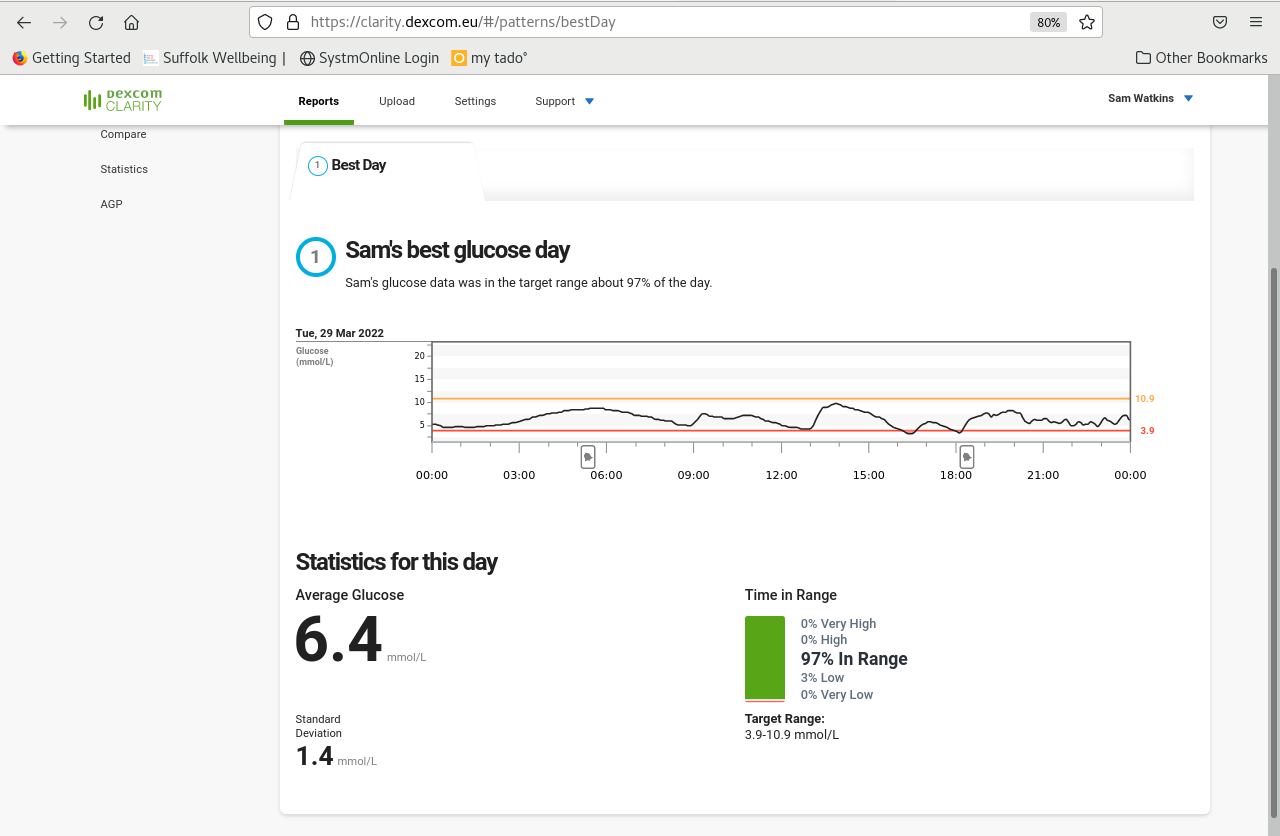
Needing the loo. Whilst doing the doing, I’m kicking myself – should have grabbed the sensor reader or at least my phone though I already know my blood sugar is high and I’m hyperglycaemic or hyper for short.

Sure enough, when I check my reader, I’m 21.5mmol/l – that’s four times what it was this time yesterday. Damn (or words to that effect).

So I don’t disturb my husband, no point in both of us being awake, I grab the insulin in my nightstand and head into my home office. I grab one of the small syringes and draw up 20iu of 100iu/ml fast acting insulin. But I don’t shoot this all into one site: I choose my right arm first, right abdomen, then right abdomen and finally the left arm.

Why not one shot? Well, insulin is not absorbed well when it’s all given in one site. Instead of being in my body for its standard 4.5 hours, it would hang around for ever as well as taking forever to drop back to normal, all the while letting the hyper take it’s toll.

By 3:35. I’ve dropped to 20.5mmol/l. At 03:45, I’m reading 19.8mmol/l. That’s just short of 2mmo/l every 10 minutes – I should be back to 6mmol/l in an hour. The feeling is relief. Every fibre in my being is still hurting but this should be temporary.

It’s not as quick as taking the insulin intravenously but it’s as good as it’s going to get. It’s 03:50, I’m 19.5mmol/l and I’m heading back to bed as soon as I finish this pint of water. When it’s flushed through my system, taking some of the ketones with it, I’ll do an insulin on board calculation and see if I need any carbs to soak up the remaining insulin.

Sweet dreams šŸ™‚


Using information to lower your carbon footprint

Sounds great, sign me up!

Love your enthusiasm (must say, it’s a little unusual)…

Focus!

You’re right.

Like many, we’re using smart meters and online portals to see what energy we’re using at any one time. Good for us and good for the planet.

But not making the most of the collected information that’s out there.

How much of the energy that’s being produced in the UK is coming from renewable systems right now? How do we evolve our usage patterns to ensure the power generators can move away from fossil fuels and gas?

Tools like Ovo’s Greenlight aim to do just that.

By letting us see where the grid’s energy is coming from, we can make the decision to do (or switch off) a major energy task like running the washing machine – when is the best time to do it for the planet? Let’s look at what we get.

Accessing “Greenlight” from Ovo

So now is not the time! Let’s dive into “See 48 hrs carbon forecast”…

The next 48 hrs in detail from Greenlight

So, we’ll wait to put the washing on until a bit later today and might team that up for when we’re producing enough solar. Thanks Ovo.

But that’s not really the point. Energy management is going to allow countries like the UK make that move towards renewable energy across the country rather than at the microsource without risking brown-outs.

Building new houses with heat source pumps and solar cells help, but for some older houses, retrofitting such technology (especially heat source pumps) is not going to be possible. Building new houses uses a lot of energy – so knocking down the old is not the answer.

Perhaps these tool help resolve that divide.