Main menu:

Site search

Categories

June 2026
M T W T F S S
1234567
891011121314
15161718192021
22232425262728
2930  

Tags

Blogroll

Here’s to the holidays, 2024.

It’s been a while since I’ve been able to kick back my heals, and I am currently sitting in my lounge, planning some lunch, watching my favourite cookery programme.

I’m a foodie. I have always liked delicious food – after all, who doesn’t. I love food combinations when I am doing something special. My everyday food belies that, probably, but great ingredients beautifully cooked taste amazing. They don’t need much else.

That said, we had a honey roast ham, yesterday, traditional fare for us the Sunday before Christmas. I’m saving some of the ham for light lunches, and of course, vol au vents. Boxing day is bubble and squeak with sausage meat fritters, and turkey and ham vol au vents.

But what to do to rest between the feasts? We are intermittent fasters, meaning we don’t eat much during the week but go free rein during the weekends. It ensures we get the nutrients we need without getting too heavy.

But the winter feasts, the holiday season, the parties, can ruin all that. In fact, in the UK, we typically put on 2.3kg or 5lbs of weight.

In the middle ages, this behaviour guaranteed survival during the times when food was scarce. In our part of the UK, the coldest months are about to roll-in. Before central heating, the weight put on over this period meant you could weather that weather.

Trouble is, under the age of 80, it can cause more harm than good.

So we’re conciously snacking for our main meals today and tomorrow, until family arrive: soufflés for lunch today with carrot soup this evening. I have ham sandwiches tomorrow while Jon cooks waffles.

Not using diet food, then?

No. But keeping the portions down, and removing things like thick wedges of bread. Nice, light meals.

The trick is keeping your carbon footprint down too. Looking at my show, they do not appreciate how much power can be saved cooking the soufflés in the microwave, instead for the hob.

It’s not about the money, honey. I’m looking at our power usage compared to last year. Most of my food is now cooked at home too, so our electricity is a little higher this year. But the power saving is dramatic – cooking with the smaller oven, microwaves when possible – and of course our heating is with electricity now…
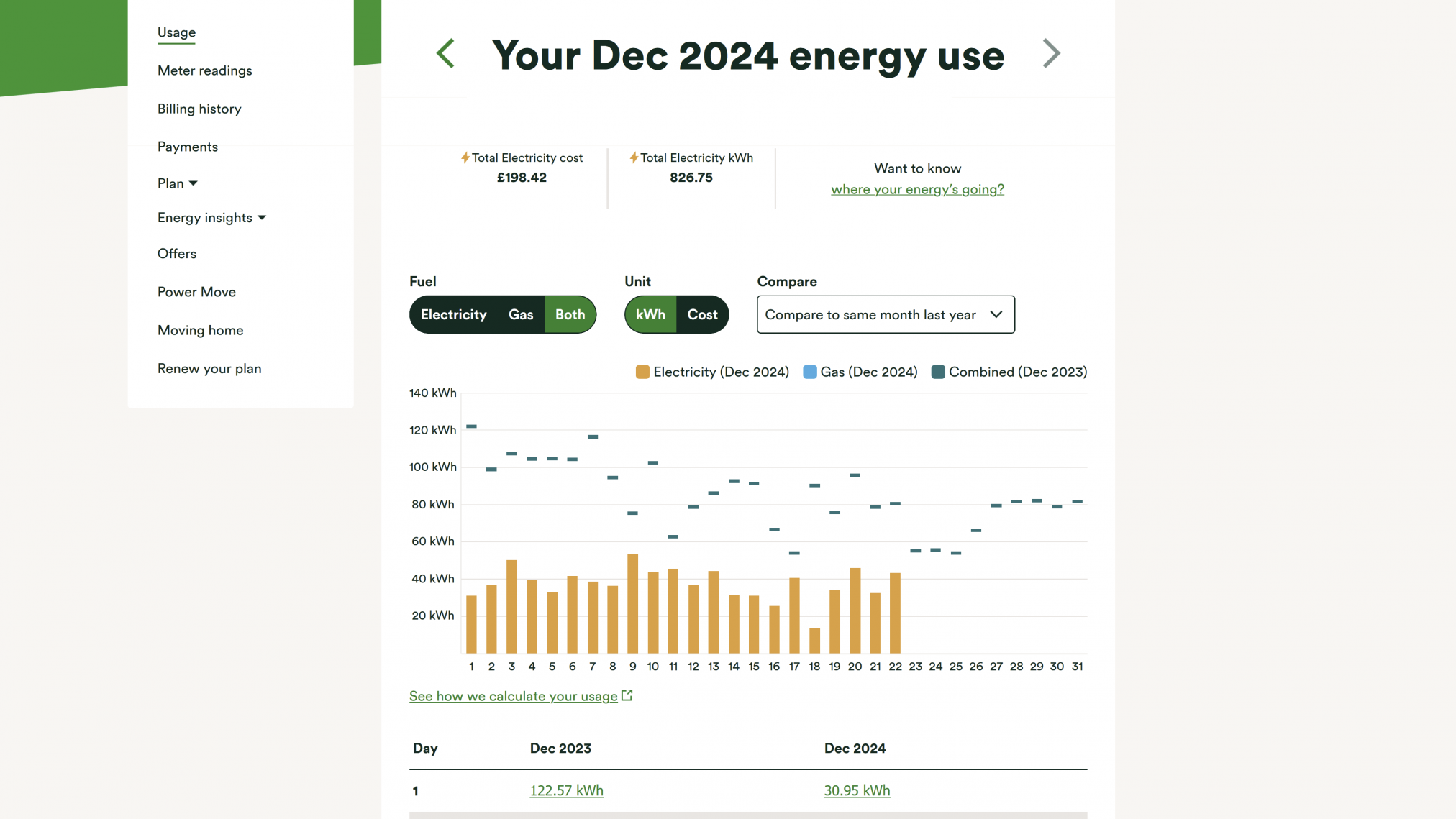
Graph showing our power consumption, both gas and electricity, between December 2023 and 2024.
Graph showing combined power consumption between December 2023 and 2024.

Oh, well it’s a lot warmer in the UK now…

Not on individual days, actually because of a lack of solar energy (it’s been cloudy), there is less solar gain in our rooms, and we’ve had to heat our rooms much more than last year.

And we’re cooking at home more. We’ve had to turn down the thermostat in our bedroom in the morning, because it was way too warm in December, with the heating on how we had it.

Looking good, then?

Yes, I think it is. Merry Christmas?.

Investing for the future

One of the things you hope for when ripping out your gas boiler and putting in a heat pump is things are not going to be worse for you.

Obviously, having our own solar generation capability means that unlike distilling our own natural gas, we can generate our own electricity. So, if it’s sunny and cold on a winter’s day, all should be good.

But, let’s be honest here, I live on a small island in the atlantic ocean, which is much closer to the arctic pole than the equator. During the winter, our shortest day is on the 21st or 22nd December and is 7 hours and 50 minutes. The sun is not necessarily going to be putting in an appearance, and is certainly not something you can bet on.

But in December 2024, I am looking out of my window and seeing a shining sun – more importantly, my solar cells are not only heating my house right this moment, but also charging my home battery.

This is kind of important because it means we can heat the house later today, after the sun sets which some stowed energy.

Which is hard to do with a gas boiler.

Interestingly, this year we still have all the figures for our gas heating. I know this because that’s all we were doing with the gas: heating the house and our water. Our heat pump provides similar figures in a handy app.

This very day in December 2023, we used 73kWh to heat the house and water. This year we’ve used 12.2kWh.

Now, it could be a much warmer day in our home town. So, last year the temperature varied between 4°C and 11°C. Not that dissimilar, our range today is 4 °C and 8°C (we’re a little colder today) . We haven’t changed our thermostats or settings, all we’ve done is switch the source of the heat… In fact, the past couple of days, we’ve turned down the thermostat in our bedroom because it was way too warm for us given how we had things setup.

Of course, that benefit could be happening right now!

A diagram of a house taking energy from the solar cells and the house battery rather than the electrical supply grid to heat our home.
A diagram showing the house taking energy from the solar cells and battery to run the house and heating.

Yawn, so?

Consider this, at the moment, right now, every 1kWh of electricity costs £0.24. Every stored unit we can make use of means we are not using electricity that has been generated by burning gas. You can see that in 10 minutes, we went from discharging the battery to feeding in excess today – the thermostats in the radiators and rooms turned off the draw from the heat pump, thus reducing our need for electricity and allowing us to charge the battery.

Now, because of the efficencies, an electric heat pump out performs a gas boiler, so environmentally it is a sounder choice. But we get the benefit of this right here right now, unlike our V2G. We’re hoping that during the summer, we can be completely off grid…

A diagram of a house taking energy from the solar cells and heating our house and stowing energy into our house battery.
A diagram showing energy from the solar cells going into powering the house and charging the house battery.

But haven’t you spent an awful lot of money to get to this point? The photovoltaics, heat pump, battery, smart thermostats…

Yes, we have invested to do this. Not all in one go, we did the solar cells in August 2014. The battery in November this year, and the heat pump was in July. The smart heating was over six months in 2021.

But this investment is giving us a big return thanks to high inflation. The solar cells paid for themselves in 5 years (and that was before electricity was £0.24 a unit).

In the next 20 years, we’ll both be retired, but it will cost a small fraction of our pensions to keep warm and have hot food during the winter. All thanks to having made the investment now.

Isn’t that what it’s all about? Saving the future…

Standing out from the crowd

I am from the UK. That means many things but ultimately, we’re a discrete people. Quiet, laid back, we don’t like fuss. We do like to talk and share, but, you know, through quiet means.

Eh, what, what’s going on?

‘Morning. Just about to talk about what’s happened since we had our gas meter removed in August.

Oh, it’s Saturday – I’m heading back to bed…

Mmm, least said about that, the better…

Where was I, oh yes… So, that apparently kicks off some “automated” processes in our energy supplier’s customer handling processes. Two weeks ago, while checking our daily usage, we found we were “moving to a new supplier”.

We were not. At least as far as we knew… A short call, and we were assured they would not be ceasing our electricity nor refunding our balance – due to V2G, we had quite a sum to see us through the winter…

The refund happened this week. We still have the banner on the customer portal telling us we’re leaving.

Now, our info to log-in to N3ergy no longer works.

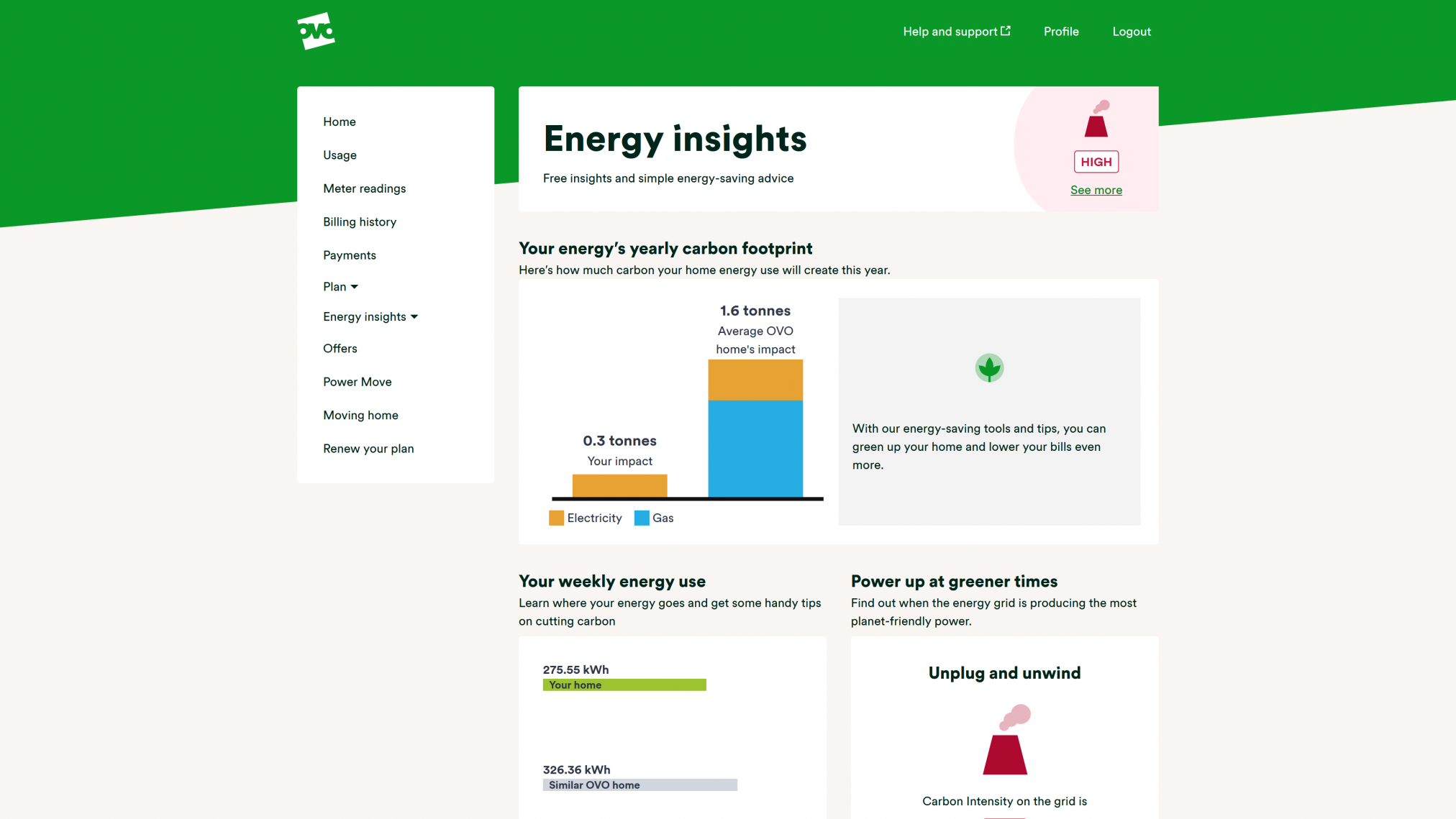
Other things are a bit hit and miss. This diagram is only sometimes available when we ask for it:

A graph showing our predicted carbon footprint this year.

Now, we’re assured that electricity is going to be delivered through the grid by our supplier, but it all seems a bit fussy, if you ask us!

Although our electricity direct debit is now only £158 a month…

Surprising things

Few people like surprises. Some say they do, but when you ask them, it’s about fun things not things like a spider dropping down on a thread before their eyes while they watch TV.

Really, do you have to?

Sorry <shame>.

One of the things we were not expecting with our Smart Meter when we got it in 2014, I wasn’t expecting it to just work off one “reader” in the house. Or how much energy said reader would consume – we soon plugged ours in having had it chew through batteries in short shrift…

But a pleasant surprise came with our new house battery, as it gives us that basic information, and more.

We can see how much of the energy we’re consuming is coming off our solar panels or our battery, and how much we’re having to pay for. That’s to our phones, so making real decisions at the point we want to make them is trivial.

If fact, I find I am not longer using the meter application attached to the solar cells. One stop at the battery app gives me all that.

Of course, there are other surprises that are not so great. It has been a cold and, more importantly, dark winter so far. But from the look of things, we should be able to go completely off grid in the summer for all our needs. Heating, hot water, cooking, cleaning, and travel with the car.

What’s not to love?

Going off grid for the summer?

Probably not. I have had “standing charge free” tariffs, which tend to be more expensive per unit but if you don’t use anything, you don’t owe anything.

Those tariffs are few and far between. Especially if you just need electricity.

Our contract is £0.24 per kWh used and £0.4842 per day for the standing charge. During the summer, if we really don’t consume anything from the grid, we’ll be paying £15.01 for the 31 day months, and £14.33 for the 30 day months.

This is important because it helps the UK pay for power generators, transmission lines, fixing issues when storm damage happens, like today when the tail end of Storm Darragh is blowing across the UK.

Obviously, to help more people make the move to solar panels and more, a cheap standing charge and expensive price per unit is the way to make it happen. But I think we’re a long way from that being the case.

How tempted were you to call this piece “shocking things”?

Very, but let’s not go there….

Being English, not American

Black Friday is a relatively new thing in the UK because it has never been an opportunity for us to shop.

I work full time, in the UK. We do not have Thanksgiving day, there is no bank holiday in November and, because we don’t have that celebration, we did not have it fixed to the fourth Thursday of November by the American President F D Roosevelt in 1939. This strategy, a planned date for Thanksgiving bank holiday is that it fits in with two goals.

Goal 1: the American tax year runs January to December. Without this bank holiday where people traditionally shop (since 1939), shops find it difficult to keep going. Clearing stock for the tax year is very beneficial to the American business model and many retail organisations return their figures with the tax year dates.

Goal 2: It was done to boost Christmas shopping figures for shops. Like most other celebrations in our modern world, this was done for commercial reasons. The Christmas decorations are out in all towns and indeed Turkeys are the favourite fare on the American tables.

Globalisation has meant American companies have made the discounts globally available. But unless you have a computer, that’s pretty academic, until this year, and things were tagged up in UK shops.

Why? This is completely artificial for us in the UK. Our big shopping day, for similar reasons, is Boxing Day.

So I was not desparate to be parted with my cash yesterday.

Financial castles in the air

I have had a pension with work since I was 18. First with the MoD, as a technician apprentice, and then with BT as a manager.

It makes sense to save for the future. But the opportunity cost of me saving £1 in 1991 as a technician apprentice was significantly more than it costs me to do the same now – partly from inflation but £1 was 22.5% of my monthly wage. It’s barely 0.01% now.

But that single £1 invested in 1991 is now worth £1,000. Which is significantly better return than inflation.

But, I’m very comfortable. I could afford to spare that money each month and lock it away for 50 odd years. What if you cannot do that?

Cash, cash ISA, baby! I cannot believe you made me say that!

Sorry 😀

A pension saves you money as you get income tax relief. But you pay management fees, transaction fees, holding fees. Not much to me, but if you’re earning minimum wage, you aren’t getting much back for your money.

Cash ISAs are great for three reasons.

  1. You can access you money if you need it. Any spare money you have can be added at any time. You cannot do that with your pension.
  2. Multiplier effect. You may not be able to use your £20,000 ISA limit each year, but each ISA can be added to new ones. This means if I manage to save £300 in my first year, the next year, I can add this £300 to the next ISA I start and still have my complete allowence and the interest I have earnt… which means it is all growing!
  3. You and your spouse can make use of both allowences. So say one is a higher rate earner the other is on minimum wage, you have £40,000 to invest each year with no tax on your interest.
  4. The other things is the £1 you save on the first day is worth the most. As a low paid earner, especially if you can start saving from the age of 16, the better off you will be in your life-time.

The £40,000 for a couple is really useful.

Given an interest rate of 4.3% per annum, it takes a single person 24 years to get enough ISAs to give an annual interest amount of £20,000.

Two people together can achieve the same thing in 12 years. Add on the full state pension, £11,502.40, and that would be an income of £31,502.40 with very little risk and no fees anywhere. It’s not a fortune, but it’s only a few thousand shy of the average wage of
£35,830 in the UK.

Plus you have £465,116.28 in savings.

In the UK, there are around 5,000 ISA millionaires. Most of them started with cash ISAs then converted them to Share ISAs. I’m no-where near there, and as my father used to say (he was a stock broker for 40 years), it’s not worth investing in shares unless you have £20,000 and ideally, you have the space to allow those assets to depreciate without it hurting.

Of course, if you have rent/mortgage to pay each month, that’s a huge ask. But it’s why those who concentrate on settling the mortgage, get such an advantage – £31,500 per annum when you are not paying any rent or mortgage is really good money – £2,625 a month.

But of course, I didn’t do that. I got the benefit of my work pension where my employer is doubling what I contribute. That’s the time when it makes the most sense to contribute to the work scheme!

Another step in the right direction?

When we got our last EPC done in April 2022, we were a little disappointed that there were no recommendations of what to do to reduce our carbon footprint.

Which was the reason behind getting the assessment redone.

As it is, we’ve made some positive steps, hopefully, in the right direction. The lattest one was achieved this week, with the installation of a battery.

What, on top of the V2G?

Absolutely. Don’t get me wrong, the V2G has worked out very well for us, but there’s a couple of things it is lacking.

The first being, we don’t get to say where or when it charges or discharges.

The second being that we want a battery back up for the house. Getting our energy use down means we can, for some of the year, live off the energy we produce from our roof. In summer we often generate more than 15kWh a day and use less than 13kWh. Having access to that power would be really useful.

It’s a little different over the winter as we’re also using electricity to heat our house and water. Being in the UK, we just don’t generate enough power during December and January to be “off grid”.

The idea for our home battery as opposed to using the car battery, is that we can go on “island mode” and disconnect from the grid when we can to or need to, say during a power cut.

There’s other things our system does too. It monitors the power from our solar cells, the power going out to the grid, and the power coming in. During the summer, it can be programme to donate to the grid or our home when prices are highest or when there is a glut of power, store energy for later.

During the summer, we should be able to go off grid for much of the time, effectively. We generate, at most, 3kWh. Our base load, (what the house uses when the heating isn’t running, or lights are on, etc), we use between 0.4 and 0.6kWh – so that excess can go straight into our battery.

Cooking, washing clothes and dishes, and heating are the big consummers in the house. Doing these functions at mid-day can make a huge difference to your electricity bill – even during the winter. Batch cooking can make use of this excess power, so the evening meal needs to be a snack or reheated in the energy efficient microwave.

That takes a great deal of planning and effort. There’s energy consummed by the fridge for keeping things cool, and again that is not a zero cost.

I have mixed feelings about batch cooking for that reason – the more you cook, the more energy you need. Then you waste that energy in cooling it down… There are other options, though again that is more effort.

I’m beginning to think you could go crazy thinking about this!

I can’t believe I did that

Five years ago, I cycled 100 miles across London, into Surrey and back again.

Having independently cycled to the station in Ipswich this morning, caught a train to London and worked a day then returned home, that seems a very long time ago.

Which is a bit of a shame, because five years ago, I promised myself I’d never let myself get that unfit again.

Of course, it’s easy to blame Covid, but to be fair, the first 6 months I kept my weight down and kept up my exercise.  It was after that I let it all slip away.

So, tonight my long muscles are a bit sore and my clothes are gently steaming as my sweat evaporates off them.

I do know I will get fit again.  I do know it will get easier.  But right now, all I want to do is wrap myself in my duvet and fall asleep.  Bon nuit, mes amis.

Lived experience

The intersection of my worlds (diabetes. cyber security, developing interesting tools, cyclist, motorcyclist, skier, driver, keen walker, sustainable living, and cooking) leads to some observations. Not least when it comes to this term: lived experience. When medical studies are conducted and are published to the masses, this is the caveat emptor, your experience may vary.

I was reminded of it while sitting in my endo’s office, waiting for my 11:10 appointment. One of the slides auto-playing in kiosk mode said about when you travel to hot and cold climes and the impact on your insulin requirements.

Now the nights are drawing in, we’re getting questions about how comfortable we are – now these are from friends but I suspect the inquiry is less to do with our general wellbeing and more to do with the heat pump replacing our gas heating system.

To be honest, it’s lovely. It took a couple of days to tune the radiators and the heat distribution system, but we are warm when we need to be and cooler when want to be doing things.

We do have an emergency heat source with our newly cleaned (and CO monitored) log burner in the lounge, which we tend to use when staying at home during the weekend and the place is below 10°C – mostly because the room is unbearably hot otherwise – over the space of two hours the room temperature rises above 12°C, even with only burning a log or two an hour.

Now, it our aim was to reduce our carbon footprint – use fewer kWh of energy to keep warm and clean (hot water). Which is a good job, because electricity prices have risen in the UK.

Oh, well worth the effort then!

Like I said, the proof will be if our total energy usage this winter is less than last year. I say winter, as we started using the heat pump in mid July and the boiler broke end of March, which was freezing this year.

And so far, it looks good. Our SPF (seasonal performance factor) is currently 4.7 – so for each 1kWh of electricity we buy, we get 4.7kWh out or 470% efficiency. This is compared to a great gas boiler giving out 0.8kWh for every 1kWh of gas burnt.

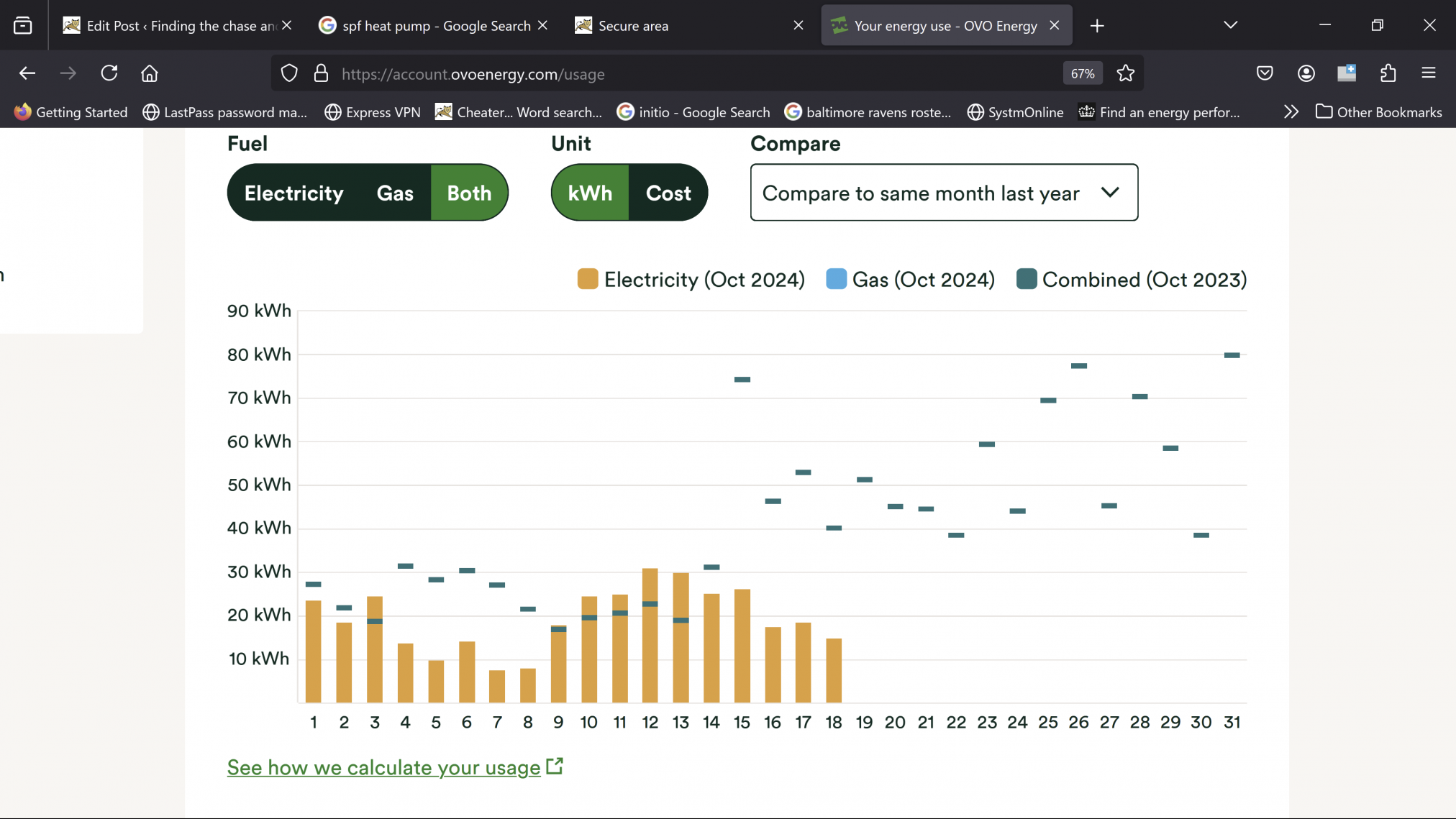
The colder it has got, the better it has been. Also great for us. More importantly, it is outperforming the combined totals most days:

Comaprison of this month with this month last year in terms of combined energy consumption.

A few of the colder days we didn’t do so well, but so far this month, the heat pump is heating our water and house for less than the boiler did – of course, what we are not seeing in the graph above is the fact the car took more energy charging than it did the other days!

Oh, so it is worth the effort then?

Well, it looks good so far. Of particular note is Tuesday 15th October – the temperature in Ipswich was 9-14°C. We were both at home and both were comfortable, lit, bathed, and cooked for, all for 25.95kWh electricity compared to a combined score of 74.75kWh in 2023 when the temperature was very similar 13-14°C.

Of course, we cannot make our own natural gas. We do have solar cells making some of our electricity though 😉

Avoiding the ultra processed foods

Studies on the impact of ultra processed foods has been doing the news circuits for a while now, but while it seems obvious that highly smoked, reformated foods (e.g. corn syrup is often cited here), and packaged foods (pringles anyone?), we should perhaps cast the net a little wider.

I love pesto: but it is not something I “cook with”. What do I mean? Well, olive oil is a processed food and a component of pesto. If I take some pastry, smear it with pesto and then bake it, the resulting pesto pastry is, by definition, ultra processed.

Cooking breaks down nutrients in food, it’s actually why we cook in the first place as it makes it easier to absorb those nutrients. But cooking more than once breaks the food down further. Should we consider such foods ultra processed too?

Breads are not all equal. A french dough doesn’t need sugar to help the yeast rise yet we class this food in the same class of processed food as a quick cooked “american styled loaf”.

Smoked foods such as sausages are commonly placed in the ultra processed list. But there is a big difference between an English style, unsmoked sausage and a 6 month smoked Falukorv. The English sausages are often sneered at in terms of taste (typically derived from herbs rather than processing) but the minced, otherwise uncooked meat is processed but not ultra processed…

Of course, our bacon was traditionally the way we preserved pork. Smoked and tasty but probably not the way we need to do things these days with fridges in every store and home.

Don’t get me started on “triple cooked” fries. Lets boil the goodness in potatoes away to just leave the simplest form of carbohydrate. Bring back the English chip, please.