
A green mothering Sunday
Mothering Sunday was not originally about celebrating Mother’s Day – it’s an old age tradition where people returned to their “mother church” – the main parish church or cathedral where they were baptized or raised. This act of returning home is the original meaning of “going a-mothering”.
It is celebrated on the fourth Sunday in Lent, the lead up to Easter and the equinox (equal day and night, only not really in northern latitudes like the UK). Easter is set as the first Sunday after the first full moon (the “Paschal Full Moon”) occurring on or after the spring equinox (March 21). So, Lent and Mothering Sunday change date every year.
For my usual category of Driving off The Grid, equinox and equilux (properly 12 hours of each in the UK), we care about this because the equinox is the begining of Spring and better chances of peak solar generation.
This year was no exception, as the pie chart from NESO shows: one of the first days in a long while where our zero carbon generating sources featured solar power.

The past week, our electricity has come more and more from our own photovoltaic panels, and any excess we have generated is put into the batteries first.
Obviously, this is important at the moment as energy prices are likely to be volitile for a while.
Living in a rural part of the country, our local news has featured the rise in heating oil costs, and a number of people have had their oil drained by theives.
We were on the gas network; when we got the heat pump, we had our gas meter removed and the pipe sealed but not removed.
But the heat pump and solar cells will cushion us over the summer while chaos is happening elsewhere in the world. Not as much as we would be if the UK was not still using gas to generate 30-40% of its electricity. The move to renewables has never been more important to give the UK generating independence.
The graph I grabbed at 2pm on the 15th March 2026 is all the more important for the fact it does not feature any gas generated power.
How has the UK made the move?
The decision was made to place a green levy on energy prices to support the financing of zero carbon technologies and sources. But it has allowed gas prices to be significantly cheaper than using heat pumps for central heating.
Typically, the levy is 13% on a unit. Our unit price is currently £0.2695 ex. VAT, so the green levy means a unit costs £0.2384 and the levy is a whole £0.0310.
“According to the Insulation Assurance Authority, [the levy] has resulted in a reduction of over 26.2 million tonnes of carbon emissions and a reduction of fuel bills by a total of £6.2 billion.” [ https://www.theecoexperts.co.uk/news/green-levy ].
While the levy doesn’t account for much, because gas is so much cheaper than electricity, the efficiency of a heat pump does not look like it costs in for many people.
If we moved the levy away from electricity and put it largely on gas, that comparison would be much more compelling. There’s a good arguement to do that.
It would also make solar cells more attractive. During winter, generation can be hit or miss, highly dependent on cloud cover. But we typically generate 3.6MWh a year, 2023 is a typical year:
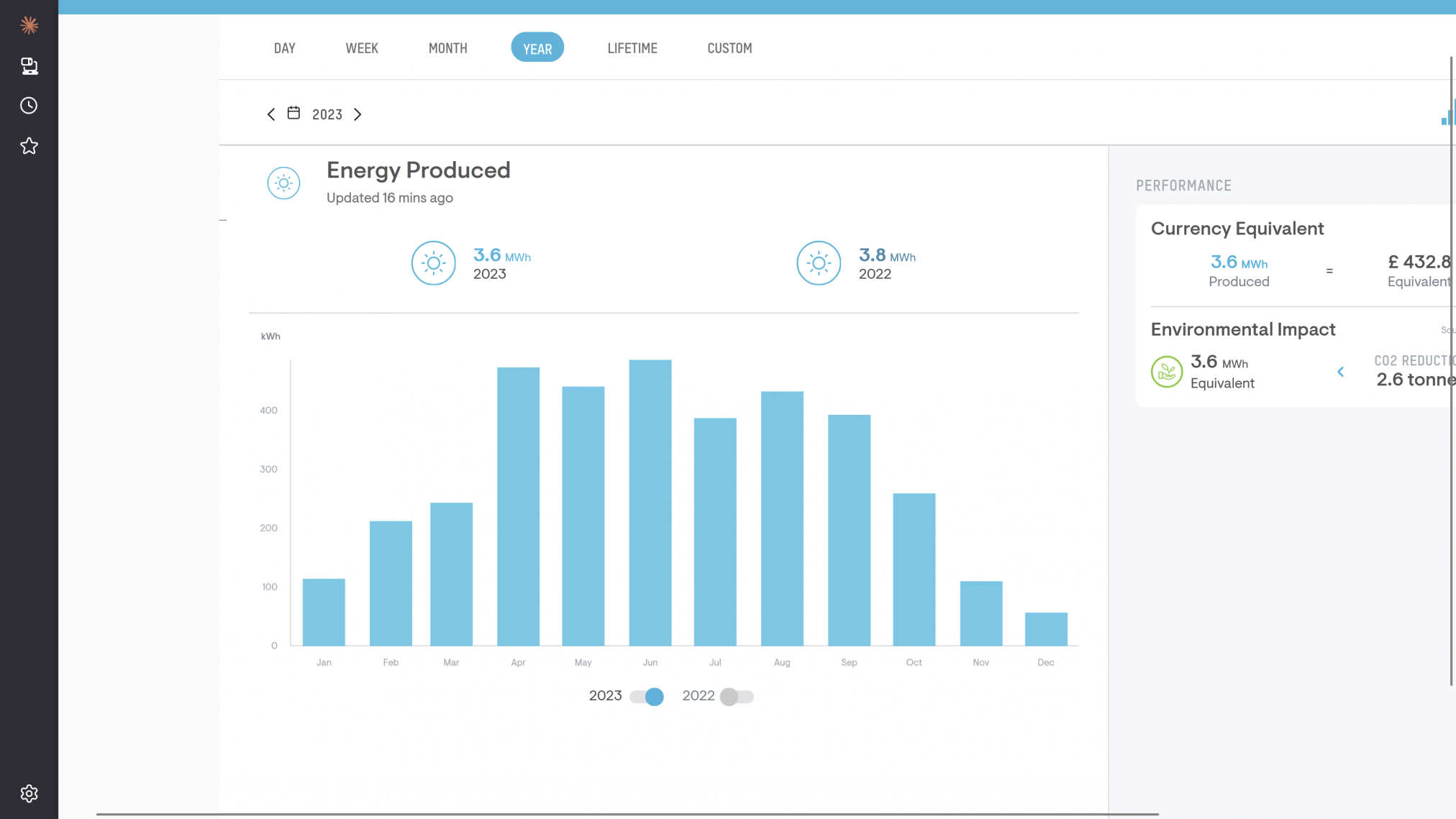
In March, with the heat pump, we start to break even in terms of getting enough solar power to dent our bill. By May, despite significant shading from trees, we are effectively off-grid and the money we pay every month is providing savings for the winter months. That and the SEG (Solar Export Guarantee) essentially pays for our winter heating.
I recently found an energy quote from 2008 where every unit was £0.089 – a whopping third of the price of a unit today and prices are rising.
The government could respond by raising the grants for moving to heat pumps for heating. But moving the levy to just gas would help encourage people who are needing to fix or replace the boiler to see real benefit in moving to heat pumps. Ironically, in rural areas, where mains gas is rarer, the uptake of heat pumps has been much higher than in towns, as being without electricity is much rarer in the UK than being without mains gas.
Posted: March 21st, 2026 under 42, Driving off the grid.