
Understanding the art of the possible.
Words to the wise: the majority of this paper is our usual exploration on how you can see the impact your efforts make in your home.
I do include the actual mathematics at the bottom to explain where some of this has come from – you do not need to read this unless you want to!
The past few weeks we’ve been examining sustainable heating. I’d like to take that to the point where we start to look at how we can put a value on the steps we’re taking by using what is at there at our finger-tips.
U-values tell us how effectively our infrastructure (windows and walls and insulation) helps us retain the heat our systems put into our rooms. Each component has its own u-value and we can add them together to get a total.
But this is not a simple sum on paper, because much of the material of our houses are built with are hidden from us: we tend to buy completely built houses without the choice of materials being given to us. EPC’s give us an estimate, but unless you have been lucky enough to witness the builds, that is all it is.
Working out our u-value.
Let’s see if we can’t “reverse engineer” our total/effective u-value, by observing what is happening in real life. We are going to do this for our louge by looking at the change hanging curtains up will make.
This is the day before the curtains went up:
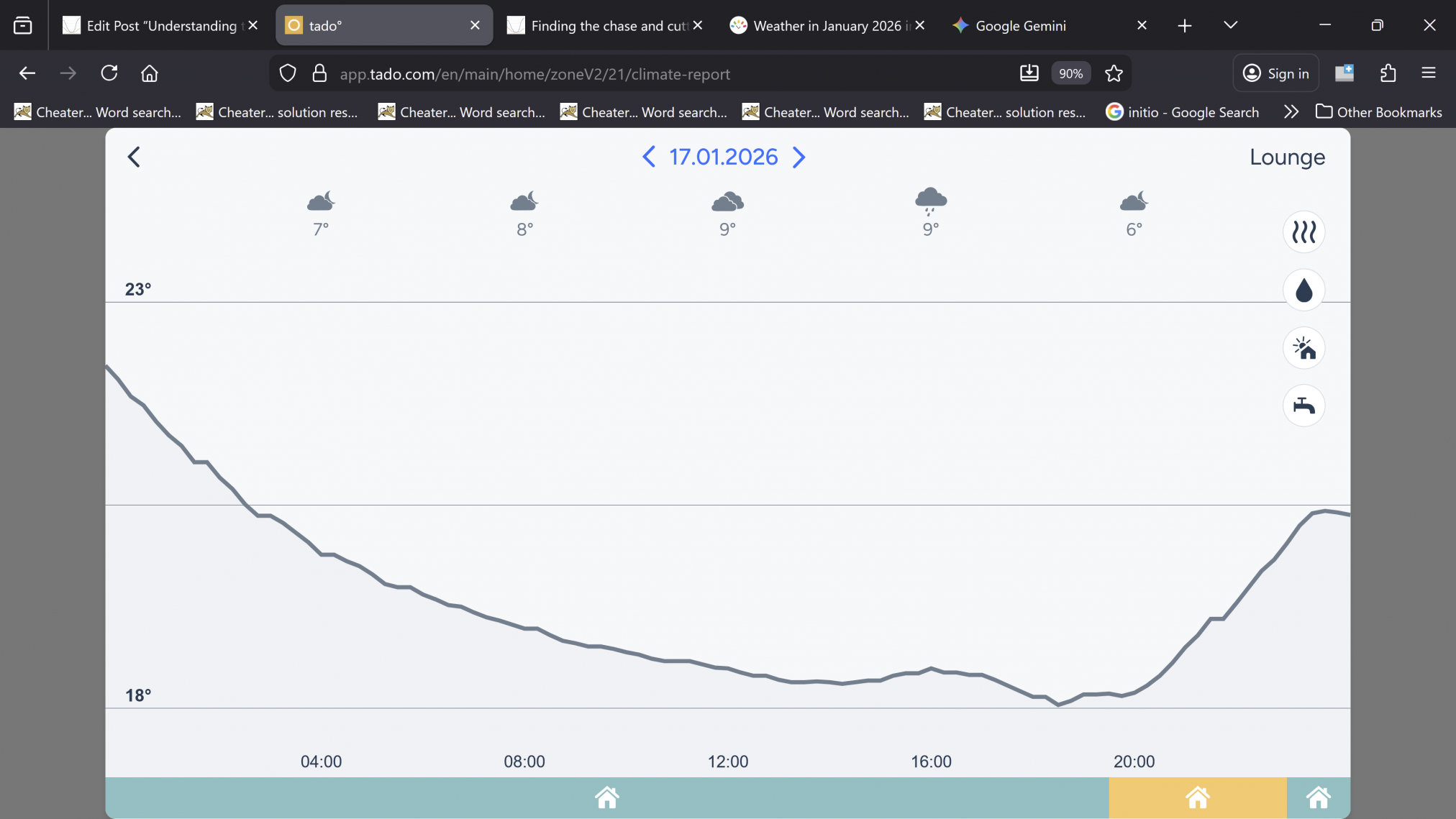
We can see the drop in temperature over night, from 22.2°C to 18.5°C by noon! Tying that to our heat camera shows that even with it’s impressive u-value our patio door is a source of heat loss – to the turn of 7.5 m2 * 1.2 W/m2K ≈ 9 W/K.
Words to the wise, a Kelvin is exactly the same size as a Celcuis – but the scale is off-set. This allows absolute 0 K to be -273.15°C, but 1K = 1°C. So, the 2.6°C we lose is worth about 24W of power.
Now, our tado thermostats and radiator valves log all the temperature changes over the past few years. But since we have had our new window, we have not had the curtains – so while I can look at the data from the last week of November and see that 2-4°C is lost almost all days. We can also see our solar gain in action or the heat pump or the log burner.
The question is, will our curtains help to cut that loss? I will use a couple of days to verify the saving.
What was the results then? How much difference does it make to put your curtains up?
The day before, means the next day is the 17th January 2026. Let’s look at our tado app and read off what happened.
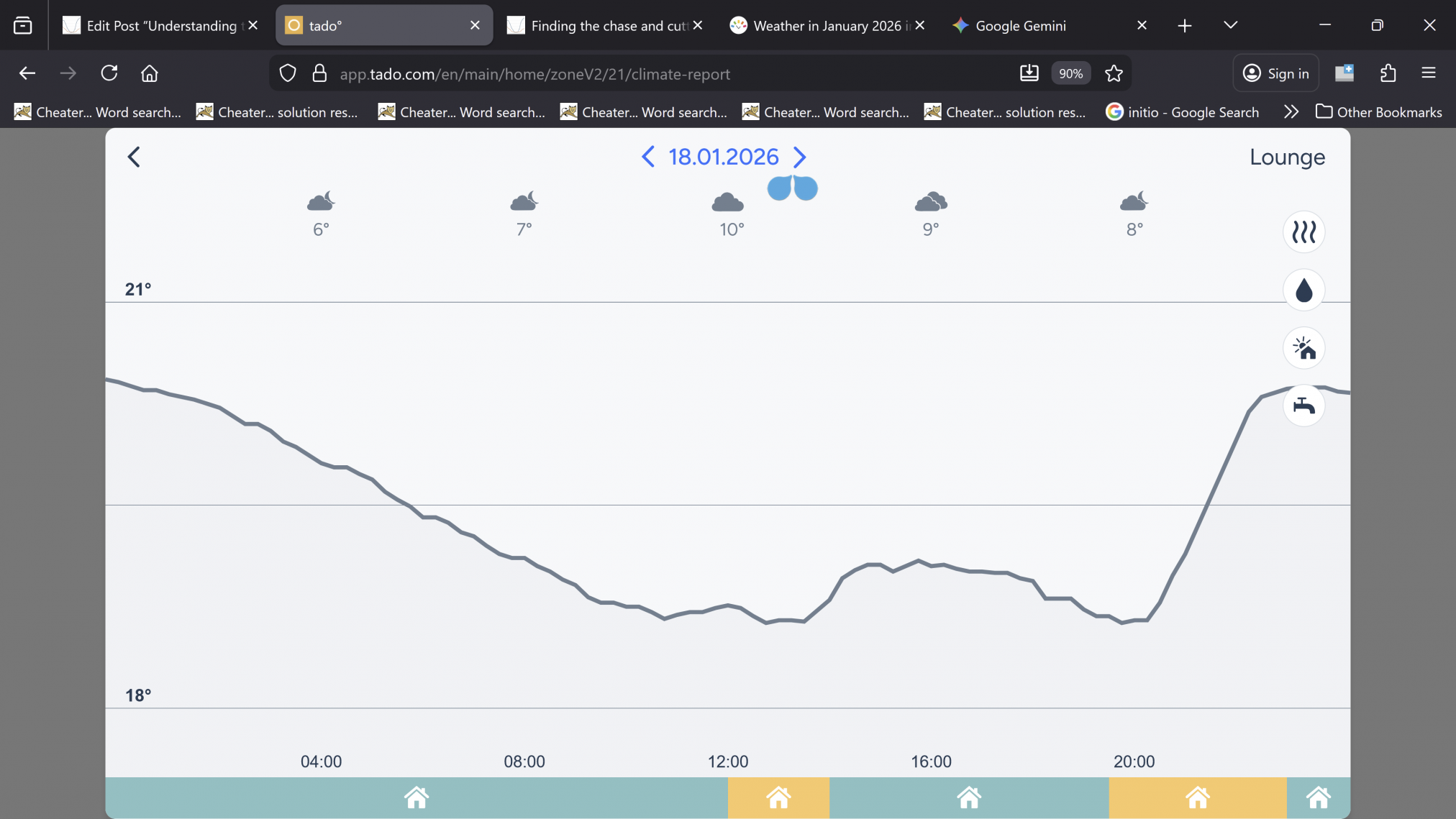
We close our curtains at nightfall, actually, I get the lights to come on 10 minutes before sunset which acts as a prompt to get up and draw the curtains. They are then opened about 7:45am the next morning.
We can see that overnight, the temperature drop is about the same but is much shallower until the curtains are opened, about 1°C. Now, we don’t have that much sun coming through the south window on the 17th January 2026, proven by the fact we only generated 1.9kWh from our solar panels that day!
In fact, the tado is passing that information on to use! See the clouds in the various time zones? We can see that we don’t have very much in terms of solar gain. But the biggest difference between the two days is the starting temperature when the heating kicks in.
- Saturday 17th Jan, when the heating came on the temperature was 18.5°C.
- Sunday 18th Jan, when the heating came on the temperature was 18.8°C.
0.3°C doesn’t sounds like much of a difference between the two shows, but it shows a big improvement in our u-values for the room, because of the save in terms of energy drop, or how much of the heat was conducted out of the room over the 12 hours in question, this is precisely what the effective u-value measures.
Curtains are not a simple addition, they need choosing, hanging, drawing, but it helps us calculate our u-value. We’re going to scrap some historical data first from https://www.timeanddate.com/weather/uk/ for our town and the 17th January. Between midnight and midday, the average temperature 6.9°C, given the room is 52m², we can see an obvious temperature drop of 4°C. So, we can assume our u-value for the entire room was 0.134 W/m²K.
Now, let’s look at the difference the curtains made: the estimated u-value was 0.121 W/m²K, we had only a 1.1°C drop but the outside temperature was an average of 6.5°C, so there’s actually more being done on that day.
The u-value is how much heat is transfered through an element of a building, or the heat conductivity and the lower the number the better. For both of these nights, the temperature outside was similar but the drop was dramatically different. In fact, on the day we had a smaller drop, the weather was cooler.
One addition has made a big difference to this room, thermally lined curtains. Nothing else is different.
I can quote you the fact the walls have a u-value of the walls is made up of the following layers:
| Layer | Material | Typical Thickness | R-value |
|---|---|---|---|
| External Leaf | Standard Red Facing Brick | 102.5 mm | 0.17 |
| Cavity/Insulation | Rockwool (Mineral Wool) | 50 mm – 100 mm | 2.7 |
| Internal Leaf | White aircrete blocks | 100 mm | 1.1 |
| Internal Finish | Plaster/Plasterboard (assumed) | 13 mm | 0.33 |
Total R-value = sum of the r-values for each layer = 4.3.
Wait a moment! What is an R-value?
We’re getting to that. An R-value is the “thickness” of a material. A thick winter coat is much warmer than a summer one for exactly that reason: it has a higher r-value because it is thicker and more insulating. We can also think of it as the opposite, or inverse, of the u-value, to such an extent that the:
- u-value = => ≈ 0.23 W/m2K.
That’s all the walls in the lounge, as with If it’s all about the green part 1, we can then work out what that means in terms of electrical energy retained.
Now, we have our patio door, u-value = 1.2 W/m2K, and our triple glazed doors and windows, they are 1 W/m2K each, and we know our observed u-value comes to a total of 0.121 W/m2K for the entire room.
So, is that curtains for heat loss?
Doh! But they do seem to make a bit of a difference, don’t they?
Now, we’ve got some accidental things we seem to have done right. The curtains reach the floor and there isn’t much of a gap at the top. We could probably achieve more if they did reach the ceiling – there is less of a path allowing heat to escape.
They are thick, and therefore heavy, curtains, fully lined with an extra thermal layer. They are gathered, all helping to make them thicker and less conductive. They overlap themselves by 50mm and they go past the window edge, again less of a path for the heat to escape around.
Five years ago, I replaced many of our venetian blinds with roller blinds, and found similar impacts. We finished the last one of these in our bedroom, when we swapped out our smaller window for a set of French Doors. One thing I wasn’t expecting is the difference the balustrade made the French doors in terms of protection from the elements!
Out of interest, where did you come up with the u-value?
Ah. U=Q÷(A×t×ΔT).
Where
Q = heat loss in terms of joules .
A = area of the room = 110m2.
t = time in seconds or 12 hours in this case, 43,200.
ΔT = difference in temperatures or our temperature loss.
For the 17th January,
Q = Energy Lost=Thermal Mass×Temp Drop
Q = 2,196,850J/K×4.0°C= 8,787,400 Joules
ΔT = Starting temperature inside minus outside average temperature = 13.7°C.
So U = 8,787,400 / (110*43,200*13.7) = 0.134 W/m2K.
For the 18th January, Q = 8,128,345 and
ΔT = 14.15°C
so, U= 8,128,345 / (110*43,200*14.5) = 0.121 W/m2K.
I haven’t really said where the Q (thermal mass) value is, I’ve just quoted it. This is made up of the surface materials in the room, our flooring, plaster, heating circuit… these all store heat and are entirely unique to your home. You can ask an AI like Gemini to help you work out what your values are likely to be or ask a heating engineer!
Posted: April 18th, 2026 under Driving off the grid.