
Not going quietly into the night.
When we got our solar cells, we were never looking to be off-grid. The move was to support us and our new electric car.
I had an interest in heat pumps, especially ground source, but in 2014, we saw solar as helping us ease the load.
Of course, the world has changed dramatically since then: war in Europe and West Asia has put pressure on fuel availability and that has impacted the price. As has our priority of our solar generation. Buying batteries in 2024 has meant we could have a back up for the house and limit the impact of getting an air sourced heat pump.
The 8th April was the first day in 2026 when we have been effectively off grid, we used a whole 500W (half a unit) from the grid.
How have we achieved this?
It’s been lovely and warm. That has taken pressure of the heat pump, allowing us to reduce our heating consumption.
Tuesday, 7th April, was really sunny, which meant that on Wednesday, we had 35% left in the battery when the solar generation took over supplying the house.
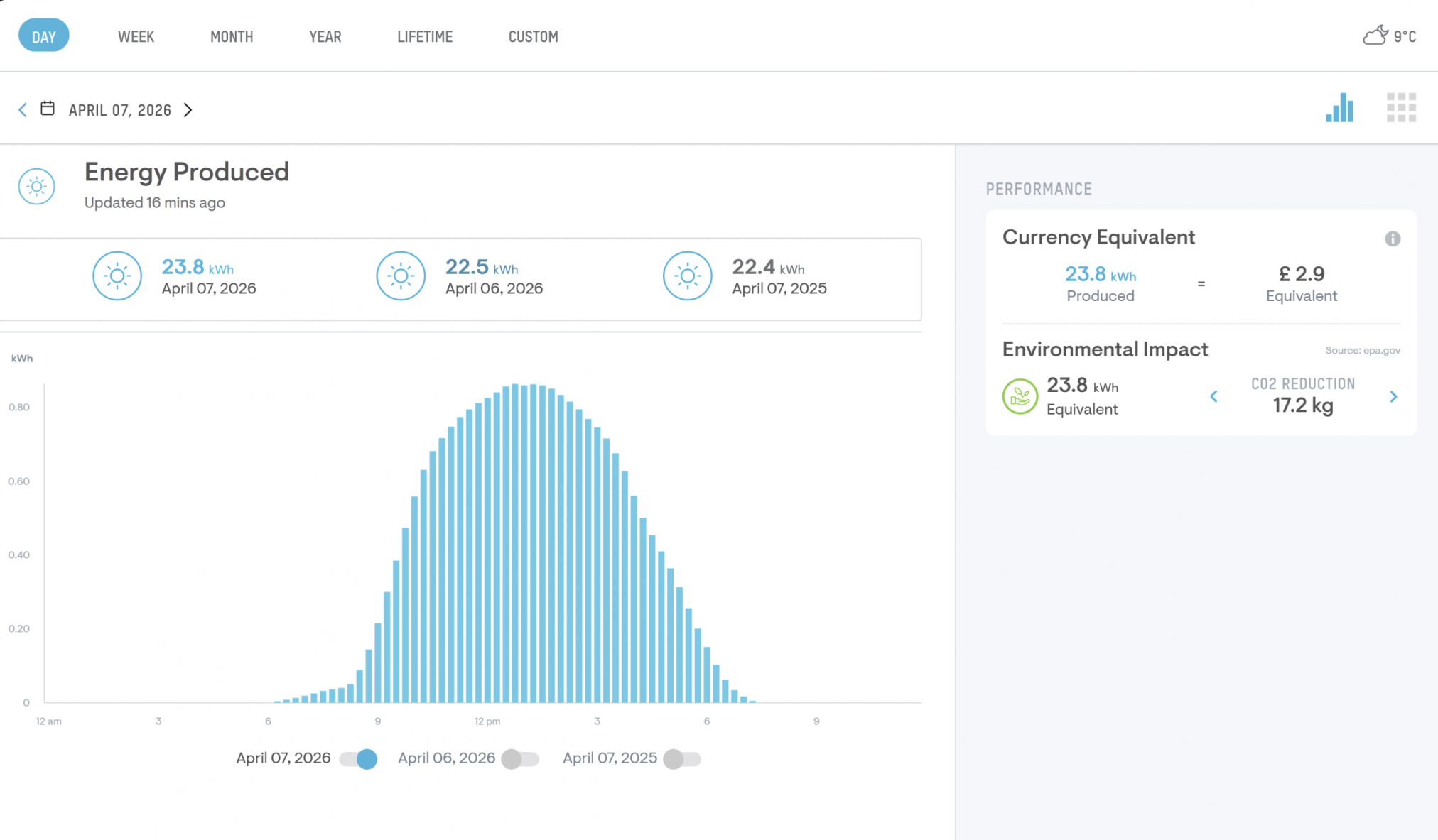
We did not compromise our lives on Wednesday, but shifted loads, like moving the hygiene cycle for the direct hot water system to the solar peak of the day. We also ran the washing machine and the tumble dryer later in the day.
I am writing this on Thursday, and at 13:43 on the 9th April, we are still running purely off the battery and the solar generation, though we should remember that the power stored in the battery was from our roof.
In fact, I am now cycling the dishwasher. But still running without taking power from the grid.
Of course, you were not the only ones doing well off solar!
No, we weren’t. The UK hit a new record for “max solar generation” beating last year’s 8th July record. There are a couple of things making that possible, but let us have a look at those figures.
| Year | Date of Max Generation | Max Peak Generated | Total Capacity Available |
| 2026 | 07 April | 14.41 GW | ~24.0 GW |
| 2025 | 08 July | 14.05 GW | ~21.8 GW |
| 2024 | 19 July | 11.20 GW | 19.3 GW |
| 2023 | 20 April | 10.97 GW | 16.5 GW |
| 2022 | 22 April | 10.30 GW | 14.5 GW |
| 2021 | 28 May | 9.30 GW | 13.9 GW |
| 2020 | 20 April | 9.68 GW | 13.5 GW |
| 2019 | 14 May | 9.55 GW | 13.3 GW |
| 2018 | 14 May | 9.38 GW | 13.1 GW |
| 2017 | 08 April | 9.15 GW | 12.6 GW |
| 2016 | 04 May | 8.20 GW | 11.4 GW |
2026 has felt cloudy and overcast, but this is not the first year the max generation record has fallen in April. Why should that be? Photovoltaic cells (solar panels) work best in three scenarios: the right amount of light, the right temperature, the right angle of incidence or the angle the light hits the panel.
Cooler temperatures in April allow the cells to work at peak, while the angle of incidence is steep enough to allow fixed panels to capture most of the light. April has an average of 12 hours of generating time in the UK.
Of course, not being on the equator means our winter generating time is lousy, but in the summer, we can get up to 16.5 hours of useful time. If your photovoltaics are geared up to enjoy it.
In both solar farms, and the typical house, we tend to put solar panels facing in one direction. That does indeed make the most of the southern aspect. But it means the cells are not geared up for our seasons.
I feel this is a missed opportunity, especially as we move to using electricity for more than lighting and cooking. Even if the power is not 100% as good throughout the day, the longer period is worth a great deal in providing power independence.
The TechoSolara app is one of the few applications that can allow you to explore what making use of different aspects can mean to your solar generation opportunities during the longer days of summer.
Why not see how you can make the most of your home’s potential to generate power throughout the year?
Posted: April 11th, 2026 under Driving off the grid.