
It went from mild to ‘Baltic’ in five minutes.
We take how warm our houses are for granted, but as someone who took advantage of a cheap deal if we got our windows replaced during the “autumn” (autumn my #@!£$), it is interesting to see why we keep windows and doors closed while it is 5°C outside!
Our Tado radiator valves and thermostats all tell you the temperature in your individual rooms…
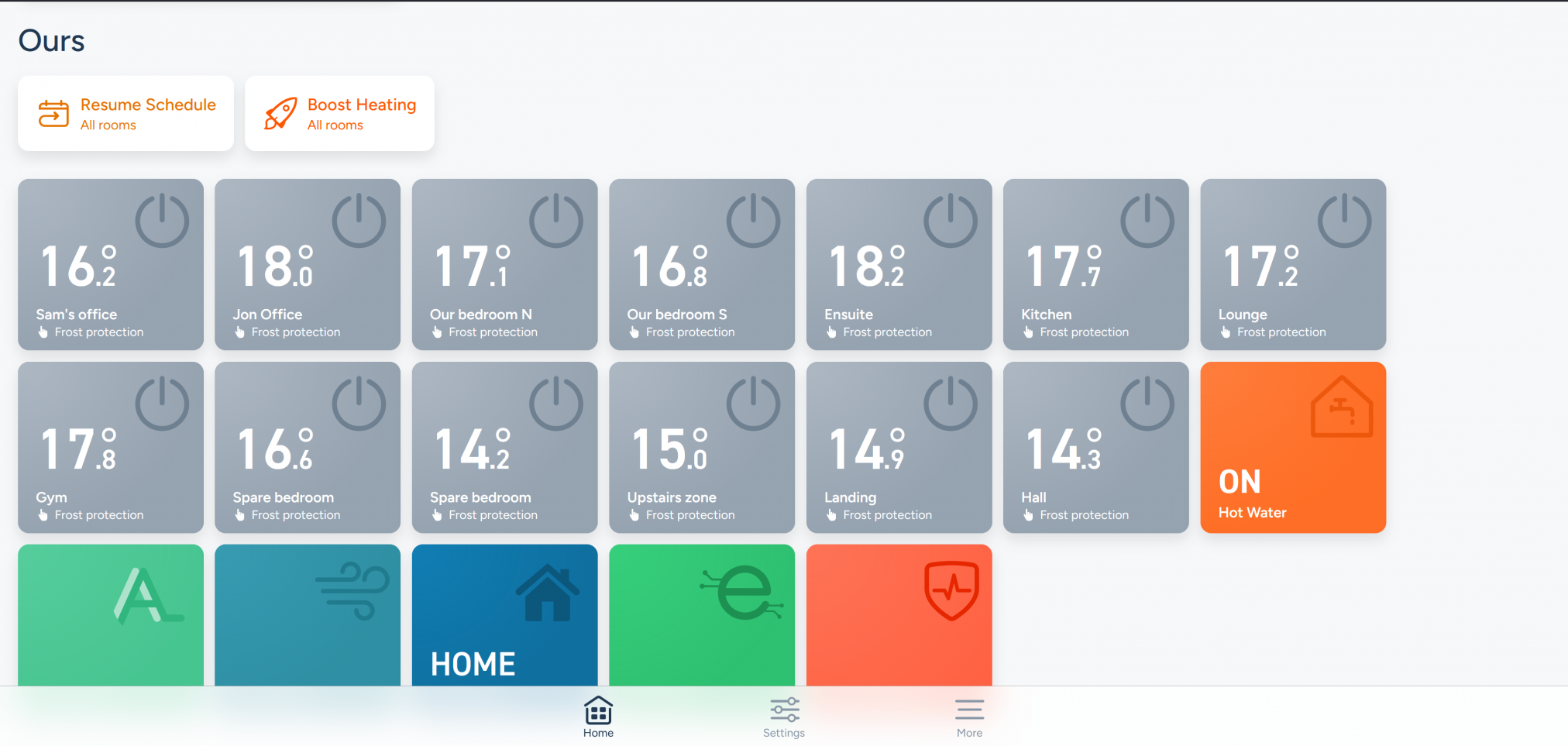
Our super-controllable house is in “frost protection” mode during the fitting times, because the heat is just leaching out of holes in the walls where the old windows used to be. Our bedroom was 19°C this morning but with the front door open and a window missing in the spare room, the temperatures soon start to drop. The internal doors are thankfully insulating, but there is no point heating a couple of rooms when the corridors are dropping in temperature this quickly every time you open the room’s door.
We can see the drop in one of the last to still be heated, my beloved’s office:
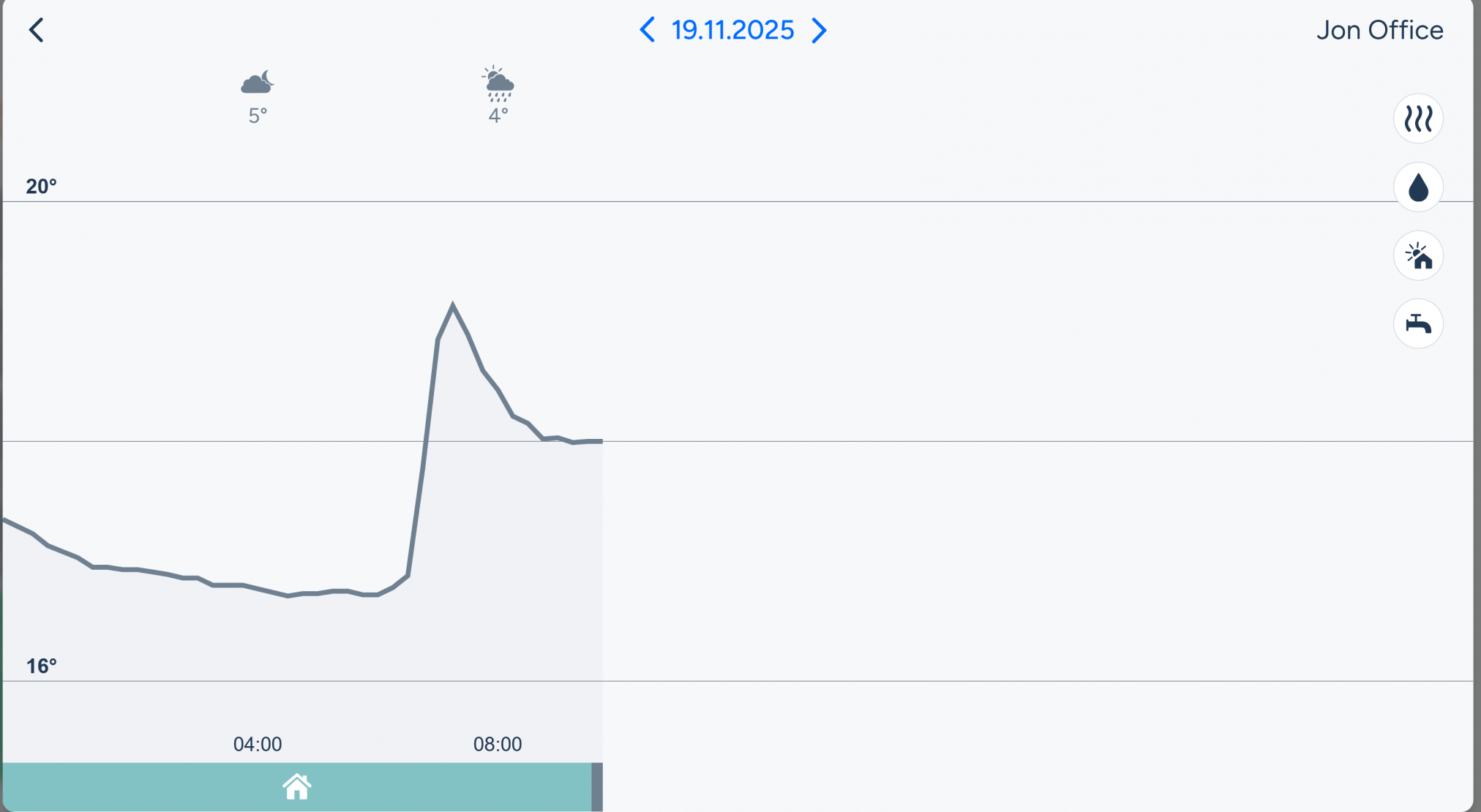
We can see from the readings from the smart radiator valve thermostat that the heating came on this morning for his office about 06:30. Even with the heat pump, the temperature rose to its setting of 19°C. All the cold air rushing past his office door then brought that temperature down to 18°C.
In a room with the actual window out, that is exacerbated. I switched off that room’s thermostat before the work started, naïvely thinking that would be enough. Obviously, it wasn’t, and the impact has been huge.
Why go to all this bother, then? You had double glazing!
Our double glazing was failing after 16 years. This first window to go was the one I had repaired (remember the extra caulking), because it had a 3mm gap between the window pane and the frame!
This one is having a tilt and turn window, which is more popular in Europe according to our window fitter and our son, respectively, for pretty much the reasons the Europeans have them installed. Our south face of the house bakes in the summer sun. Having a window upstairs we can open inwards means we can fit external shutters, allowing us to shield during the summer heat and recover during the night. Instead of opening the window to vent, we can tilt it at night with the shutter shielding us from moths and other insects.
We don’t need this downstairs, because we can walk to the outside of the window and pull a shutter closed, but upstairs, we need to do something different.
The triple glazing is to reduce our u-value further – vital for the north face of the property during the winter. U-values are the rate at which heat is lost from a surface and is dependent on a few things such as materials, air gaps, and is measured in Watts per square meter a degree Kelvin or W/m2K. (Kelvin’s are used here as they are the scientific unit (also known as the SI unit) for temperature, unlike the Celsius unit and you then don’t need a pesky ° symbol when typing this out). The lower the u-value, the better. It’s one of the things measured on an EPC (Energy Performance Certificate) report.
Our old units, were starting to fail (apparently they were made in 2009 and installed later that year, looking at Google Map’s “see other dates”). No-one lived in the house until late 2011, early 2012. By the time we had moved in May 2013, some of the fixings and hinges had begun to rust. The vaccum units started to fail last year – but with the boiler failing, we had other priorities!
Windows are never as good as brick at keeping a house warm. But on top of good units, having them fitted by someone who knows what they are doing is essential. Any gaps round the windows will let any heat poured into the room find an escape route. I know people who moved into a house that had had the windows (not UPC ones, just wooden frames) installed upside down. When a window is installed upside down, rain pours into closed windows from the top. A good fitter is vital otherwise it can all go horribly wrong.
One of my pet peeves is trickle vents. Required by building regulations, they poke a hole through your sealed units. Doh! The idea of them is to “let hot damp air vent when you can’t open a window” but all they do is chill the windows allowing said damp air to condense on your glass panes. Eight months of the year, in the UK, they are just causing more issues than they solve, and the other four months of the year, we can just open the window!
That aside, it’s really exciting to be fixing our window problems for the next 25-30 years.
By the time you read this, all the work will be complete and you’ll only have to wait a week to see the finished result. We’re at the point now with 80% of the upstairs windows fitted though not completely fixed and finished.
What about the temperature inside your house at this point?
Good question. Let’s have a look at that.
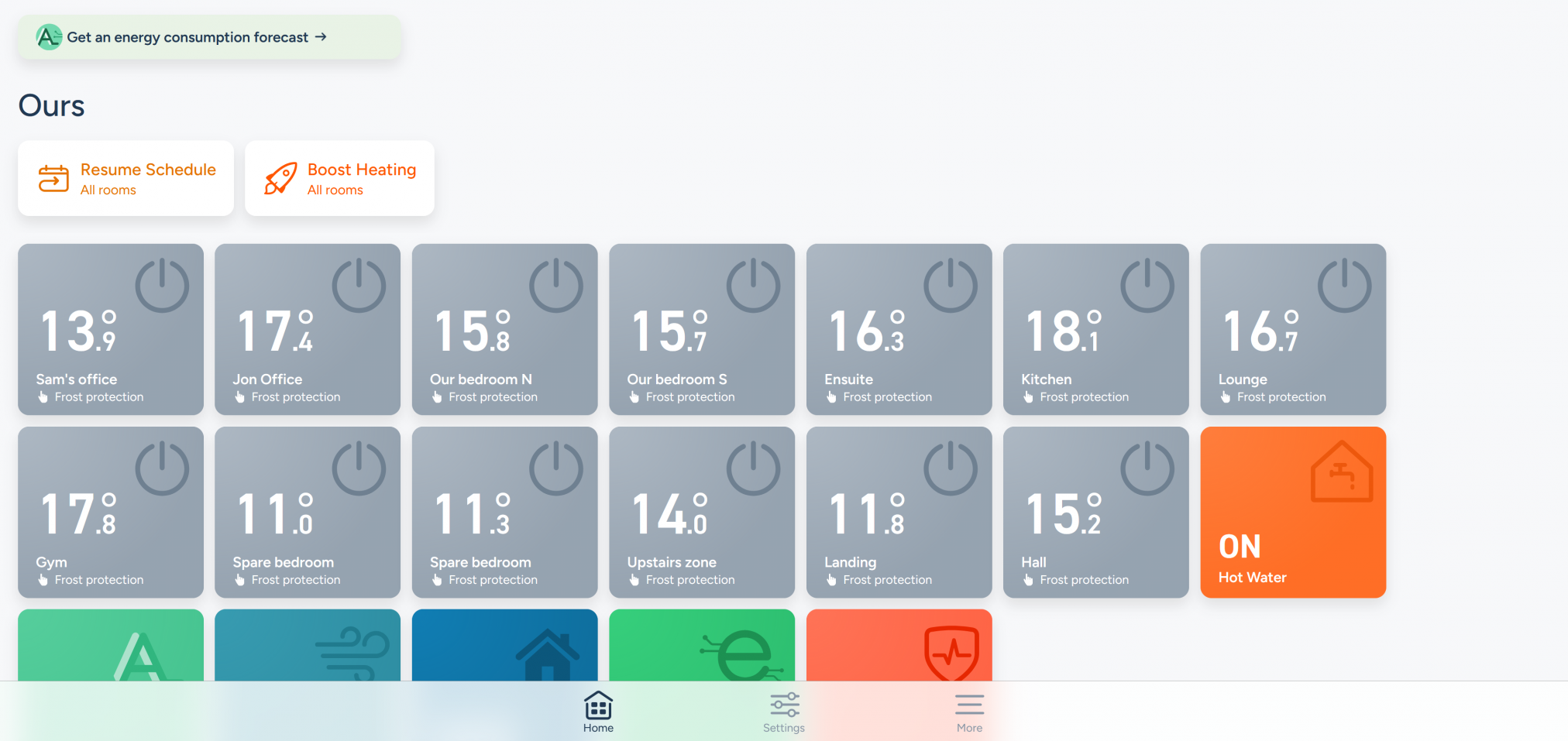
The kitchen and Jon’s office have kept their temperatures up – the benefits of a closed door, good insulation, and windows not being messed around with. The spare room is, frankly, a bit parky. As is the landing – having dual aspects and open doors here. My office has lost a few degrees too, but is looking great with its new window. Our main bathroom has also been done but it’s thermostat isn’t a smart one, so isn’t showing the 12°C on the room’s thermometer.
Most of the removal and refitting has been done today, so I am gently starting up the heating. Upstairs that means the ensuite and bathroom in our spare room – our home from tomorrow night for a few days – will start to get warm again.
Sounds like hell.
But it should be worth it. I will do a deep dive analysis on the figures at a later date.
Though, as hinted, this is about more than just improving the u-values. Our house was completed in 2012. Yet, “cottage-style” windows were installed. By choosing modern style windows, we should be improving the aesthetic too and allowing light to fill the rooms.
Converting our bedroom’s window to a French door (with balustrade initially) will let in more light and allow the courtyard to be see from anywhere in the room.
The same goes for the large patio door in the lounge. It shares the same view, albeit from the ground floor. Only, the small French door and window the other corner of the room meant the courtyard could only be enjoyed from a few points in the room. The window area is increased but so too is the wall area – and corners, we will gain two big corners in the room.
It’s hard to describe the benefits of walled corners in a room. A place to put a cabinet or a chair, a set of shelves, or just a piece of wall. The 1960s architecture in the UK often featured wall to wall windows. Why, oh why?
There are some wonderful rooms that have round the corner windows, with a great view, this can be stunning. But it needs really careful thought about how you enjoy those views.
We’re lucky in that our lounge is really open, a basic rectangle that can be divided into zones. A reading zone, TV zone, small table for a snack in the evening and a music listening zone. With the new patio door, the courtyard is now a feature against all these activities.
One of my favourite things about the courtyard is the fact there is a flower in bloom at every stage of the year. Whether chrysanthemums and a clemetis in October, November, December, a Christmas rose or snow drops in January and February, bluebells in March and April, Wisteria in June and July, honeysuckle and weigela in July and August, clemetis in July, August, and September. Something is happening somewhere for you to look at. Whether in the garden or in the lounge.
Posted: December 13th, 2025 under Driving off the grid.