
First day, almost off grid
The week 28th April to 4th May has had some brilliant solar collection days in our little part of the world.
Indeed, April itself was the sunniest we’ve ever had, with a whopping 524.5 kWh being generated by our grid – and the thing about solar is that everyone whose cells were orientated in the same direction and elevation could get the same results.
All thanks to a photon hitting a part of the photovoltaic cell induces a current by displacing electrons from one part of the material to another – measurable as a direct current.
Thanks to the density of the material, that can happen for many years: this August our cells will be 11 years old.
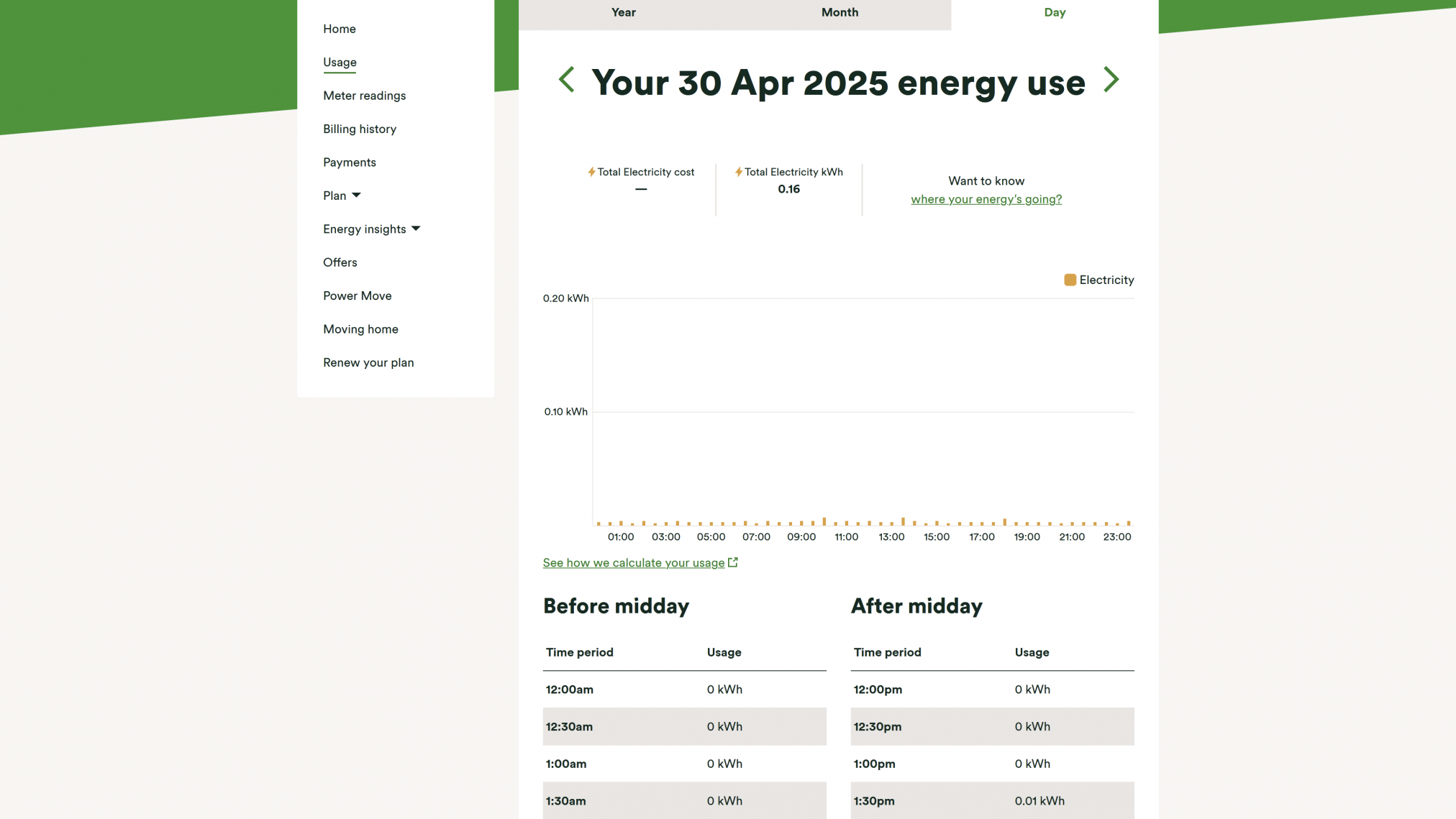
Theming this up with our air sourced heat pump means we only used between 160W and 220W a day during this week from the grid. That was basically noise when the sun dipped and the battery wasn’t quite balanced against the fluctuating needs of the house.
When we first got our cells, batteries weren’t really available at anything like reasonable cost or cost to benefit ratio. It’s partly why feed in tarrifs existed along with selling your excess power back into the grid – which only really possible with appropriate meters. It just shows what progress has been made in the past 11 years.
Every little bit helps, of course. I’m writing this on the last forecasted warm day of the next five, and if we’re not warming the house, our energy needs are not super low, but are not too bad. Our energy supplier does a comparison to “similar homes” – five bed (or more) houses, with washing machines, dishwashers, tumble dryers, electric ovens, microwaves, electric hobs, heat pumps, EVs, home battery sources, and solar cells. We say how many people are living in the house too.
Hold on, aren’t you living in a four bedroomed house?
Yes, but if I do that, the numbers are even worse in how much better we’re doing and actually, volume wise, our house is nearly twice as big as most four beds, nearly 80m2 bigger than many five beds in the UK. I thought that was a good way to balance the scales.
Anyway, we’re not making a big effort to energy save, but our usage last month from the grid was dramatically lower (205.8 kWh compared to 709 kWh) than the similar homes.
It’s true, we have a nice home, mostly we just do big trips once or twice a year. We do a significant amount of our own cooking, and the move to the microwave and induction hob has made a big difference. We have an insulated house and none of our bulbs are rated above 6W – we’re not sitting in the dark, just making the investment on the cost of the bulb against it’s usage. Tapo/Kasa helps by dimming lights when we can too, and turning thigns off.
Our battery app lets us see when we’re off the grid allowing us to time things like the washing machine and dishwasher to run without the need of the grid. The peak draw on the grid is between 4pm and 7:30pm – during the summer, our battery allows us to use electricity stored up from during the day.
We’re making use of solar gain to ensure we do not need to heat the house at the moment. Our draw of 601kWh for heating and hot water in January has gone down to 187kWh in April and that was all powered by the sun.
We also try to avoid doing big things without the battery in place, a daily view from our smart meter shows we manage that fairly well.
Of course, our energy supplier reckons our energy footprint is 0.4 tonnes of
CO2 per year, largely thanks to the fact we’re not doing anything with mains gas. That compared to 1.6 tonnes of CO2 per year in the similar homes. But, our supplier has already suggested we pay only £177 to them a month (£2,124 pa) to cover all our heating needs.
Even so, 503.2 kWh a month of seems like a great deal to be spending for a few easy steps.
Doesn’t that mean you’d be significantly better off at the moment if you didn’t have a tarrif that had a standing charge?
The short answer is yes. For the 1st and 2nd May, we paid £0.09 for our energy usage and £1.39 for the standing charge…
Ouch!
Indeed, but typically when we had a standing charge free tarrif we paid 2.5 times as much per unit of energy, so our £0.09 would become £0.23 instead. Over a year, that’s quite a sum, and need sto be compared to the £170 rounded up on the standing charge. So we’ll think carefully before making that leap.
Posted: May 24th, 2025 under Driving off the grid.