
Living off the grid
Yesterday was the first day this July we were using electricity supplied from the national grid.
In fact, since the middle of May this year, we have, where humanly possible run ‘off-grid’.
Where humanly possible?
Some things are scuppering this philosophy. This sounds so ungrateful, but our electricity supply company gives us free hours of electricity and I am sorry, but I am going to try and use that.
We’ve also had three days where we just haven’t had enough of a chance to harvest and store enough from our solar cells.
But in June, we only spent £3.81 on electricity consumption. Our electricity is £0.2375 per kWh (aka as a unit), plus VAT of 5%, so £0.249375. So we used 16.2kWh from the grid. We also pay a standing charge of £0.5138 +VAT (£0.53949) a day.
Surely you would be better off with a cheaper contract!
I love doing this analysis, because our £20.22 in June was mostly the standing charge. Full stop exclamation mark. We could go for a contract with a cheaper per unit price.
Every single one of those has a much higher standing charge. When we’re producing our own electricity, it makes no sense to do that.
In many ways, I am not against that. In the UK, our energy companies are privately owned, and they are trying to make money. We are not a cash cow for them, exactly the opposite. I also like the fact we have the grid to fall back on. It needs investment to keep it working and up to date.
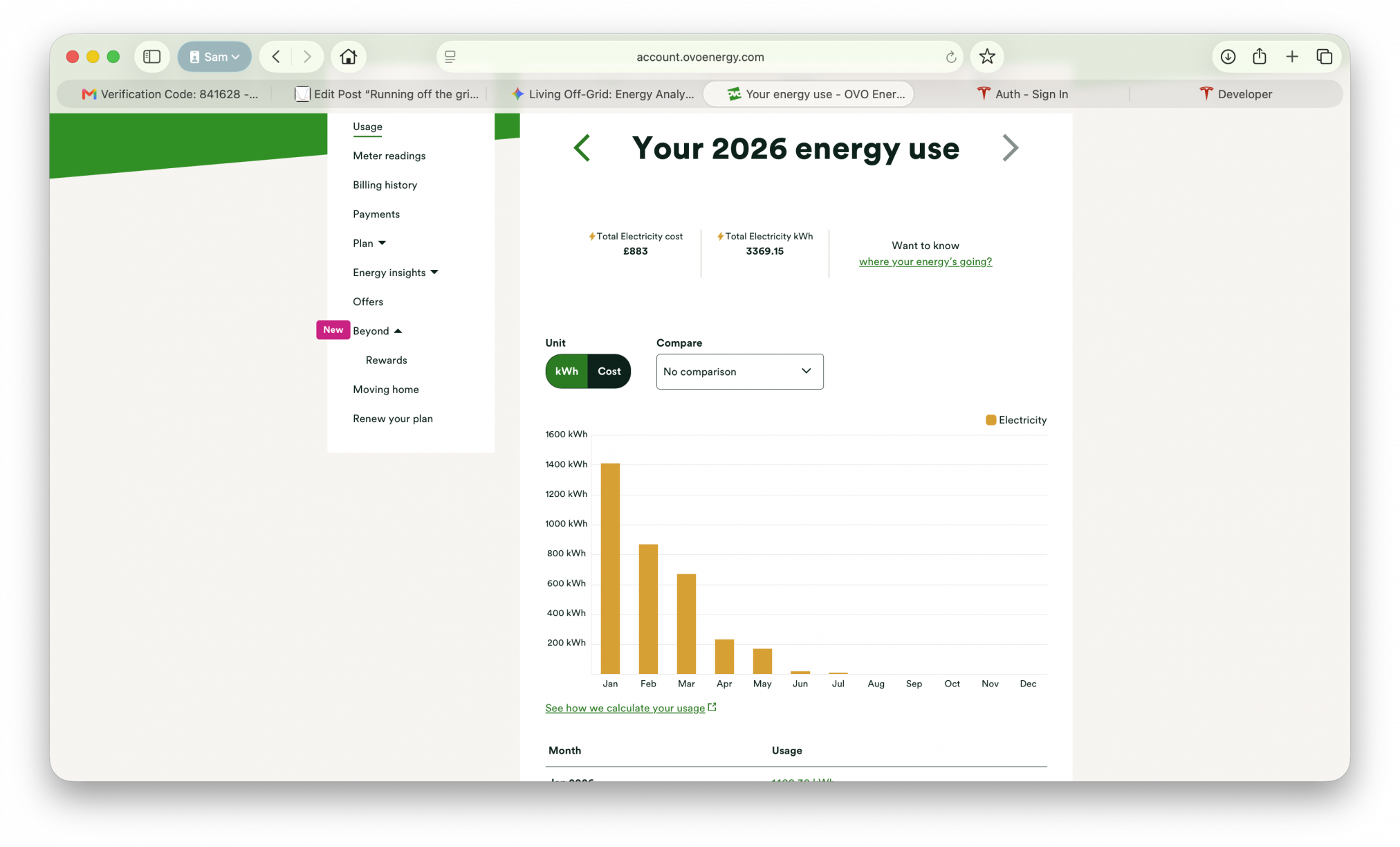
I willing accept a charge of £0.249375 per unit, so that my monthly bill in the summer is as low as possible. To date for 2026, our usage bill has been £883.00, or 3369 kWh from the grid.
How low did you go?
Good question, and you know I love my figures. Let’s do a month by month walk through.
May 2026.
I realise that to reduce our bills, I need to ‘go off-grid’. This means the Tesla Gateway is operating in ‘island mode’, so it is not feeding power back into the grid or taking power from the grid.
In fact, this seems by far the best way to ensure we do not use anything more from the grid than we have to.
I have set up various rules on the Tesla Gateway to fit in with our energy provider’s rules on the free electricity (zero rated), but the Powerwall logic is really basic. We are limited to 1 kWh for an hour, the Powerwall seeing it as a cheap way to charge the battery means we have to buy electricity.
Self-powered mode again doesn’t really help if it sees protecting the battery from running too low for an hour as not being worth the effort during our ‘peak time’.
Telling the battery to only charge off the solar also doesn’t work. Being in island mode does. And keeping an eye on it. When the battery gets to 100%, the gateway stops consumption from the solar panels. It effectively turns them off, which isn’t helpful. At those points, I need to reconnect to the grid.
As I said, we didn’t start doing the off-grid thing until late-May. Basically, in terms of our Tesla Powerwall’s analysis and our electricity bill, you can see the difference it made.
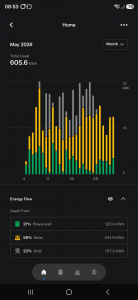
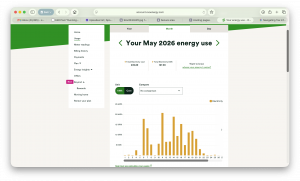
I learnt a great deal during this time on how the Tesla made decisions. None of them seemed geared towards us, and the fact we wanted to reduce our carbon footprint, and take advantage of cheap electricity albeit with some rules.
June 2026.
I’m still fairly nervous about all this: forget the business imperative, I use insulin. During a heat wave, the most valuable commodity I own is my fridge which protects my insulin and keeps it effective. Without insulin I die. I would die from starvation, but not as quickly or as painfully.
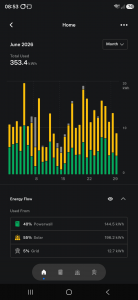
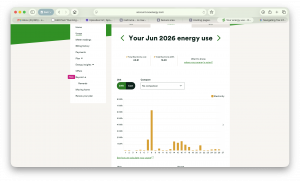
But this is the first month we pretty much manage it. We have not had a stellar month compared to last year. But generating 401.6 kWh absolutely covers everything we use, and some. 401.6 – 353.4 = 48.2 kWh. Although it doesn’t appear on this month’s bill, we even manage to donate some spare energy once I realise we have to manually do that. The SEG payment was £0.23.
July 2026.
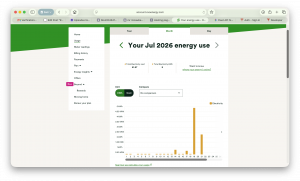
I am happy enough that, while there is a week to go, we have enough evidence to say the case is proven. This has worked for us. Again, compared to last year, we are not generating as much electricity from our solar cells. Their performance is still high, at 12 years old, we still get days at 21 kWh, it’s just that is dependent on the weather. We’re also not ideal for mid-summer, the equinoxes are our peak generation time. The summer highs are purely down to how long the sun is in the sky.
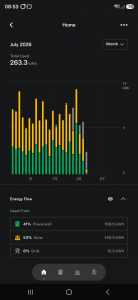
We generated 298.9 kWh as I write this article and we have consumed 263.3 kWh. To quote Mr Micawber: annual income twenty pounds, annual expenditure nineteen pounds nineteen and six, result happiness. Annual income twenty pounds, annual expenditure twenty pounds naught and six, result misery. We are using less than we’re earning, so we are very happy bunnies.
I’m noticing July is more than June, and your usage is really high.
Yes, there is a whole extra day in July, and that makes a difference.
Yes, we power an electric car. This makes electricity much more valuable for us: every unit we use to drive the car means we’re not buying petrol or diesel. We haven’t had gas heating our rooms or water since 2024.
We cook, clean (washing machine, hot water, vacuum, dishwasher), have powered vehicles, have lighted rooms when it is night, work, and entertain ourselves from our electricity. It’s doing everything.
It’s more than many, but it might explain the difference. When we’re asleep, our background usage is between 100 and 300 W an hour. Before we got the batteries, I worked out what was taking electricity, and if possible, changed the devices or our behaviour to bring our requirements as low as possible.
Before April, our base usage was 200 – 400W but we swapped out a router and its wifi extenders and that has made a huge difference.
The big question is, how long does your battery last?
During the summer, two and half days guaranteed, longer if we make an effort or are out of the house. I have connected to the grid for our free hours of electricity.
Posted: July 25th, 2026 under Driving off the grid.
Tags: #AllElectric, #BatteryStorage, #ElectricityBills, #EnergyEfficiency, #EnergyTech, #EVCharging, #HomeAutomation, #HomeElectrification, #HomeEnergyStorage, #IslandMode, #NetZero, #OffGrid, #SEG, #SmartTariffs, #SolarPV, #SustainableLiving, #TeslaPowerwall