
Putting on your top hat when we’re not talking about millinery.
As the UK is coping with high humidity and high outside temperatures, it may seem an odd time to be thinking about insulating your pad. Summer is a perfect time to strip out older insulation and replace it with newer, “up to code”, materials and thicknesses.
There are 21 million homes in the UK and only 7 million meet the insulation standards set after 1976. Only 1.6 million meet the newest set of standards, set in 2003.
Given that the average home uses 12 MWh of gas for heating, insulating to today’s standards would lower that bill to 9 MWh, saving approx. £172.20 at £0.0574 per kWh of gas. When prices go up to £0.0733, that is worth £219.90, per annum.
Spread that over 13.9 million homes, and that reduces the UK’s gas usage by 41.7 TWh, a cost of about £2.4 billion if the gas price is £0.0574p per kWh. Prices are about to go up to £0.0733 in the UK on the 1st July 2026, making that total worth £3.1 bn.
Let’s look at what you can do to “get your house up to code” and make these savings. This is going to be one of three in a series looking at insulation for your house. Starting with the roof, the walls, and, finally, the ceilings and the floors. In this entry, we’re talking about your roof, or your house’s hat.
Reaching, very reaching…
I try. In the UK, all new houses were fitted with roof insulation since 1973 in response to the burgeoning energy crisis.
I’ve a strong sense of deja vu
Indeed, much like the global economic situation we find ourselves in now. Back in 1973, that insulation was typically mineral wool (often fibre glass). Before then, mineral wool laid to 28mm in depth, and was seen in some homes from as early as 1965. 1973 saw that rise to 60-70mm… Actually, let’s see that in a table and a graph.
| Year | Minimum requirement (mm) | Estimated U-value (W/m2K) |
|---|---|---|
| 1960 | 0 | 2.5 |
| 1973 | 60 | 0.6 |
| 1976 | 70 | 0.5 |
| 1985 | 100 | 0.35 |
| 1990 | 150 | 0.25 |
| 1995 | 200 | 0.2 |
| 2002 | 250 | 0.18 |
| 2003 | 270 | 0.16 |
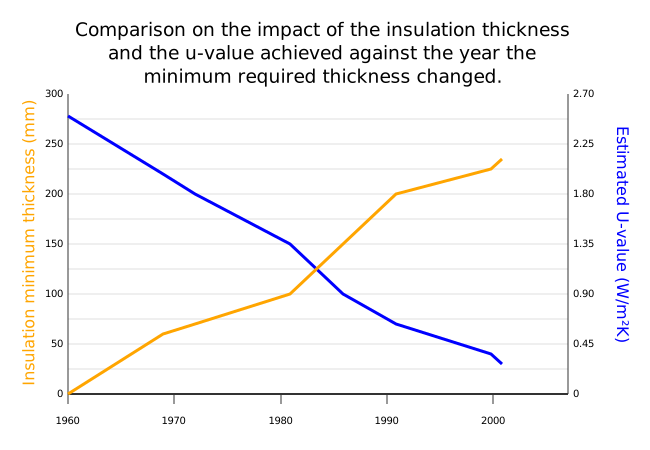
Here is a quick reminder on what the u-value is (aka the thermal transmittance). The u-value measures the rate of heat transfer through a material, divided by the difference in temperature across that material. A lower numbered u-value is better, the limit being 0W/m2K – or zero difference in the heat being lost. The graph above let’s us see that we can dramatically reduce the amount of heat lost by increasing the thickness of the roof insulation, if the insulation material is mineral wool.
Some things not obvious from the results.
A couple of things to realise here.
- The thickness of the insulation is achieved by layering different pieces of rock wool together. Though these days it can be bought in 50mm thick slabs too, in which case you would buy six layers to achieve 270mm.
- When climbing about your loft, ensure your feet touch only the beams and girders. Your plasterboard ceiling will not appreciate any weight on it!
- While it can be done as a DIY job, protective equipment is essential. Rock wool/mineral wool/fibre glass insulation is made from small particles that can be absorbed through the nose and lungs, skin, and eyes. Therefore, the following is required:
- Breathing equipment and respiratory filters up to standard FFP2 or P3, disposable ones are best.
- Wearing tightly fitting safety googles, fitted over glasses. This is to protect against air born fibre fragments.
- Good boots are essential. Leather or thick soled and padded working boots.
- Long sleeved and trousered, loose fitting clothing. This means any material that brushes against you is caught by the clothing and not absorbed through the skin. A type 5 (dust tight) coverall is ideal.
- Heavy duty gloves with a good layer of protection.
- Ideally a hard hat and protection for the head, ear, and neck against brushing against the material.
Young children and pets should be kept away from the area. Dust sheets sealing the loft hatches can help keep exposure contained, otherwise any fibres need to be vacuumed using a HEPA filter, or use a damp cloth which can be binned, and wear gloves while you wipe up the residual dust.
Sounds scary.
Sorry, but I needed to ensure anyone inspired to renew or install from scratch their loft insulation knew that safety equipment wasn’t optional. Of course, you can pay specialists who have this equipment to do the work for you.
Newer versions of stone or fibre glass mineral wool come with layer of reflective material for better infrared insulation.
Of course, you can also use sheep’s wool, with products often called thermafleece, that are produced from that renewable of sources, the common or garden sheep. That doesn’t need as much safety equipment to install.
Having installed it, mineral wool is good for 30-50 years where it is not compressed, it is protected from the elements, and rodent or pest ingestion or habitation. Ensure there are no heavy boxes stopping your base layers from being compressed. A u-value of 0.16 W/m2K is an amazing level to sit at. Of course, the UK building standards mean that this is baked into new builds, and any renovations being performed.
Where the loft insulation material is damaged, or thermal bridging occurs, it is worth refreshing the loft.
So, install it once, and we’re sorted?
A couple of things to appreciate, if you are doing it yourself.
- Any gaps provide a thermal bridge. If you are using a roll, make sure your layers overlap.
- Any compression reduce the performance. If you are thinking of boarding out the loft, ensure the posts you are using will allow that 270mm to sit without being squeezed.
- Ensure the rock wool sits against the ceiling boards and over the girders and beams.
- Venting – ironically, you don’t want any thermal bridging but it is essential to ensure the roof itself, above the thermal insulation, can breathe to prevent damp.
These are things the professionals build into their designs which you must consider when doing the job on your home.
Then all done?
This is an amazing start. But there are things done on newer builds that are worth considering.
- Celotex between roof rafters, sitting the house side of the roof underlay. These sit on laths, allowing 50mm gap between the membrane and the Celotex to allow everything to breathe. This technique allows you to butt right up against the rafters and even cover them with a thin strip of Celotex to prevent a thermal bridge.
- Dormer windows are really difficult to insulate well. Consider a plan to allow a box of insulation to be created but allow that air gap.
- Steel girders, even powder coated ones, need special attention. They are often boxed in Celotex. This is to stop the steel beams and columns getting cold and allowing water to condense on them. This is not a DIY task, because if it get it wrong, you risk dramatically shortening the life of these critical building elements.
Good luck with your roof’s insulation project, I hope I’ve provided food for thought.
Posted: June 13th, 2026 under Driving off the grid.
Tags: #BuildingPhysics, #EnergyEfficiency, #HomeImprovement, #HouseHat, #Insulation, #NetZero, #Roofing, #SustainableLiving, DIY