
It feels like years since it’s been here.
It’s hard to believe the UK has broken its solar generation record twice this April, after such a dull and grey winter. The day before that last record was broken, the UK achieved its lowest ever value for how much carbon dioxide was used to produce its electricity. These two things are connected!
When you have solar panels, you appreciate the tie between the temperature and the amount of sun your bit of the world really gets. The cooler weather and the sun’s angle on the panels add up to great solar generation. If the clouds are at bay…
This year, the start was grey but by the 7th April, we had one of our best days ever, as did the solar generation farms in the UK, producing at total of 14,414 megawatts (MW) or 14.414 GW (gigawatts).
When it’s not what you have, but what you do with it.
Our solar generation means we had enough to cook, clean, heat water, run extractor fans, charge the car a little, heat a couple of radiators first thing in the morning.
It wasn’t the only day we were in this situation. Towards the end of the month, and we had had several “off-grid” days. In prep for our annual barbecue, I was able to make four batches of rolls from our generated power and the stowed excess from our generation.
The second tesla battery was in place by this time last year, but it still feels a bit new and revolutionary. We are not gaining much from exporting excess electricity just now, though as the days lengthen this summer, that will change.
I know many people are buying electricity at 5p a unit and selling it back at 15p a unit. I am not sure how I’d feel about that as our goal has been to reduce our carbon footprint since having the batteries. Ovo are about to do a “2 hours of free off peak electricity a week” between the 18th May and the 2nd August 2026. I suspect this will be during midday. We’ll use it to run the dishwasher and cycle the washing machine!
When we’re not generating enough ourselves, I look at the energy mix from NESO. NESO’s forecast of the grams of carbon dioxide per kilowatt hour of electricity generated is published. Please see https://www.neso.energy/data-portal/national-carbon-intensity-forecast/national_carbon_intensity_forecast_methodology). Your energy provider will provide this to you through their website or app, as seen in the figure.
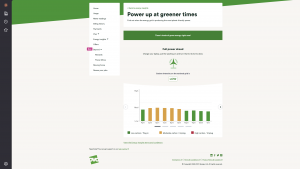
Given this forecast, we’ll be making sure we’re making us of our 27kWh stored in our battery from 5pm to 10pm. Our current draw is 1.5kWh as I finish off the final batch of rolls. This means we should be fine until the sun rises tomorrow.
Our Tesla app allows us to see exactly what is being used anywhere in the house. We can see what is coming off the roof into the house and/or battery. Even at 5:40pm, we are generating nearly a kilowatt of electricity. Switching to the microwave, we can cook our evening meal during peak time. This avoids pulling off the grid during the first few days of May.
Gearing ourselves to manage within this budget has not meant changing our lives. We pay £150 a month to be attached to the grid for backup power. If we have a very good spring to autumn, that can drop to £40 a month in January and February.
For us, it works really well. We save up the money to insure the house and the cars during this time. Pairing that with the water meter, and we can see that our monthly bills are a predictable £170 a month.
I appreciate that is really high compared to many. Remember when the energy prices rose in 2021 and people were finding their energy alone jumped to £400 a month?
What about your carbon footprint?
We’ve used 3.217 MWh of electricity from the grid this year, so far. The carbon rate is currently around 129 gCO2/kWh => 421 kg CO2. The estimate for the year is approx 1,266kg CO2 or 1.266 tonnes of CO2. Heating is the main source of this carbon. We need to consider that there are two people living in the house, so that’s 633kg CO2 per person.
The remainder of the year should see us using significantly less. Increased solar generation and the heat pump will see to that. Still, it would be amazing to bring that in to under 1 tonne of CO2 per annum.
As I look at the Enphase website while writing this blog, I realised we hit a major milestone. Since we installed our photovoltaic panels in August 2014, we have generated 41 MWh of clean electricity. That’s allowed us to stop 11 tonnes being released into the atmosphere, roughly 1 tonne per annum.
It’s a reminder that while the daily ‘budgeting’ of energy is a modern habit, we watch TV, heat our food, have cups of tea, but the cumulative effect of twelve years of sun-catching is where the real change happens.
How does that compare?
The average UK home produces 6 tonnes of CO2 per annum, the majority of that being for heating. That’s the estimate for an EPC E rated property in the UK.
This is a small percentage of a person’s total carbon footprint. Tools existing that provide an estimate of your footprint, and this year, my total is likely to be around 6 tonnes – that’s all my food, travel, heating, cooking, and purchases.
A typical footprint in the UK is around 10 tonnes per person: transport makes up the majority of this. Since starting my own business, I have chosen to work from home, allowing me to dramatically cut my footprint in terms of transport. I now do around 5,000 miles in my car (around 3,000 of that in my EV), 2,000 on my motorcycle. That saving in transport means nothing if I move it to heating the house excessively or making inefficient cups of tea!
Complicated?
And potentially hiding a great deal of the detail. I don’t buy clothing often, I still wear clothes that I bought as a teenager.
Meat is part of my diet, but rarely have more than 100g (4oz) of meat in a sitting and no more than that during a normal day (our barbecue is the exception for that). I try really hard to ensure my food is sourced locally. It is the hardest thing of all to control. The closest I come is ensuring we eat food that is in season in the UK.
Food sourcing is the one I’d love help with. If you’ve cracked it — or found something that works even partially — I’d really like to hear about it in the comments.
Posted: May 16th, 2026 under Driving off the grid.